By now, you’ve probably seen images of the 2026 World Cup — the slide shows and reels and supercuts of great moments. (This is how a culture metabolizes a mega-spectacle after it’s over, like forest microbes turning a dead deer back into dirt.) There’s Lionel Messi breaking the all-time goal-scoring record. Erling Haaland leading Norway fans in the Viking row. Messi being tossed into the air by his teammates like a tiny doll. A tsunami of joyful humans flooding the streets of Mexico City. Cape Verde’s goalkeeper Vozinha heroically saving shots by Messi — until inevitably, messianically, Messi scored on him.
But I have my own private highlight reel — and it is very different. That’s because this summer, for the first time in my life, I went to see the World Cup in person.
Soccer is a perfect sport for screens. It is flat, green, beautiful, geometric, legible. It feels healthy, like eating fresh lettuce with your eyes. It works equally well on a laptop screen or an airplane screen, a screen the size of a building or a tiny screen you hold in your palm. You can watch it closely or just leave it on in the background, like an aquarium.
This year, however, I went beyond the screens. I took my human body to the real-world source of all the images. And I didn’t just go once: I went and I went and I went and I went. I went to Dallas, where I witnessed the Messi phenomenon firsthand, and to Kansas City, where I drank Fernet con Coca out of a red plastic cup, and to New Jersey multiple times. I sweated through just about all of the clothing I own.
So what is the difference, being there? So much. In fact, that’s the main thing: the MUCHNESS.
On a screen, soccer is perfectly contained. That’s what we love about sports: limitation. Every game is a new world — a concentrated, arbitrary zone in which action is supercharged with meaning. A soccer match provides what the historian Johan Huizinga calls a “magic circle.” For a couple of hours, we get to abandon ourselves to the purity of suspense, terror, ecstasy, relief.
When you go in person, you get the actual world. You see everything around the magic circle, everything it takes to make that sacred space exist. Before games, I loved wandering through the mazelike corridors under the stadiums — hallways crowded with tangles of industrial pipes and towers of supplies (ice, plastic cups, hot dog buns). I passed cathedral-size laundry rooms, retired soccer stars dressed up to talk on TV. On the field, I watched sprinklers water the grass just before kickoff and during breaks. (“Hydration breaks,” it turns out, are not just for the players.) All of this made me appreciate the game more — because look how much it costs. Not just economically but in time, in emotional investment. Fans pay not only in ticket money but in boredom, in sunburns, in annoyance at the endless lines.
Estimates for how many people watched the World Cup final start at 1.5 billion and go up from there. It is a vast alignment of human attention — a Milky Way of consciousness. But then, suddenly, it’s over. All the urgency and relevance drains out of it. It’s like an egg that hatched. In performing its job, it made itself useless.
So what hatched out of the 2026 World Cup?
For one thing: Spain, the champions. They were almost a perfect team: a model of selflessness, skill, efficiency, coordination. Spain was rarely flashy or dramatic; they just quietly managed opponents to death. They were exactly the team we didn’t know we needed — an antidote, in almost every way, to the bloviating self-importance of the World Cup itself.
Because look: As much as I love the World Cup, it is also horrible. This year’s version, especially, came off as an “Infinite Jest”-level satire of naked corporate greed. The final match felt less like a sporting event than an excuse for celebrity cameos and product advertisements. Tom Cruise gave a speech for some reason. Major announcements poured from the mouth of the “Let’s get ready to rumbllllllle” guy. The trophy was hauled onto the field in a giant bespoke Louis Vuitton trunk.
What about the final match itself? Let me put it like this. One Mother’s Day, I drove my wife to brunch at her favorite restaurant. It’s a long drive, and they don’t take reservations, but it’s worth it — except that, unfortunately, on this particular Sunday, it turned out to be closed. On the way home, I had to stop for gas, and inside I thought it would be funny to buy some scratch-off tickets as a gift, but my wife didn’t really think it was funny, and also she didn’t win any money, and we were starving, and then I took a wrong turn and ended up way out in the country, and when I pulled over, there was a vulture eating a dead skunk.
That memory popped into my head toward the end of the game. (Direct quote from my notes: “How is this game like this???? How is it not different than this???”)
The ugliness was Argentina’s fault. They played badly, and also with shocking violence, and Messi — global soccer’s main character — never got anything going. His hero’s journey came to an end.
The player who won the Golden Ball (M.V.P. of the World Cup, essentially) was the Spanish midfielder Rodri — the least flamboyant superstar in the tournament. When Rodri takes the field, he tucks his shirt in like a good boy heading to church. He has no social media presence and seems impervious to memes. Rodri’s skill set sits so deep inside the motherboard of soccer logic that it’s basically invisible to the casual viewer; you could fall asleep to his highlight reels. His job is to retain the ball, to control the game — and then to set up the angle that will set up the angle that will allow someone else to have the highlight. In this World Cup, other stars put up huge statistical lines: Messi (8 goals, 4 assists), Mbappé (10 goals, 4 assists). Rodri (0 goals, 0 assists) just went ahead and won. Watching him hoist the trophy felt disorientingly satisfying — like watching the most qualified man on Earth get elected president. Spain’s victory felt like a protest against the state of the world: a victory for substance, sanity, professionalism, community.
I know this is a cliché, but I can’t help it, because I am a human animal and clichés flow through my veins: The most important thing you will see at the World Cup is all of the people. They’re everywhere! When you watch on screens, you can see them, of course — but those are pixel people. I am here to tell you that they are, in reality, people people. The World Cup throws you into an ocean of maximum humanity.
FIFA claims to have an exact count of all the people who attended this year’s World Cup: 6,810,966. I hope they are counting me as five or six of them. Because, depending on the day and the city and the stage of the tournament, I was a whole different person — giddy, bored, grumpy, chatty, amused, anxious or full of rage.
After the final, I just felt sad.
The golden confetti hadn’t even stopped falling before it hit me — that empty feeling at the end of a party. (As the poet says: “Oh how fast the evening passes / cleaning up the champagne glasses.”)
I was happy for Spain. But I was sad for the 2026 World Cup. Just like that, it would go up on the dusty shelf of history alongside everything else: the Gettysburg Address, the discovery of fire, Jimi Hendrix’s performance of the national anthem at Woodstock. We respect those things, we salute them, but they don’t live.
Messi, whom I had been following and writing about for weeks, is up on the shelf now, too. He is a historical figure.
After the final, Messi wept. I saw children in Messi jerseys weeping and grown men in Messi jerseys weeping. The stadium’s big screens showed a close-up of Messi, weeping, and the screen was surrounded on all sides by the Argentina fans, dressed as Messi, weeping.
I stood near the top of the stadium and watched the trophy ceremony. The Spanish fans chanted and sang — a joyful explosion of red and yellow and blue. I walked over to a railing that looked out toward the parking lot. There they went: rivers of sad Argentina fans, pouring away, heading to trains and cars and shuttle buses. The Sea of Infinite Messis was drying up.
I watched until the police made me leave.
When I reached the turnstile to exit the stadium, I stopped. The World Cup was over. It was getting late. There was nothing left for me to see. But I couldn’t make myself leave. The turnstile felt like a major threshold in my life. It was the border of that magic circle. On the other side was normal life, normal time. I turned back to look at the stadium. Fans kept streaming out. I watched a Spain fan stop to trade flags with an Argentina fan. After a few minutes, I couldn’t come up with any good reasons to stay. So I left.
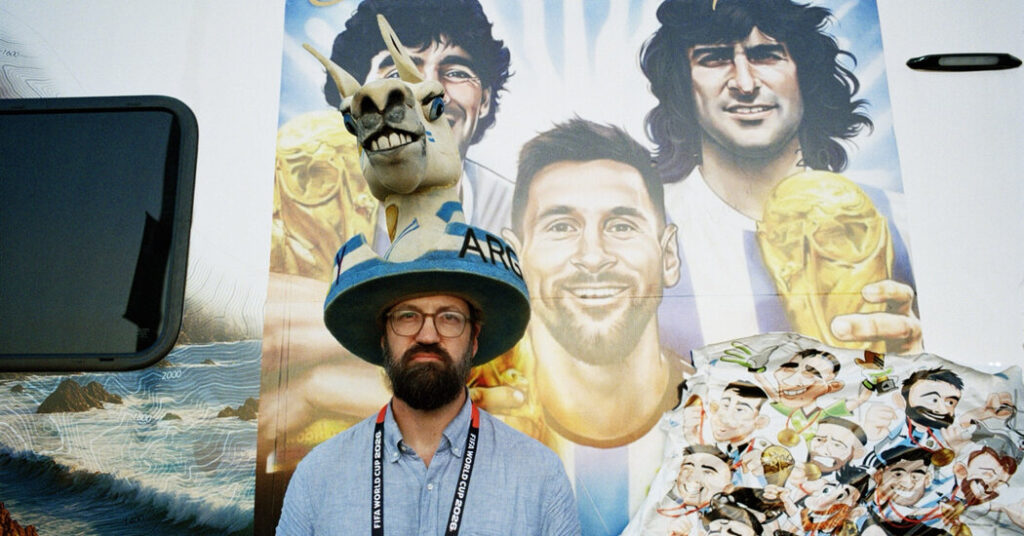
The sun was setting. In a parking lot, I saw an R.V. covered with images of Messi and Diego Maradona, with Argentina slogans and symbols. The driver was standing next to it, all decked out in Argentina gear — and to my surprise, he was peeling the Argentina decals off the vehicle.
It was a rental, he told me. He had to strip it down before he returned it. Over the last 41 days, he said, he and some friends had driven back and forth across the U.S.A. — more than 7,500 total miles — to watch every single Argentina match.
I asked him if he was sad that the journey was over. No, he said. He was disappointed by the final game, obviously. But the tournament itself was amazing. He had witnessed history: the final World Cup (probably) of the greatest player of all time (probably). And that history, he told me, was now part of his own personal history. Thirty years from now, he said, he would be in his 80s, and he would be able to think back about this trip. And he could say to himself: I did this.
Sara Messinger is a documentary photographer whose work focuses on subcultures and identity. Her work was most recently exhibited at the Leica Gallery in New York and at the Photo Elysee Museum in Lausanne, Switzerland.
The post My (Crazy, Heartbreaking, Glorious) World Cup Adventure appeared first on New York Times.