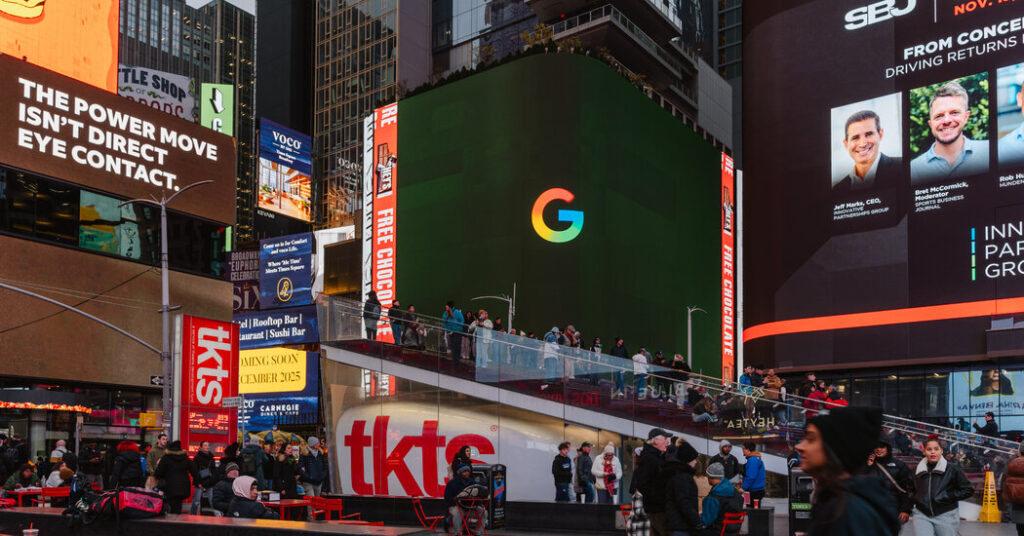
Alphabet, Google’s parent company, said on Wednesday that its investments in artificial intelligence were paying off and fueling growth across its businesses, amid broader questions about whether tech companies’ enormous spending on the powerful technology can be justified.
The Silicon Valley giant, which has shelled out billions to develop cutting-edge A.I. models and to build data centers that provide the computing power for the technology, said revenue for the three months that ended in June totaled $119.8 billion, up 24 percent from a year earlier. In particular, Google’s cloud business, which lets companies rent computing power and A.I. tools, surged 82 percent to $24.8 billion.
Profit rose to $112.1 billion, quadrupling from $28.2 billion a year earlier, boosted by investments in other A.I.-related companies like SpaceX and Anthropic. Those investments were valued at about $99 billion, Google said. The results exceeded Wall Street’s projections of revenue of $116.5 billion and profit of $35 billion.
“Our A.I. investments are redefining what’s possible across every part of our business,” Sundar Pichai, Alphabet’s chief executive, said in a statement.
Google has been racing to lead A.I. as the powerful technology transforms jobs, workplaces and its own internet search business. To compete with rivals such as OpenAI and Anthropic, Google said in June that it was raising $80 billion to fund its data center projects by selling its stock, and that its capital expenditures for the year could be as high as $190 billion, more than double the $85 billion last year. That spending will continue to “significantly increase” next year, Google said.
But some have questioned whether such spending is excessive. Last week, stock markets fell over concerns of increasing A.I. competition from China after a Chinese start-up, Moonshot AI, released an A.I. technology that was nearly as powerful as the leading American model, Claude Fable 5 from Anthropic.
So far, A.I. has been a boon to Google’s business. The company has melded A.I. into search, with its Gemini chatbot generating answers and users assigning A.I. “agents,” or bots, to run continuous searches on their behalf. Advertisers on YouTube have new A.I. tools, and viewers have A.I.-curated video recommendations. And companies are clamoring to use Google’s cloud computing services to run their A.I. projects.
Google is “one of the best positioned A.I. companies around,” said Brian Nowak, an analyst at Morgan Stanley.
Apart from the growth in cloud computing, revenue for Google’s advertising business rose 14.4 percent to $81.6 billion. In May, the company expanded its A.I. offerings in search, overhauling its iconic search bar for the first time in 25 years with new A.I. tools and adding the ability for people to assign continuous searches to A.I. agents that can act autonomously to function like digital personal assistants.
The Silicon Valley company’s subscription business, which includes users who pay for YouTube services and those who pay to use Google’s A.I., grew 15 percent to $12.9 billion.
On Tuesday, Google unveiled three A.I. models, which are intended to work more effectively and at a lower cost than previous versions. The company’s flagship model, Gemini 3.5 Pro, was set to be released in June but has not been made available. Google said the Pro model remained in testing.
The post Alphabet Quadruples Profit to $112 Billion, Fueled by A.I. Investments appeared first on New York Times.