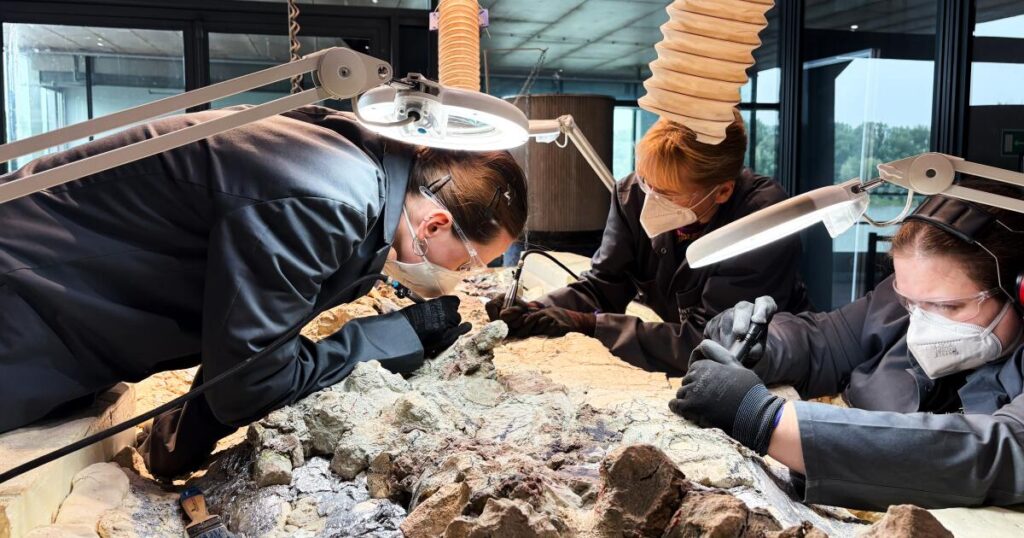
WARSAW, Poland — Volunteers armed with chisels, brushes and protective goggles chip away at rock encasing the bones of a massive prehistoric amphibian in a glass-walled laboratory on the ground floor of Warsaw’s Copernicus Science Centre.
On the other side of the wall, visitors watch the work unfold on the bones of the nearly 20-foot-long skeleton. Children point with excitement while parents contemplate the creature the massive bones once belonged to.
The painstaking restoration is part of an unusual public science project. More than 2,000 volunteers are helping Polish scientists restore the skeleton of the Mastodonsaurus, a fearsome aquatic predator from around the dawn of the dinosaur age.
The work is meticulous. Bone must be separated from surrounding rock millimeter by millimeter with a pneumatic chisel, whose needle gently breaks away rock while ultraviolet light reveals where the bone ends and the surrounding rock begins.
The volunteers are managers, cleaners, tattoo artists — not geologists or paleontologists. They receive training and special protective gear, before they begin two-hour-long chiseling sessions under supervision.
“I imagine that those bones were lying underground for 240 million years and I am the first human on earth to touch them,” said Tatyana Kozyk, the coordinator of the volunteer teams. “I’m still trying to wrap my head around this experience.”
An ancient aquatic predator
One of the largest amphibians ever to exist, the Mastodonsaurus lived about 240 million years ago during the Middle Triassic, while the earliest dinosaurs were appearing but before they came to dominate Earth. It was an underwater ambush hunter, preying mainly on fish and smaller amphibians.
Scientists believe it could grow to nearly 20 feet in length. It had a broad, flat head, long jaws and sharp conical teeth, its appearance resembling a crocodile’s, though it belonged to a different branch of the vertebrate family tree.
When the restoration is complete, it will be the largest exhibited in a museum anywhere in the world, said Tomasz Sulej, a paleontologist and professor at the Institute of Paleobiology at the Polish Academy of Sciences. Its skeleton weighs 2,865 pounds.
Sulej and his colleague Wojciech Pawlak from the Faculty of Geology at the University of Warsaw are credited with discovering the skeleton in southern Poland in 2023 and coming up with the idea to invite volunteers to help with its restoration.
Sulej says there are no other known Mastodonsaurus skeletons this large anywhere else in the world, and the discovery promises to help scientists learn more about the species.
“The structure of the body is different from what we knew so far,” he said. “This is information that is completely new to the scientific world.”
Other Mastodonsaurus skeletons have been found elsewhere, including in Germany and Russia, Sulej said, but they are around 6½ to 10 feet long.
A chance to reflect on the past and future
Dorota Serafin, a 51-year-old manager from Warsaw who volunteers for the project, said working with the skeleton of an ancient animal is an experience that is at the same time “relaxing and philosophical, even mystical.”
Serafin said she plans to return for other sessions and eventually bring her family to Copernicus when the restored skeleton is exhibited, which is expected to happen in October or November.
In addition to the startling experience of touching the remains of an animal that lived hundreds of millions of years ago, contact with the Mastodonsaurus offers an opportunity to reflect on the future, those involved in the project said.
The amphibian inhabited Earth’s waters after the largest-known mass extinction and just before the dinosaurs appeared. As humanity contemplates the potentially catastrophic effects of climate change, Sulej says the story of the Mastodonsaurus offers some hope.
“The Mastodonsaurus lived after the great extinction, which shows one thing, that nature always manages,” Sulej said. “It’s not true that humans can destroy life on this planet. Nature and life always find ways to survive.”
Ciobanu writes for the Associated Press.
The post 2,000 volunteers join a painstaking effort to restore massive skeleton of prehistoric predator appeared first on Los Angeles Times.