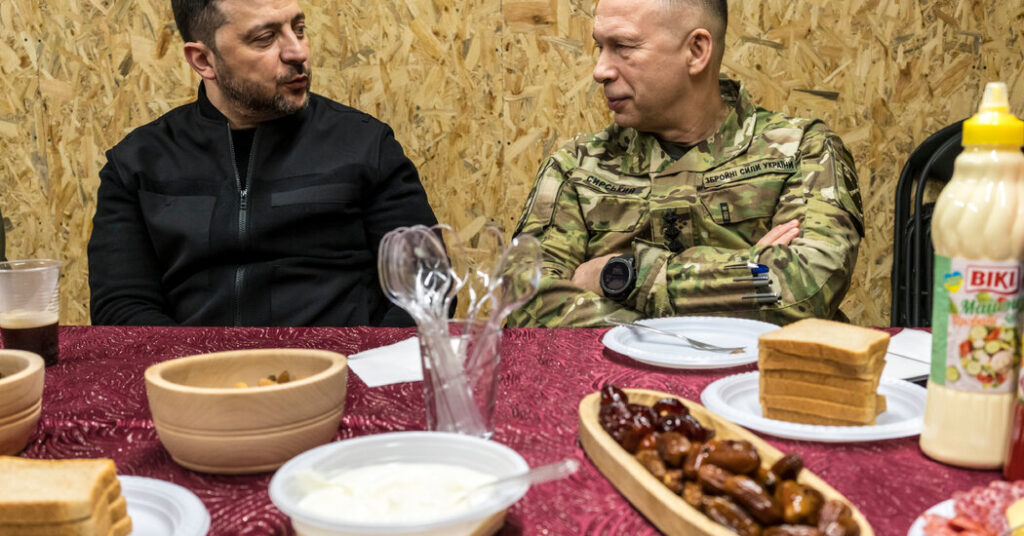
President Volodymyr Zelensky of Ukraine removed his top general on Tuesday amid swelling public protests and growing concerns that the national unity that had helped the country survive nearly five years of war was in danger of fracturing.
The dismissal of Gen. Oleksandr Syrskyi was a major reversal for Mr. Zelensky, who just days earlier sided with the general and fired Ukraine’s defense minister, Mykhailo Fedorov.
Thousands of people had joined mass demonstrations to pressure Mr. Zelensky to change course and reaffirm Mr. Fedorov’s vision of warfare as increasingly dominated by drones and robots. As he championed a military overhaul that leaned into high-tech innovation, Mr. Fedorov, 35, emerged as a symbol of hope to many Ukrainians, particularly young people.
Mr. Fedorov’s dismissal after only six months in the job came as Ukraine seemed to finally have regained the initiative in the war, in large part through the increasingly effective use of long- and medium-range drones to strike targets in Russia and Crimea.
Mr. Zelensky said that he had been forced to choose between the two men as the differences between their camps had become impossible to resolve.
Ultimately, as the protests grew, it became clear that the rift extended far beyond a clash of personalities. For many Ukrainians, Mr. Fedorov embodied a modern, tech-driven path to victory that might spare lives, while General Syrskyi had come to represent the darkest, most punishing realities of a war fought through sheer attrition.
While General Syrskyi, 60, was praised for his role in the defense of Kyiv and a counteroffensive in Kharkiv in September 2022, his tenure after his appointment as commander in chief of the armed forces in February 2024 faced scrutiny.
Like many senior Ukrainian commanders, General Syrskyi was trained in the Soviet military system, where personal loyalty was frequently valued over tactical innovation. Critics described him as rigid and out of touch, and he never won widespread public admiration.
During the prolonged and bloody 2023 battle of Bakhmut, General Syrskyi earned the nickname “the Butcher” for his perceived tolerance of high casualties for limited tactical gains. It was a narrative he disputed, saying that preserving soldiers’ lives was his top priority.
Criticism of General Syrskyi erupted almost immediately after Mr. Fedorov was fired. Veterans, analysts and active-duty soldiers accused General Syrskyi of blocking initiatives to adapt to a rapidly changing battlefield. Protesters took to the streets with signs bearing variations of “Fedorov is innovation, old grandpas are degeneration.”
Mr. Fedorov said that the military establishment had resisted procurement reforms that he championed to promote competition and to sever informal ties between the General Staff and politically connected arms manufacturers.
He accused General Syrskyi of maneuvering behind the scenes to preserve his own power and said that instead of defeating Russia, the general had “figured out how to split the country.”
The situation reached a breaking point as dissent within the military spilled into the open.
Gen. Mykhailo Drapatyi, the commander of joint forces, issued a rare public statement supporting Mr. Fedorov, writing, “Silence does not protect the army; it only allows mistakes to accumulate.”
Col. Pavlo Yelizarov, a deputy commander of the air force, submitted his resignation, calling Mr. Fedorov’s removal “a great blow to the country’s defense.”
Faced with this deepening turmoil, Mr. Zelensky met with brigade commanders to hear their concerns. His office urged patience at home while seeking to reassure allies abroad.
“The situation is being resolved professionally, constructively and in the interests of our state,” Kyrylo Budanov, the former intelligence chief who is now the head of the president’s office, said in a statement. “I ask everyone to remain calm.”
“The enemy is closely watching every one of our internal disagreements and is waiting for us to start fighting among ourselves,” he said. “To our enemies, I say this directly: You will not live to see it.”
Mr. Zelensky spent days huddled with senior military leaders from across the ranks and sought to bring Mr. Fedorov back into the fold.
After meeting with the president, Mr. Fedorov said a constructive dialogue to address his concerns had begun. “There will definitely be changes,” he said in a statement.
Since Ukrainians have largely accepted that there can be no elections while the war rages, mass demonstrations have become a pressure release valve and a check on power.
Last year, tens of thousands of Ukrainians staged protests across the country after an effort by Mr. Zelensky to neuter the nation’s anti-corruption agencies. The government quickly changed course in response to the protests.
The demonstrations that followed Mr. Fedorov’s firing exposed long-simmering tensions within the military. The infighting was profoundly dangerous, soldiers said, because it could undermine combat cohesion and worsen the military’s personnel crisis by driving disillusioned troops toward desertion.
General Syrskyi remained largely silent as the controversy swirled, posting only videos of himself meeting with commanders on the front. But on Monday, he published a column in the Militarnyi news outlet to respond to what he called a “mythology about conflicts” and to defend his tenure.
He wrote that he was surprised to learn of any conflict with Mr. Fedorov and apologized if any offense had been taken.
“Ukraine is bigger than Fedorov, Syrskyi and any of us,” he wrote. “Ukraine will stand not because it has irreplaceable people, but because it has an army, institutions and millions of people who do their job. Reducing this war to a confrontation between two people is the greatest service we can do to the enemy.”
Ultimately, Mr. Zelensky concluded that removing the general was the only way to restore unity.
The post Zelensky Dismisses Ukraine’s Top General appeared first on New York Times.