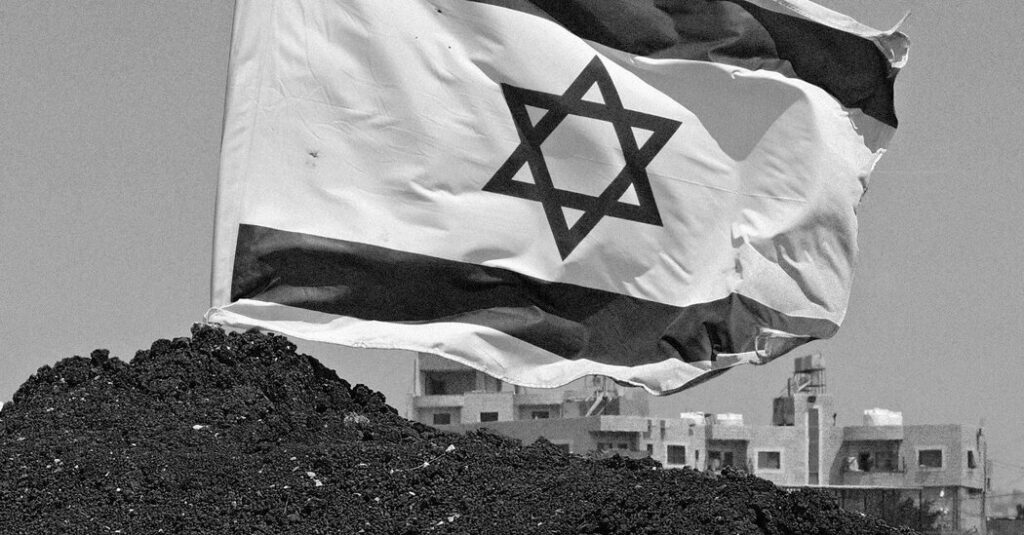
Of all the fronts on which Israel is exerting force, the West Bank is where the Jewish state is the most invested, exerts the most control and has received the least American pushback. It is also where over half a million Israeli citizens live among some three million Palestinians who are under military occupation without citizenship. President Trump has not put any brakes on Israeli settlement expansion, creeping annexation, military raids, demolitions of Palestinian homes or settler attacks — all of which have reached record numbers under the government of Prime Minister Benjamin Netanyahu.
The West Bank is far more strategically and ideologically vital to Israel than any war it is fighting, and it is the area in which Israel has the most longstanding, coherent and unchallenged goal: as much land for Jews with as few Palestinians as possible. The West Bank is also the only arena in which Jewish settler militia groups are operating like a paramilitary force to advance Israel’s goals.
These militias are not rogue entities, as Israeli leaders have proclaimed. They are organized groups of civilians made up of a combination of Israeli settlers who establish new settlement outposts across the West Bank, settlers who were called up for reserve duty since the Hamas attacks of Oct. 7, 2023, and serve in regional defense units, and rapid response squads, which are local volunteer emergency teams tasked with providing first response in their settlements. Imagine a neighborhood watch, but with military-grade weapons and the use of deadly force. In June, a United Nations report found that “financial and military support” from Israeli authorities had “enabled settler attacks.”
On Aug. 9, one such militia began to terrorize three Palestinian families in the village of Qusra. They set up a tent outside their home, cutting off access to electricity and water and stymying their freedom of movement.
In this case, one of the homes is owned by Loui Ridi, a Palestinian with American citizenship from Ohio. He traveled back to Qusra, putting up an American flag on the roof of his house. Israeli forces had declared the area a “closed military zone” and removed the tent settlers had erected, but did not restore the Palestinian residents’ ability to move in and out freely. Settlers still roamed around, in violation of the order, while the Israeli Army effectively replaced the settlers in surrounding the homes.
“Actions by those who carried out this horrific act of terror meant to intimidate and harass this family are disgusting,” the U.S. ambassador to Israel, Mike Huckabee, said in a statement on X. Mr. Netanyahu and President Isaac Herzog have also condemned these attacks. But the settler militias terrorizing Qusra and other villages across the West Bank could not continue to act as they are without state and military cover. These are not isolated extremists or hooligans, as Mr. Huckabee, Mr. Netanyahu and other leaders have said.
Nor is this simply settler violence. In the West Bank, Palestinians live in daily fear for their lives. Mr. Ridi is not the only homeowner at risk. Even as the U.S. flag waved over his home, there was another settler attack against a different Palestinian home in Qusra on Aug. 29. Israeli settlers arrived in white pickup trucks, their faces masked, throwing stones. Despite a statement by Mr. Netanyahu condemning the act and assuring that authorities would take action, there has been only one reported arrest related to the attacks in Qusra and a handful of arrests related to other settler-based violence in the area. These moves may not result in much: Even when arrests are made, only 3 percent of settlers are convicted.
In other words, what’s happened in Qusra is a feature, not a bug, of Israeli policy, which has expanded and deepened its control over the occupied territory over the last four years. This has been accomplished through intensifying economic strangulation, restrictions on freedom of movement, transferring governing powers from military to civilian control and, most egregiously, the emboldening of settler militias. Such groups already existed when the current government was formed in late 2022. But in the past three years, these militias have been largely given free rein to intimidate, harass and make Palestinian life in the West Bank unbearable. Since 2023, thousands of Palestinians have been displaced by a combination of settler attacks, military operations and restrictions on access and movement. On Sept. 2, Israeli forces demolished homes and structures in the Palestinian village of Khirbet al Tabban in the southern West Bank, rendering the village’s 70 residents homeless.
The Hamas attack on Oct. 7, the deadliest single attack on Israelis in the country’s history, accelerated the use of violence in general, and settler militias in particular, under the most pro-settler, far-right government in Israeli history. Under this government, Bezalel Smotrich, the finance minister, has expedited the destruction of Palestinian homes while streamlining the building of Israeli ones, whereas Itamar Ben-Gvir, the national security minister, has distributed arms to Israelis by easing regulations for licenses, adding around 7,000 firearms to settlers. This has further blurred the line between civilian and soldier, enabling armed settlers to act with a sense of authority whether wearing a uniform or not, most acting without any command structure and with a sense of entitlement — and impunity.
While reversing the settlement enterprise is the only politically and morally sound path, it is unlikely, even if Mr. Netanyahu’s government finally falls in October.
The two dominant camps within the Israeli political landscape today are what might be called the annexation camp and the control camp. The annexation camp is best represented by the far-right politicians in the Netanyahu coalition. They have worked tirelessly to quash the possibility of a viable Palestinian state. Most of them prefer the formal annexation of all of the West Bank to Israel, while the more moderate among this group, including some politicians in the opposition, aim for formal, or at least de facto, annexation of what was known under the Oslo Accords as Area C — the 60 percent of the West Bank under Israeli control and where Israeli settlements are largely located.
The control camp includes much of the defense establishment and centrist leaders. Among this group, the hope is to preserve Israeli military control over Palestinians and retain many of the settlements without establishing provocative new settlements, while minimizing friction with Palestinians, primarily by reining in settler violence — a quieter occupation of sorts. Flashpoints, like the recent approval of construction in an area known as E1 east of Jerusalem, a divisive plan that would further cantonize Palestinians and cut the West Bank in half, would thus most likely be avoided. However, if this government actually manages to start construction there, it’s unclear whether a new government would reverse the move.
The phenomenon of settlement expansion and terror did not begin with the current Israeli government and, in all likelihood, will not end with it. Settler militias clearly act with state backing in the service of a greater national project that is largely uncontested in Israel: Israel’s permanent control over much of the West Bank. A recent poll found that 55 percent of Israeli Jews want to keep settlements in any future agreement with the Palestinians, while 38 percent support annexation of the West Bank.
While any reduction in settler violence is a welcome and necessary step, to end the systematic destruction of Palestinian life and truly facilitate Palestinian self-determination, external pressure from countries around the world will be necessary. First, the international community must insist that the next Israeli government put an end to settler militias. It must then compel Israel to dismantle the settlement enterprise as a whole.
Mairav Zonszein, a contributing writer in Opinion, is the senior Israel analyst with the International Crisis Group, a nonprofit think tank dedicated to conflict prevention.
The Times is committed to publishing a diversity of letters to the editor. We’d like to hear what you think about this or any of our articles. Here are some tips. And here’s our email: [email protected].
Follow the New York Times Opinion section on Facebook, Instagram, TikTok, Bluesky, WhatsApp and Threads.
The post It’s Not Just the West Bank Settlers. It’s Israel. appeared first on New York Times.