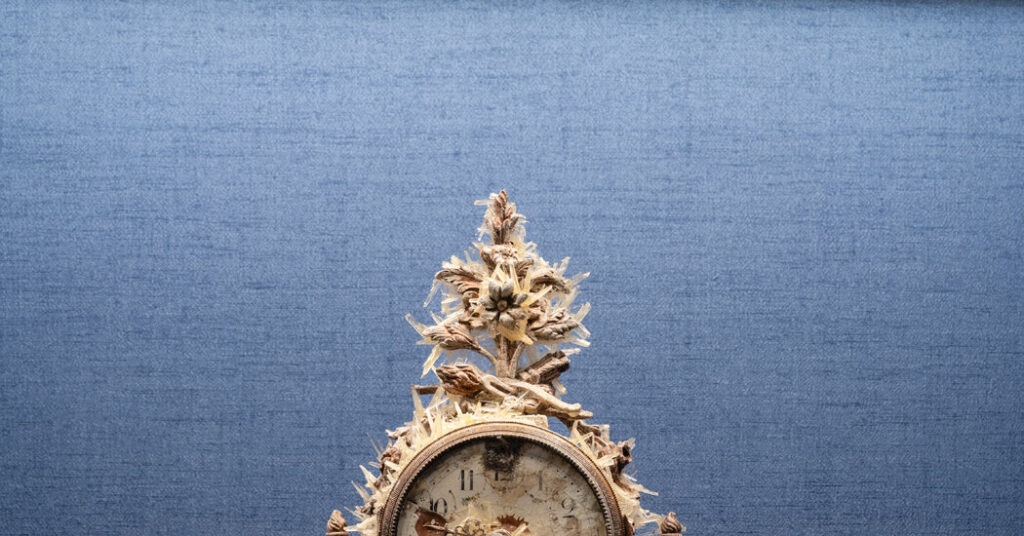
The mechanical clocks that the Franco-Swiss artist Julian Charrière has on display at the Museo Correr in Venice do not tell time. But encrusted with calcium carbonate, mineral crystals, salts and phosphates, they have been transformed into objects that show its passage.
“Instead of traditional time-measuring instruments, they are now surfaces on which time physically accumulates,” Mr. Charrière said in an interview May 5, during the preview week of the 2026 Venice Biennale.
The installation of 13 clocks, titled “Imperfect Lovers,” is the centerpiece of “Spiral Economy. Charrière and Canova,” a show on view through Nov. 22 that explores the relationship between classical sculpture and geological time. Presented across five galleries as part of the museum’s “Dialoghi Canoviani” series, the show pairs Mr. Charrière’s installations, films and sculptures with works by the Italian neoclassical sculptor Antonio Canova (1757-1822).
“The connection between Charrière and Canova is marble,” said Pier Paolo Pancotto, an independent curator from Rome who worked on the show. He was referring to the fact that calcium carbonate is a chemical compound found in the Carrara marble Mr. Canova used, as well as in Mr. Charrière’s pieces. “He is a sculptor in his own right,” Mr. Pancotto said, of Mr. Charrière.
To create the installation, Mr. Charrière bought 13 clocks created in the 19th century and for about 18 months subjected them to natural mineralization processes in locations such as calcifying waterfalls, limestone caves and highly saline environments.
Twelve of the clocks then were grouped around the 13th: a mineralized punch-clock once used by a British factory to record workers’ arrival and departure times. It serves, Mr. Charrière said, as a symbol of the Industrial Revolution’s conception of time.
“I wanted to deconstruct the idea of that ticking clock we inherited from the Industrial Revolution that governs our lives,” he said. “Before that, our lives were governed by seasons, by light, by things that had a direct link to the planet.”
The exhibition also includes work such as Mr. Charrière’s “Spiral Economy” (2025), a reproduction of an airport vending machine filled with fossilized ammonites from his own collection. (The name of the piece was used as the exhibition’s name too.)
And in another gallery, facing Mr. Canova’s “Italic Venus” (1804-1812) is “Albedo,” a video featuring underwater footage shot in the Arctic Ocean from the viewpoint, Mr. Charrière said, of a beluga whale, enhanced with hydrophone recordings of marine mammals. “It is the song for a world which disappears,” he said.
Mr. Charrière said the exhibition questions the human desire to make permanence out of a world in constant change and the geological processes that unfold over scales far beyond human life.
“We are wishful that we could actually freeze time,” he said.
The post In Venice, Clocks That Convey More Than Just Time appeared first on New York Times.