A few months out from graduating with a master’s degree in urban planning, Jin Shangyu is watching artificial intelligence upend the industry she is trying to enter.
Job boards are filled with roles that require A.I. expertise, while listings for traditional roles seem to be dwindling. Much of the work involved in the early stage of a design project, which used to involve several people, can now be executed with a few clicks of a mouse.
Since getting her degree from the University of Hong Kong, Ms. Jin, 26, who is from northern China, has applied for about 150 internships and entry-level jobs in Hong Kong and mainland China, but has been met with silence. She took a $400 professional A.I. course in hopes of standing out in the marketplace. It does not seem to have helped. No wonder, she thought: If even seasoned workers are being undercut by A.I., what chance was there for those seeking to enter the work force?
“My feeling is that we, new graduates, are exactly the kind of people that A.I. will replace,” she said. When she thinks about planning for her future, she said, “I really don’t know how to even begin because I don’t see hope.”
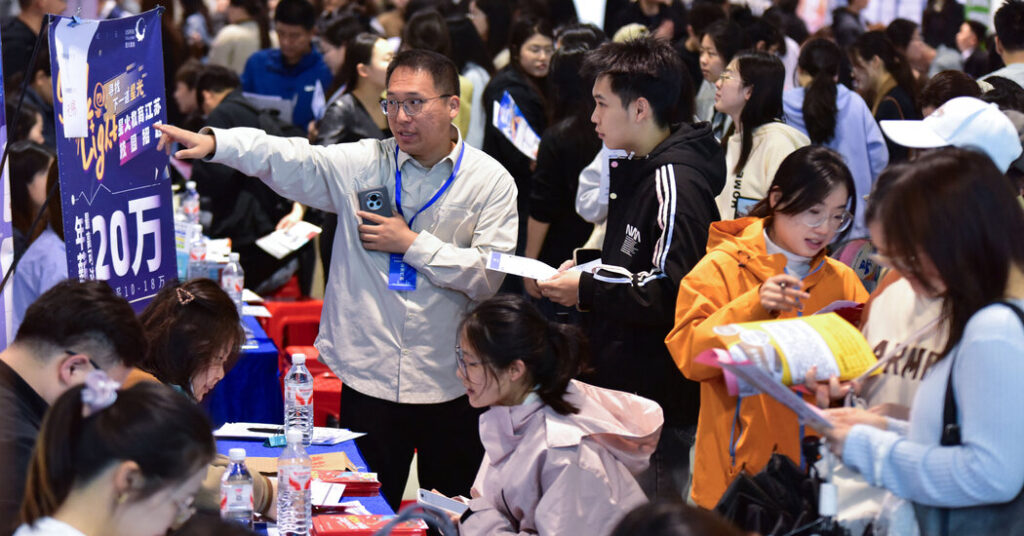
An estimated 12.7 million new graduates are joining China’s work force this year, the largest yet of a cohort that has been steadily growing over the years. They are facing two intractable and connected challenges. Like previous classes, they are entering an oversaturated job market and competing for a shrinking pool of entry-level positions in a sluggish economy. But they also face a new obstacle in the added uncertainty of A.I., which is beginning to restructure industries and change recruiters’ priorities.
It is a global problem. College graduates around the world are grappling with the prospect that entry-level jobs could simply disappear. But in China, the concern is acute. The country has adopted A.I. at an almost unmatched pace, spurred by government support and broad public enthusiasm, while youth unemployment remains stubbornly high.
This July, the rate for urban residents aged 16 to 24 was 17.9 percent. The supply of desirable, well-paying graduate jobs has not kept pace with the ballooning number of young people who entered college.
“A.I. has arrived at a particularly difficult moment, though it did not create the underlying problem,” said Christian Yao, a senior lecturer at Victoria University of Wellington in New Zealand who has studied how young Chinese people are navigating the job market.
Unemployed and Unhappy
For China’s leaders, who have long derived much of their political authority from the promise of prosperity, there is a risk that high youth unemployment could be a source of political unrest.
Any negative effect that A.I. may have on youth unemployment, however minor, is acutely sensitive for the party, said Scott Singer, a fellow and co-director of the China AI Initiative at the Carnegie Endowment for International Peace. More broadly, he said, “China is extremely concerned about the labor market impacts from A.I. It’s perhaps their greatest concern right now” in relation to A.I.
Wary of the potential human and political fallout from the A.I. revolution, Beijing is leaning on companies to avoid layoffs. It has signaled through several court rulings that it is unwilling to accept A.I. cost savings as a justification for job losses.
In January, the government announced “targeted employment support for key industries,” and some party officials have proposed more sweeping interventions, such as encouraging employers to offer vocational training to help workers adapt to an A.I.-centric job market.
So far, the impact of A.I. and automation has been felt most strongly in manufacturing and food delivery, two of China’s largest employment categories. The effect on white-collar jobs is only starting to be felt, experts said.
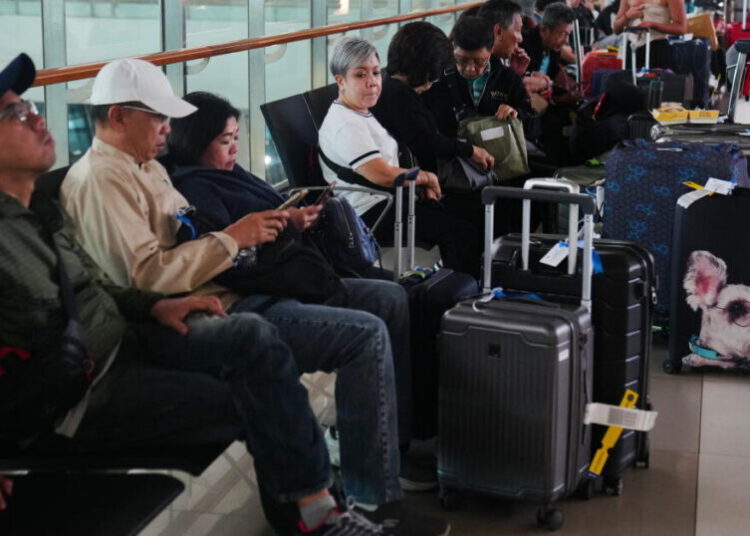
In interviews, young job seekers described trying to find their footing in a landscape that was changing rapidly because of A.I. They spoke of anxiety, uncertainty and, in some cases, despair as their job searches dragged on. Their only consolation: Everyone seemed to be struggling together.
“My spirit has been ground down into nothingness,” said Zinnia Zhou, who graduated this year with a master’s degree in television broadcasting.
Ms. Zhou has submitted more than 2,800 job applications over the past year. That has led to fewer than 20 interviews and zero job offers so far, she said. She used to carefully comb through job listings and apply only for positions that fitted her skill set — now she applies for anything. Even landing an interview no longer gives her hope.
Ms. Zhou said she had noticed an increasing number of job openings for roles around producing A.I.-generated dramas and shows. But her university degree had done little to prepare her for the way the labor market was changing because of A.I., she said. And employers, at least in Hangzhou where she was looking, seemed to be interested only in candidates who had significant experience, she said.
“There’s too many applicants, and they want someone who can get started right away,” she said. “They’re not interested in training you.”
A Qualifications Arms Race
Though A.I. is creating some job opportunities, they are largely open to a small pool of applicants who are already skilled in the technology, said Mr. Yao, the Victoria University lecturer. At the same time, he said, junior white-collar work, such as administrative tasks, research, basic analysis and coding, are more susceptible to automation.
“China is especially exposed because its entry-level professional market was already highly competitive,” he added. A qualifications arms race is emerging, he said, adding that “we now see master’s degrees, and sometimes doctorates, requested for relatively junior roles.”
For some new graduates, even a high-level degree can no longer feel enough. Luna Wang, who graduated this year with a master’s degree in management, has applied for nearly 200 jobs in Hong Kong and mainland China in fields like project management, product management and procurement planning, with little success.
Still, Ms. Wang, 25, felt relatively sanguine about the impacts of A.I. on her career prospects. She said she did not think that the technology would significantly affect her because the jobs she is applying for cannot easily be automated, as they require negotiations and face-to-face interactions.
“You need to have skills that robots and A.I. can’t do to survive,” she said.
For Ms. Jin, the urban planning student, the opportunities that were available to her predecessors appeared to be vanishing. In the faltering economy, there were fewer projects for designers to work on and a lack of openings at design institutes, where many new graduates go after university, she said. And companies seemed to be automating the tasks traditionally done by interns that would help them gain skills and experience.
She saw new roles in areas like A.I. operations opening up, but found it difficult to gauge whether these would lead to a long-term career or were just the product of temporary hype. Some companies seemed to be rushing to adopt A.I. without having a clear idea of what they wanted to achieve with it, she said, describing the landscape as “very chaotic.”
While she keeps applying for jobs, she is trying to make use of A.I. to help her create a portfolio that she hopes will help her stand out. She hopes that the labor market’s A.I. convulsions will settle down in the next few years.
“I think we’re going through a period of upheaval right now,” Ms. Jin said. “I just happen to have the bad luck of living through such a period.”
Siyi Zhao contributed research.
The post China’s New Graduates, Facing a Dire Job Market, Must Also Contend With A.I. appeared first on New York Times.