When Cameron Hamilton took the helm of the Federal Emergency Management Agency at the start of President Trump’s second term, he wasn’t an obvious choice: He had worked in emergency situations in combat zones and on the U.S.-Mexico border, but hadn’t handled natural disasters.
But he wanted to serve in the Trump administration and help safeguard FEMA, he told a podcast last year. Mr. Hamilton, a former Navy SEAL, believed so strongly in the agency’s mission, in fact, that he told a House hearing in May 2025 that he disagreed with Mr. Trump’s suggestion that FEMA should “go away.” He was fired as acting director the next day.
Barely a year later, Mr. Hamilton, 40, is back, poised to lead the disaster agency. The Homeland Security and Governmental Affairs Committee is expected to advance his nomination on Wednesday, setting the stage for a full Senate vote.
Mr. Hamilton’s return illustrates not just a reversal of fortunes, but also how FEMA’s standing has improved within the administration as it became clear that shuttering the agency was unpopular among many states.
Some storm-prone communities still worry about the administration’s cuts to FEMA’s staff and its talk of shifting more responsibility for disasters to state governments. And it’s not clear whether the agency — and Mr. Hamilton — are ready for hurricanes, floods or a potentially extreme El Niño weather pattern.
“He does not know fundamental operational aspects of FEMA,” said Samantha Montano, a professor of emergency management at the Massachusetts Maritime Academy and a frequent critic of the Trump administration’s disaster management policy. “He has not been in the field long enough for that to be possible.”
Mr. Hamilton also appears to lack the extensive experience in emergency management that is required by law.
After failures in FEMA’s response to Hurricane Katrina in 2005, Congress required that the agency’s leader must have a “demonstrated ability in and knowledge of emergency management and homeland security” and at least five years of “executive leadership and management experience in the public or private sector.”
Under previous administrations, including in Mr. Trump’s first term, FEMA chiefs had decades of experience leading disaster response in city or state governments.
Mr. Hamilton does not. He served in the Navy SEALs for a decade before working for eight years as an emergency management specialist at the State Department and as a division director at the Homeland Security Department. In those roles, administration officials said, he planned and carried out crisis response work, kept U.S. personnel and facilities safe in dangerous environments, and managed more than 4,000 emergency medical technicians and first responders.
“I did not pretend or presume by any means to be the most qualified individual” to lead FEMA when he became acting administrator, Mr. Hamilton told the American Emergency podcast.
FEMA and White House officials said Mr. Hamilton’s background did not conflict with the post-Katrina law.
At Mr. Hamilton’s confirmation hearing last month, none of the senators questioned his experience. And many emergency managers across the country support Mr. Hamilton’s confirmation. They are counting on him to trim bureaucracy and make changes that would speed aid — and restore stability after months of upheaval.
“I think Cameron has proven himself as a leader,” said Josh Morton, president of the International Association of Emergency Managers. “He very much listens to what local emergency managers and state emergency managers have to say.”
A remarkable resurrection
Mr. Hamilton’s ouster last year struck many experts as the surest sign yet that a broken but essential agency was being dismantled.
FEMA helps states and local governments respond to overwhelming emergencies. For most of the past three decades, that work has cost about $12 billion annually. But as climate change intensifies some types of disasters and more people move into vulnerable areas, the price tag has often surged into the tens of billions of dollars.
Mr. Trump and Kristi Noem, who was homeland security secretary at the time, both mused publicly about scaling back or eliminating FEMA last year as they shrank its work force by about 20 percent.
So Mr. Hamilton made waves last May when he told a congressional panel: “I do not believe it is in the best interest of the American people to eliminate the Federal Emergency Management Agency.” Ms. Noem fired him the next day, then oversaw a significant slowdown in the flow of federal disaster aid.
Mr. Hamilton posted on X that while his departure “was earlier than I hoped,” he wasn’t stepping away from emergency management. He shared a video message he had delivered to FEMA staff in which he urged them to “find the most innovative and creative methods available so that we can deliver assistance to survivors.”
Trump Administration: Live Updates
Updated
- Trump rejected nearly 6,000 clemency applications this month.
- The new Air Force One will be out of service for ‘upgrades,’ the White House says.
Many emergency managers say he kept that up after his dismissal. He took a job with a contractor that works with disaster agencies in Texas and Florida, two large storm-prone states. At emergency management conferences, he discussed how FEMA could become leaner and more efficient.
FEMA officials declined to make Mr. Hamilton available for an interview. Administration officials did not respond to a request to interview the homeland security secretary, Markwayne Mullin, whose department oversees FEMA.
In an interview with the podcast American Emergency conducted last fall, Mr. Hamilton described himself as a victim of ongoing clashes with Ms. Noem and her top adviser, Corey Lewandowski. He said that he had “never encountered such unprofessionalism in my life” and remembered expecting to be fired even before he spoke out about FEMA’s future on Capitol Hill.
In response to questions from The New York Times, Mr. Lewandowski called Mr. Hamilton “a constantly outspoken critic” of the Trump administration who pushed for the status quo rather than “leaner and more accountable programs.” Ms. Noem did not respond to a request for comment.
Despite that conflict, Mr. Hamilton had allies in the White House. Tom Homan, Mr. Trump’s border security adviser, for example, had endorsed Mr. Hamilton’s unsuccessful bid for Congress from Virginia in 2024. Later that year, Mr. Hamilton kept armed guard outside Mr. Homan’s home amid threats over Mr. Trump’s plans for immigration policy.
So after Mr. Trump fired Ms. Noem in March, Mr. Hamilton was ready to return. Ms. Noem had exerted such control over the agency that her departure left an opening for someone who was clearly a break from her approach. Someone like Mr. Hamilton.
How FEMA could transform
As state officials and members of Congress mounted a pressure campaign to preserve FEMA last year, talk inside the administration about its elimination faded. Emergency managers privately and publicly stressed the safety risks that weakening or eliminating FEMA could pose — as well as political vulnerabilities for lawmakers, who love to boast to constituents about securing federal aid. A 2025 Pew Research Center survey found nearly two-thirds of Americans consider it a good idea for the government to provide financial assistance after disasters.
Even before Ms. Noem was dismissed, an administration task force had concluded the agency should be maintained. Its report, issued six weeks after Mr. Mullin took over the Homeland Security Department, called for delivering disaster aid more quickly, reducing FEMA’s role in long-term recovery and pushing states to manage more disasters on their own.
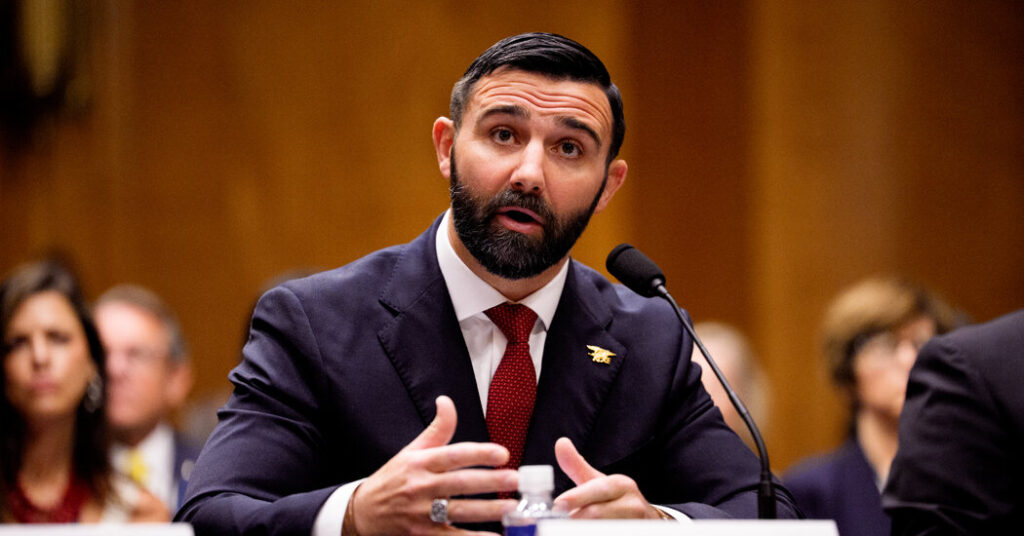
At his confirmation hearing, Mr. Hamilton pledged to distribute disaster aid faster and increase accountability for spending.
“We would need to strike a new balance to encourage cost reasonableness and cost savings,” he said.
Mary Ann Tierney, who served as the top career official at FEMA during Mr. Hamilton’s stint as acting administrator, said that she had spoken with him about shifting more of FEMA’s work to its regional offices and to states. The idea was that FEMA’s headquarters had become bloated and that states could provide help more efficiently, often on their own dime. But Ms. Tierney stressed that such changes would need to occur gradually to give communities time to prepare.
No matter who runs the agency, emergency managers expect it to change soon.
The administration has indicated it wants to raise the threshold for when disaster damage warrants aid, which could mean significantly fewer communities qualify for federal help, according to a coalition of former FEMA officials and local leaders called Sabotaging Our Safety.
“It’s going to make community rebuilding very hard,” said Davante Lewis, a Democrat elected to the Louisiana Public Service Commission in 2022 and a member of the coalition’s board.
Questions about qualifications
On questions about whether Mr. Hamilton is legally qualified for the job, Abigail Jackson, a White House spokeswoman, said all of Mr. Trump’s nominees “are highly qualified.” Victoria Barton, a FEMA spokeswoman, said he had more than 20 years of “executive leadership and public service experience in emergency management, response and recovery operations, special operations, logistics, and program management” that met “all statutory qualifications.”
Administration officials stressed that while the post-Katrina law requires executive leadership experience, it does not specify that work must be in disaster response.
Representative Jared Moskowitz, Democrat of Florida who led that state’s emergency management department from 2019 to 2021, said “it’s hard to argue” that Mr. Hamilton lacks qualifications after he had already led FEMA for several months.
But Dr. Montano called it “frustrating” that lawmakers and emergency experts would now change their standards for FEMA’s administrator. Mr. Hamilton “does not come close” to the experience other FEMA leaders have held since Katrina, she said.
Ms. Tierney said it was up to Congress to decide if Mr. Hamilton meets the intent of the post-Katrina law.
“If the Senate believes Cameron meets the letter of the law they passed, then he is the FEMA administrator,” she said.
The post He Got Fired From FEMA. His Return Could Mark a New Era for Disasters. appeared first on New York Times.