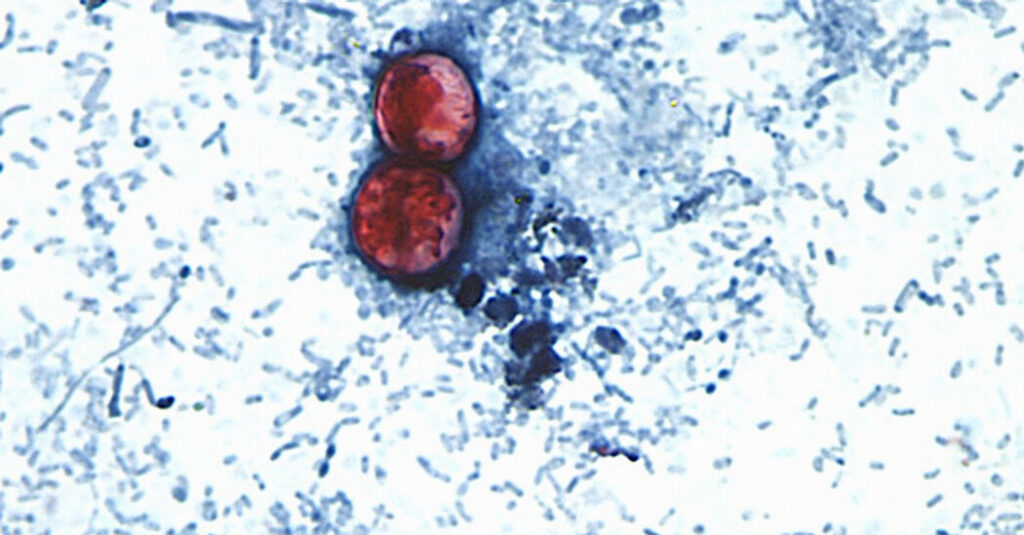
The hard, and nauseating, truth about cyclospora is that it’s spread through human feces. Over decades of research, scientists have not found a single place aside from the human gut where the parasite grows. So now that we’re in the midst of the largest recorded outbreak in United States history, one has to ask: How did human excrement get into our food?
As infections surge across much of the United States, public health investigators are working to figure out how this microscopic parasite contaminated the produce eaten by so many people.
The current case numbers — more than 6,000 people sickened in Michigan alone — suggest that human feces somehow got into our food system on a “surprising scale,” said Matthew Moore, a food safety microbiologist at the University of Massachusetts Amherst.
An understanding of the parasite’s life cycle — and of what happened in previous outbreaks — offer clues about how it might have gotten there.
Cyclospora infects the small intestine, causing frequent watery diarrhea that carries the parasite’s oocysts, or eggs. If those oocysts then contaminate produce — such as from a worker’s unwashed hands (alcohol-based hand sanitizer does not kill the parasite) or through water used to irrigate fruits or vegetables — they can cause illness in a person who consumes the food days or weeks later. In a global food system, where a lot of fresh produce is shipped across the world, inadequate hand-washing facilities or a leaky latrine on a single farm could sicken many people, even thousands of miles away.
Many of the standard techniques for disinfecting the water used in agriculture, including adding chlorine, are geared toward killing bacteria, not parasites, Dr. Moore said. This means that water that appears “clean” on a test might still contain cyclospora from human feces.
For most cyclospora outbreaks that investigators have successfully solved, the source has turned out to be either the water used for irrigation or the hygiene of the people harvesting the crops, said John Guzewich, who worked on food-borne disease outbreaks at the Food and Drug Administration from 1997 to 2011.
Previous outbreaks have been linked to lettuce and salad mixes, raspberries, basil, cilantro, fruit mixes, snow peas and snap peas — all of which are often consumed raw. Cooking produce to at least 158 degrees kills the parasite.
Researchers have found that cyclospora oocysts are particularly “sticky,” clinging to certain types of produce more than other microbes do. That’s especially true of foods like raspberries and cilantro, which have tiny hairs that can harbor the parasite, said Kalmia Kniel, a microbiologist at the University of Delaware who studies cyclospora. This also helps to explain why rinsing herbs or berries with water at home is not entirely effective at removing the oocysts.
Several cyclospora outbreaks linked to raspberries in the late 1990s illustrated one way the parasite can contaminate fresh produce, said Melvin Kramer, an epidemiologist who worked in several state and local public health departments before founding a food safety consulting group.
In 1996, after collecting detailed food histories from people sickened with cyclospora, investigators traced the illnesses to raspberries from a few farms in Guatemala. There, investigators determined it was likely that the insecticides and fungicides sprayed onto the berries had been mixed with contaminated water. The farms had sourced the water from wells or a nearby river, both of which were vulnerable to runoff from latrines, especially during the rainy season. Although the water was filtered, the filter removed only debris, not microbes like cyclospora.
Before this year, the largest outbreak in the United States in recent history occurred in the summer of 2020, sickening 701 people in 14 states and hospitalizing 38. Federal officials linked it to Fresh Express bagged salads containing iceberg lettuce, red cabbage and carrots. They traced at least some of that produce to a farm in South Florida and detected cyclospora in a nearby water canal that had been used to irrigate crops on the farm. Later, genetic analysis confirmed that the cyclospora found in the canal water matched that found in people sickened in the outbreak, said Frank Yiannas, who was a top official at the F.D.A. from 2018 to 2023.
That was the only cyclospora outbreak occurring during his tenure for which investigators were able to find the source of contamination, Mr. Yiannas said. “It’s very rare for F.D.A. to be able to point with specificity to the sources of contamination, whether it’s a farm, a field or a ranch.” And, he added, it’s even rarer for investigators to figure out how the produce was contaminated in the first place.
But, he said, tainted irrigation water is the most likely route of contamination for most large cyclospora outbreaks.
Given the size of the current outbreak, Dr. Kniel said, it is unlikely that a single sick person who didn’t wash his or her hands properly before harvesting produce could have caused such widespread illness.
Instead, the parasite might have spread to multiple farm workers, causing many to shed oocysts in their waste. Then, a leak in a septic system or heavy rainfall might have somehow allowed human waste to seep into water that was used to irrigate crops. The same type of contamination could also affect water used to wash fresh produce, or could be spread on harvesting or processing equipment.
“You’d have to have a lot of produce being irrigated with a lot of water that was contaminated by a lot of cyclospora to see this number of cases,” said Keith R. Schneider, a professor of food safety at the University of Florida.
Chopped and bagged lettuce is particularly vulnerable to contamination, Dr. Kniel said, because many heads of lettuce from multiple fields may mingle before processing.
If federal investigators want to find the cause of the current outbreak, Mr. Yiannas said, they will need to “get out there and sample the heck out of the environment.” Otherwise, he added, “they’re not going to be able to determine it.”
That degree of sampling — as with the rest of the steps in the cyclospora investigation — requires resources, expertise and time.
“Some people think that outbreak investigations can be solved in 50 minutes just like murder mysteries in TV detective shows,” Mr. Guzewich said. “I would love if it happened that way.”
The post Cyclospora Spreads Through Human Feces. How Did It Get Into Our Food Supply? appeared first on New York Times.