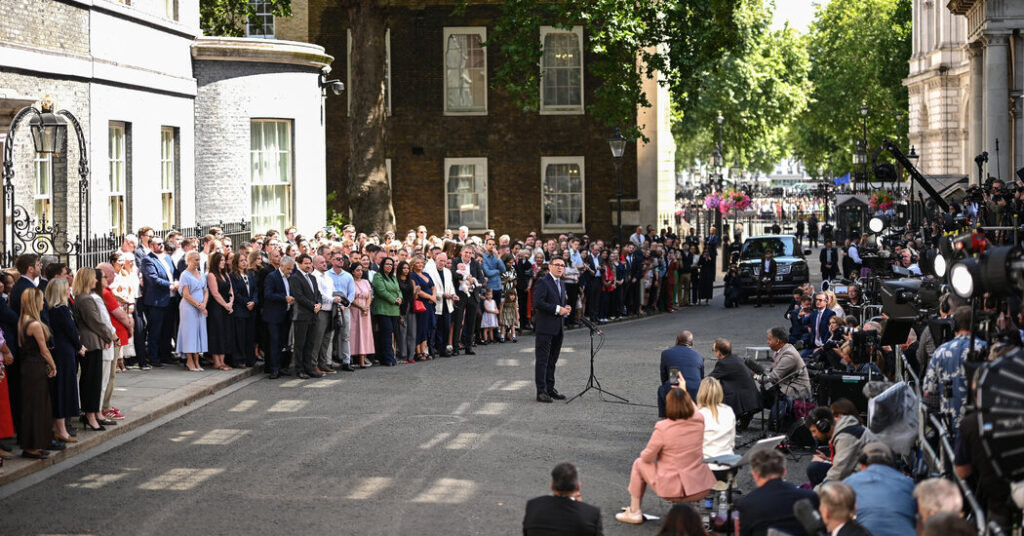
Prime Minister Andy Burnham used his first remarks as Britain’s new leader to proclaim the formation of his government as “the moment when Britain starts to believe again, the moment we bring back hope.”
He was all smiles on Monday as he shook hands with King Charles III and then strode into No. 10 Downing Street after the bloodless coup that ousted Keir Starmer, his Labour Party colleague.
Now the high-wire act begins.
Mr. Burnham had been prime minister for only a few hours when Britain’s jittery bond markets reacted with alarm to a handful of comments that he made to reporters about the need to respect fiscal rules while using “any flexibility within them.”
That prompted a sell-off in British bonds, which pushed the 10-year yield above 5 percent, while the pound dipped 0.3 percent against the dollar. It was a reminder, if Mr. Burnham needed one, that delivering “hope” back to the British people will almost certainly require painful trade-offs.
Even before Mr. Burnham walked into his new office, his aides had been signaling that he understood the public’s eagerness for change and did not want to repeat the mistakes of Mr. Starmer, who was accused of squandering the Labour Party’s majority by not moving quickly enough to push his agenda after the last general election in 2024.
“We will make this moment a circuit breaker for Britain,” Mr. Burnham said in a short speech aimed at the country’s restless and frustrated voters, “bringing forward the biggest changes in the last 40 years.”
But rapid change often invites a backlash, and the arrows started flying quickly.
Nigel Farage, leader of the populist, right-wing Reform U.K. party, demanded that voters in Britain be allowed to decide whether Mr. Burnham should remain in office to pursue his agenda. The prime minister is not required to hold an election until 2029.
Mr. Farage posted on social media that Mr. Burnham “cannot be allowed” to make the biggest changes in politics in 40 years without a mandate. “We need a general election now,” Mr. Farage wrote.
Kemi Badenoch, leader of the Conservative Party, wished Mr. Burnham “every success” but quickly pivoted to criticism, saying, “We cannot borrow more money, and the tax burden is already too high, so the only answer is spending cuts.”
Mr. Burnham also got a warning shot from Jamie Dimon, chief executive of JP Morgan Chase, who said in an interview with The Financial Times that the bank might rethink its planned $4 billion London office if Mr. Burnham were to impose big new taxes on lenders.
It is not yet entirely clear what kind of reception Mr. Burnham will receive from members of his own party, especially the progressive lawmakers who frequently clashed with Mr. Starmer.
Nearly all of them supported Mr. Burnham’s drive to replace Mr. Starmer. But Mr. Burnham’s decision to keep Shabana Mahmood as home secretary signaled that he backed her efforts to crack down on legal and illegal migration with an overhaul of asylum and settlement rules. Those rules are opposed by many members of the progressive left in the Labour Party.
Another early decision by Mr. Burnham could cause internal dissent: His pick of John Healey, former defense secretary, as the new chancellor of the Exchequer to oversee Britain’s finances.
Mr. Healey resigned from Mr. Starmer’s government last month after accusing Rachel Reeves, then the chancellor, of blocking additional spending on defense. Many progressives express fear that greater military spending will come at the expense of money for welfare, social services, housing and projects to address carbon emissions.
In his remarks, Mr. Burnham said that he intended to deliver a 10-year plan for Britain’s future later this year, and he expressed hope that the agenda would be supported by members of all political parties.
He also pledged to quickly take aggressive action to respond to the sluggish economy and to the feeling among many Britons that the cost of living had increased too rapidly. The goal, he said, was to “do something to give people some breathing space now.”
The first move came early Tuesday when Mr. Burnham announced that the government would eliminate value-added taxes on electricity, saying the change would save households about $60 this year.
Aides said that Mr. Burnham would pay for the electricity bill savings with money from Mr. Starmer’s plan for a national digital ID, which Mr. Burnham intends to scrap.
Mr. Burnham also pledged on Monday to end the nationwide scourge of “rough sleeping,” a British term for homelessness.
In his conversation with reporters on Monday, Mr. Burnham hinted at other possible moves that could come soon. He suggested that he might cut income tax for lower earners, and refused to rule out increasing rates for higher earners. Each of those moves, if he makes them, will require a deft hand to manage the fallout, both political and financial.
Still, the new prime minister appears to have avoided one potential pitfall — so far. Mr. Burnham’s first call with a foreign leader was to President Trump, who previously said that he knew little about the new British prime minister except that he was “extremely liberal.”
But the initial contact appeared to have gone smoothly. Mr. Trump posted on social media: “The call was interesting, and went very well. I wished Prime Minister Burnham, GOOD LUCK AND GODSPEED!”
A statement from No. 10 indicated that the prime minister had invited the president to at some point visit Manchester, the city that Mr. Burnham led as mayor for nine years.
The relationship with Mr. Trump is famously difficult for foreign leaders to navigate. But at least on Mr. Burnham’s first day, he appears to have managed it.
“They looked forward to speaking again soon,” the British statement said.
The post Burnham Promises Hope and Change. The Hurdles Are High. appeared first on New York Times.