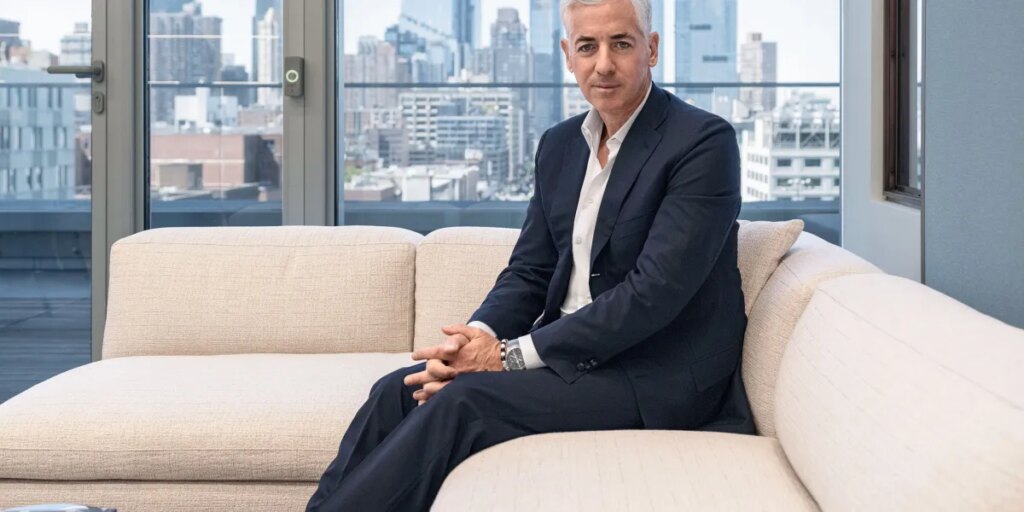
It’s a fine June day in New York City. Bill Ackman peels off his suit jacket in the afternoon sunshine, and hands it to a chauffeur parked outside his office in Manhattan’s Hell’s Kitchen. Wearing a crisp white shirt and a “Never Forget 9/11” blue cap, the 60-year-old billionaire sets out for a three-mile walk. He’s on a very personal errand, but Ackman is all business as he strides briskly through the city.
At a trim six-three, Ackman takes pride in his fit appearance, which he attributes to avoiding sugar and alcohol. He’s not shy about dispensing workout tips to his staff and discussing how many pull-ups he can do: “I’ll say 10,” he notes, adding, “I could do 100 if you give me enough time, though I’d have to rest between sets.” (If a pull-up bar had sprung up from the sidewalk, I have no doubt that he would have leaped upon it to make his point.)
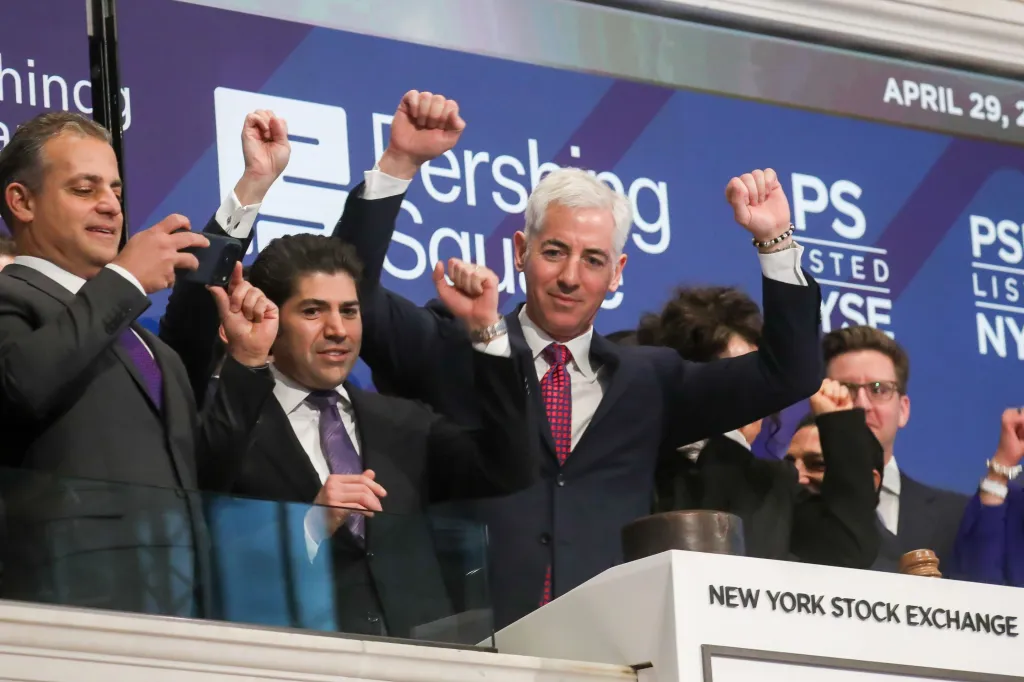
If Ackman feels superhuman these days, it’s understandable: He has just turned his investment firm, Pershing Square, into a public company and simultaneously launched a publicly traded investment fund in an unusual double NYSE listing. The move caps a Wall Street odyssey that began in the 2000s, when he first made a name for himself making bold bets as a short-seller and an activist investor.
His early wins included exposing vulnerabilities in the bond insurer MBIA and anticipating the rise of Chipotle—contrarian investments that led Pershing in its first decade to outperform the S&P fivefold. He has also weathered dramatic stumbles, including a failed $1 billion short-selling campaign aimed at the supplement company Herbalife and a disastrous bet on Valeant Pharmaceuticals that cost Pershing $4 billion. Ackman’s misfires, though, have been offset by some prescient investments in the face of black swan events like the subprime mortgage crisis and COVID, cementing his reputation as one of the shrewdest and most daring risk-takers on Wall Street.
More recently, Ackman has flexed his influence across academic, cultural, and political realms, thanks in large part to his outsize X account, which boasts 2.5 million followers. Indeed, his rising profile as a pugnacious public commentator has arguably exceeded his influence on Wall Street. On X, Ackman banters with the likes of Elon Musk, and launches broadsides at targets such as the former president of his alma mater, Harvard University, whom he helped drive from her chair over the school’s handlingof Gaza war protests. He has also been one of the loudest critics of New York City’s democratic socialist mayor, Zohran Mamdani.
Ackman relishes financial and digital combat, but he also has an idealistic streak that separates him from some of the tech world billionaires. He is a longtime champion of an idea—government-supported retirement accounts for all Americans—that has gained traction with the Trump administration. He believes such accounts will make more people feel they are sharing in the country’s broader prosperity, and rebuild fading faith in capitalism, which Ackman sees as integral to the American Dream.
In business and in public life, Ackman comes across as a man riding an unstoppable winning streak. But fate recently delivered a painful personal reminder to this master of the universe who has so often bent the world to his will: There are some things that even a powerful billionaire can’t control.
How a short-seller became a culture‑war combatant
Most people have hobbies or interests. Bill Ackman has obsessions. The business world learned this in 2002 during his remorseless short-selling campaign against MBIA, in which Ackman faced down a fierce political and media retaliation campaign and was ultimately vindicated in his claims about the firm’s exposure to toxic mortgage-linked assets in its portfolio.
Ackman has compared the structure of his NYSE-listed fund, Pershing Square USA, to his hero Warren Buffett’s legendary Berkshire Hathaway empire, with its “permanent capital” model. It’s a typically bombastic comparison. The combined value of Pershing Square—the firm and fund—is some $16 billion on the NYSE, while Berkshire Hathaway is worth more than a trillion.
“When I grew up, if a guy in my neighborhood got a Corvette, no one resented the guy. Everyone was like, ‘Wow, that’s supercool.’ ”
BIll Ackman
Ackman’s style is not for everyone. The financier Carl Icahn, Ackman’s longtime nemesis and business rival, famously denounced him as a self-righteous crybaby. More recently, former Harvard president Lawrence H. Summers—himself hardly a favorite of the left—called Ackman pressuring Harvard to publicly release the names of student protesters “the stuff of Joe McCarthy.”
The same relentlessness that built Ackman’s reputation as a scourge of corporate excess—and, to critics, a bully spoiling for a fight—has increasingly spilled beyond balance sheets and boardrooms. Ackman has become more ideological, expanding his crusades into cultural and academic realms. What was once a highly focused, if combative, investment thesis has evolved into a campaign to defend the moral and economic logic that Ackman believes underpins American capitalism itself. In this year of the nation’s 250th birthday, Ackman worries that the American tradition of celebrating hard-won material success is being displaced by a politics of disparagement and envy. Too many people, he argues, fail to understand that the American Dream is built upon free-market gumption.
“When I grew up, if a guy in my neighborhood got a Corvette, no one resented the guy,” he observes. “Everyone was like, ‘Wow, that’s supercool. Hopefully, someday I can be as successful as that guy so I can buy a Corvette, too.’ We want to get back to that version of America, where people admired people’s success, as opposed to AOC basically saying, ‘If you’re a billionaire, you either committed fraud or you stole from people.’ ” (New York’s Democratic Rep. Alexandria Ocasio-Cortez did not respond to a request for comment about Ackman’s remark.)
The wealthy suburb of Chappaqua, N.Y., where Ackman grew up, probably had its share of Corvettes. Ackman describes his own home as comfortable but relatively modest, and recalls that he had to work for any spending money he had. His father, who worked in commercial real estate, made clear to Ackman from a young age that he would have to make his own way and not expect a penny of inheritance.
“My father always said to me, ‘Bill, in life, you have to keep your antennae up,’ ” he told the Wall Street Journal last year. “ ‘Opportunities present themselves. You’ve got to take advantage of them.’”
Fostering opportunity—to be leveraged with hard work—is Ackman’s foundational ethos, says Linda Rottenberg, a friend since Ackman’s undergraduate days at Harvard and the cofounder and CEO of global entrepreneurial network Endeavor. “He’s always been driven, but he was always equally determined to make the world a better place,” she says. “He always has believed that the system should give everyone opportunity, and then you have to make your own way … He wants to try to give everyone opportunity, and to give everyone a shot.”
Spreading the upside of Wall Street
Ackman acknowledges that a growing number of working Americans feel that the opportunity to succeed, or even just to live a comfortable life, no longer exists, that their paychecks can no longer buy a piece of the American Dream. This has resulted, he points out, in a situation where a surge in the stock market is cheered by the roughly 60% of Americans with a stake in it, while the remaining 40%, those without the means or know-how to invest, have nothing to celebrate.
He recalls making this point to President Donald Trump at a gathering of leading Wall Street figures at the White House late last year, telling him: “We’ve got a meaningful percentage of the country who, when the stock market goes up, they’re not participating. If anything, they get resentful.”
The solution he proposes is to ensure that everyone has skin in the game and the opportunity to benefit from markets. In 2020, Ackman wrote an essay for the New York Times calling for the U.S. government to create “birthright” accounts in zero-cost equity index funds that would provide every American with $6,750—an amount that, prohibited from withdrawal until retirement and compounded at a tax-free 8% annual return, would exceed $1 million by age 65.
Ackman endorsed Trump in 2024 after years of supporting Democrats, and called him “the most pro-business president we’ve ever had.” And he found a receptive audience in the president for his thinking on government-supported retirement accounts. He and brokerage founder Charles Schwab campaigned for the expansion of a Biden-era program offering matching funds for IRA accounts as an incentive for lower-income workers to contribute—a program that Trump rebranded as “American Dream Accounts” for workers. “The president said, ‘You know what, Bill? I love this idea,’ ” Ackman recalls. “ ‘Come see me in the White House, and let’s get this done.’ ”
The administration also launched “Trump Accounts” for kids—a program similar to Ackman’s plan that provides $1,000 in seed funding to newborns.
It remains to be seen whether these accounts can meaningfully reduce the country’s widening wealth chasm, or reduce disillusionment among the poor and working class. There’s also the question of how many of those Americans would actually avail themselves of such benefits. To address that concern, Ackman argues that personal finance basics should be taught in schools: “It’s critically important, in order to have a safe retirement, to learn how to invest at a young age,” he says. “You have to start early in order to have a really good outcome.” Ackman has tried to do his part for financial literacy, posting a YouTube video that promises to relate the essentials of finance and investing in under an hour. (It has 13 million views.)
But Ackman is convinced that simply having an investment portfolio of their very own, and watching wealth grow before their eyes, will shift many Americans’ perspective. “Everyone, in my view, needs to participate in capitalism,” he declares. “Otherwise, you’re going to prefer socialism.”
Walking up Seventh Avenue, I observe that he might not be the best emissary for financial inclusion given that, well, he’s a 60-year-old white billionaire in a city that voted for a mayor who has vowed to tax the rich.
“Don’t say that so loud!” interrupts Ackman, looking around at the crowded city street with a laugh—seeming half-amused and half-serious.
Betting on capitalism
As Ackman marches purposefully into Central Park, New York’s crown jewel is noisy with the bustle of tourists, popcorn vendors, and horse-and-carriage drivers waiting for passengers. Its southern entrance is also marked by a newer feature: long shadows cast by the line of massive luxury towers erected in recent years that steal sunlight from the park’s playgrounds and baseball fields. (Ackman himself owns a piece of trophy real estate on this so-called Billionaires’ Row—a 13,500-square-foot unit in the One57 skyscraper that he and a group of friends bought in 2015 as an investment property, for a headline-grabbing $91.5 million.)
There’s no denying that billionaires have shaped the area around Central Park in positive ways, too. The avenues running along the park’s eastern and western edges are framed by museums, art galleries, and concert halls bequeathed by Carnegies, Morgans, and Fricks. Whether you consider them robber barons or industrial visionaries, these figures from America’s Gilded Age left a tangible legacy that benefits millions to this day.
“I think significance in life ultimately is measured by how positively you affect the largest number of people, and I think you can do that just being a capitalist.”
Bill Ackman
Ben Soskis, a scholar at the Urban Institute, notes that the late 19th century saw the creation of mass concentrations of wealth in a few hands, and that figures from that era established American philanthropy as we know it—focused on education, the arts, and scientific research.
Ackman, who cites the giving of Buffett and Andrew Carnegie as inspirations, follows this tradition, in his way. His Pershing Square Philanthropies (including the Pershing Square Foundation), describes its role as providing “risk capital for philanthropy” and reports more than $1 billion in grants and investments to date.
Broadly, however, Ackman leans toward solutions to society’s problems that tap into private industry and market forces. He envisions a future where there are incentives for companies, on the day they go public, to donate a small percentage of their shares to retirement accounts held by all Americans. “Look, I think of philanthropy as the solution when there isn’t a capitalistic for-profit solution to the problem,” he explains. “But if there is a for-profit solution to the problem, it has a much higher probability of working if it’s a capitalist model.”
Indeed, Ackman suggests, profit-driven companies can often do more to improve lives than any charitable foundation. “I think significance in life ultimately is measured by how positively you affect the largest number of people, and I think you can do that just being a capitalist,” he says. “Jeff Bezos—just by building Amazon—think about the millions of people he’s employed, the cost savings and convenience he’s brought to hundreds of millions of people, the advances in technology, everything else.”
Ultimately, Ackman says, “I want to be measured by my overall impact.”
A different kind of battle
Ackman’s quest for lasting impact has mostly played out on grand stages—in markets, opinion pages, and the halls of power. But lately, his energy has been redirected toward something far more intimate: the fight to save his daughter.
On a quiet, tree-lined side path in Central Park, a different Ackman emerges. He tells a story that has not been reported in the media to date: of the terrible day in February when his family discovered his 26-year-old daughter, Lucy, lying on the floor of her apartment 15 hours after suffering a brain hemorrhage. A person who has experienced many hours of brain compression, as Lucy did, is usually beyond treatment. Miraculously, she regained consciousness after a month. She has lost her voice—an especially painful situation for a writer of TV dialogue—and most of her sight. But she is improving.
Ackman was preparing for Pershing Square’s double IPO during the crisis and its aftermath, and took business calls from the room next to Lucy’s, with breaks in between to avoid leaving her bedside for long. Now, in Central Park, Ackman chokes up as he shows a video of the brave young woman clutching a black dog. In this moment, it’s easy to forget that Ackman is a billionaire; he is simply a parent watching his child struggle.
A beat later, Ackman is back in action mode, talking about the brain institute he plans to build in partnership with Mount Sinai Hospital, where Lucy is being treated. He has purchased a 400,000-square-foot property on Manhattan’s West Side, with additional development rights. The discussion of his plans seems to reinvigorate him.
Back in the cacophony of Fifth Avenue, he reverts to the parry-and-thrust style he likes to use with reporters. “What else have ya got?” he asks. We return to some of his favored bugbears: The New York Times. (“I read it last,” he grumbles.) Harvard University. (“I want to see Harvard succeed,” he says. “[But] I think they’re waiting out the Trump administration.”)
By the time we reach the Metropolitan Museum of Art, it’s clear Ackman is eager to get to his destination: Mount Sinai, to see Lucy, confer with her doctors, and talk about plans for the brain institute.
This is his new venture and obsession, and his approach is classic Ackman, says Mary Erdoes, CEO of JPMorgan’s Asset and Wealth Management unit, who has worked with him for years: “He’s going to go big,” she says. “His philanthropy has the same passion to it as every company, idea, or anything else—and he is all in.”
This article appears in the August/September issue of Fortune
The post The American Dream According to Bill Ackman appeared first on Fortune.