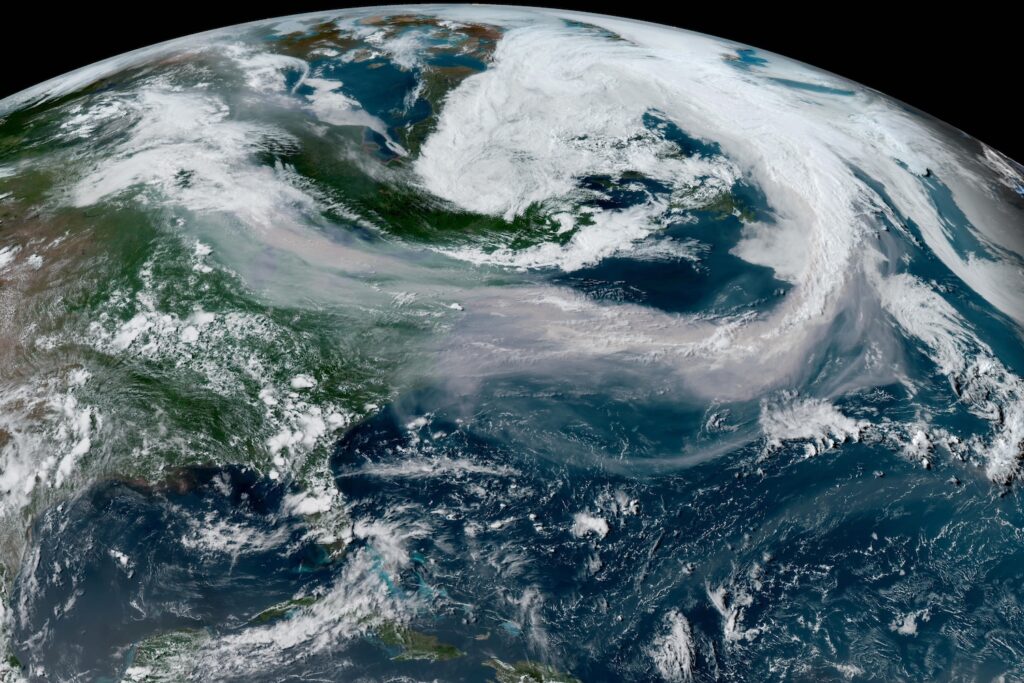
Huge amounts of wildfire smoke continued to pour into the United States from Canada early Friday as Detroit, Chicago and D.C. topped the list of the world’s most polluted major cities.
The smoke drifted into Baltimore and D.C. overnight, creating very unhealthy air quality with index values of 281 and 247, respectively, as of 6 a.m.
In D.C. and much of Maryland, a Code Red air quality alert was in effect for Friday, while Code Purple was in effect for Western Maryland.
“A Code Purple Air Quality Alert means that air pollution concentrations within the region are very unhealthy for the general population,” the Maryland Department of the Environment said in a statement.
The smoke was also covering Northern Virginia as it continued to waft southward Friday morning. It was expected to reach as far south as Charlotte on Friday afternoon.
Through early Sunday, around 109 million people are forecast to be affected by unhealthy air quality or worse across the U.S.
In Chicago and its suburbs Friday, a haze continued to blanket the skies after a record-breaking day Thursday, with the state environmental protection agency and the Indiana Department of Environmental Management extending air quality alerts through Friday evening.
Wildfire smoke “continues to plague the area,” the National Weather Service said Friday, “though improvements in visibility are expected from mid-morning through early afternoon as the wind direction changes and pushes smoke northeastward.”
The Toledo area was enveloped in a cloak of brown, dirty-looking haze Thursday, with air so bad that volunteers scrambled to set up two emergency shelters in local churches.
In the time crunch, volunteers went out to places where the homeless gather to let them know directly where they could take refuge.
“This is the worst smoke we’ve ever experienced,” said Julie Embree, the executive director of the Toledo Lucas County Homelessness Board. “It’s hard to breathe for anybody — much less people who have a medical condition.”
More than a third of the city’s homeless population is over 60, she said, and many of the families have at least one member with medical issues, which become exacerbated by the acrid smoke.
“It’s really heartbreaking to hear some of those stories,” Embree said. “The task — in addition to being unsheltered and wondering where your next meal is coming from — is how do I get from one location that’s indoors and air-conditioned to the next?”
In New York City, residents woke up to brighter skies and fresher air Friday after winds shifted the smoke farther south following two suffocating days of poor air quality. But New York officials urged residents to remain on guard in case winds shifted again later in the day.
Farther west, the smoke was particularly intense Friday around Pittsburgh, where the city’s skyline was obscured and local officials told residents to stay indoors. The conditions forced the closure of city pools and several regional amusement parks, including Kennywood and Idlewild Park and Soak Zone.
The National Weather Service in Pittsburgh said conditions were dangerous even for motorists because of concern that smoke could mix with moisture in river valleys to create “super fog.”
“In some river valleys, there may be enough moisture coupled with the smoke to cause super fog and reduce visibility to zero,” the Weather Service warned on social media.
On Thursday afternoon, the Allegheny County Health Department, which oversees air quality in the Pittsburgh region, said conditions had deteriorated so severely that it was forced to implement emergency measures for the steel-producing Mon Valley. The department ordered companies there to “temporarily reduce activities that produce emissions.” The order was expected to remain in place through much of Friday.
“If you can comfortably stay indoors, please prioritize doing so,” Allegheny County Executive Sara Innamorato (D) said in a news conference Friday morning. “If you do not have an air conditioner, go someplace with air conditioning — libraries, malls, movie theaters are really popular options.”
As haze filled the skies, experts cautioned vulnerable populations to take extra care.
Older adults, children, pregnant women, those with cardiac or respiratory conditions, and workers with long exposure to the smoke are most at risk, said Alexander Duarte, a pulmonologist and professor at the University of Texas Medical Branch.
Symptoms include coughing, irritation in the throat, itchiness or discomfort, and breathlessness with activities, he said.
Some of the effects for individuals with preexisting conditions are “acute worsening” of ailments like asthma and COPD.
It’s also possible to see more hospitalizations and emergency room visits.
To reduce exposure and mitigate symptoms, avoid outdoor activities and add filters to air conditioning systems, Duarte said.
What to expect through the weekend
Thick smoke coverage early Saturday across the Mid-Atlantic is expected to gradually decrease throughout the day. That exiting smoke is forecast to blow into the Northeast and New England.
A storm system approaching from the west will bring rain and possible strong-to-severe thunderstorms to these regions Saturday, and they will interact with the smoke.
Rain can briefly make the smell of wildfire smoke stronger by dragging down smoky air from higher in the atmosphere. Once steadier rain develops, however, it begins washing smoke particles out of the air.
By the time the storms pass late Saturday, there will probably be noticeable improvements in air quality across much of the East.
Meanwhile, in the Midwest, a break in the smoke is forecast around Minneapolis on Friday. That clearing will reach Chicago and Detroit from late Friday into early Saturday. However, this break will probably be short-lived, with new smoke plumes arriving later Saturday.
These new plumes could continue blowing eastward Saturday night and Sunday, with the potential for smoke to return to the Northeast and Mid-Atlantic.
The World Cup final is scheduled to begin at 3 p.m. Sunday in East Rutherford, New Jersey.
Forecast rain in western Ontario on Friday, Monday and Tuesday may reduce smoke concentrations in the source region, so the intensity of subsequent smoke plumes that drift into the U.S. may not be quite as high as those this week.
The size of Canada’s largest out-of-control fire, near Ontario’s remote Wabakimi Provincial Park, was 787,802 acres, according to the Canadian Interagency Forest Fire Center — roughly 18 times the size of the nation’s capital.
Across Canada, 194 out-of-control and large fires were burning as of late Thursday. So far this year, nearly 6 million acres have burned there. In 2023, when apocalyptic smoke reached the Northeast, more than four times that amount of land area had already burned in Canada.
Fires in northern Minnesota, which were also contributing to the smoke plumes, had burned more than 63,000 acres.
President Donald Trump on Friday threatened to impose tariffs on Canada in retaliation for the wildfire smoke, but it was not clear he has the legal authority to impose such a levy.
“We are holding Canada responsible for the fact that they are not properly maintaining their Forests, and Brush therein, and the United States is being unnecessarily invaded by filthy, polluted, and unhealthy air, the quality of which is dangerous, and totally unacceptable!” he wrote on Truth Social.
The White House did not specify what law Trump would use to implement the tariffs. Spokesman Kush Desai said in a statement that the president has “numerous tariff powers at his disposal” and is committed to leveraging them. He did not respond to a question about how the administration would calculate the tariff rate, after Trump called the cost of the pollution “incalculable.”
Trump added in his post that he planned to call Canadian Prime Minister Mark Carney to discuss the fires, amid economic tensions between the United States and its northern neighbor.
On Thursday, meanwhile, thunderstorms rumbling across Oregon, Washington and Idaho appear to have sparked more wildfires.
“The wildfire situation across North America just got worse. Tens of thousands of lightning strikes across the Pacific Northwest has ignited dozens of new wildfires across Oregon and Washington,” wrote forecaster Colin McCarthy on Thursday evening.
Smoke from these fires is forecast to drift around eastern parts of Oregon and Washington as well as western and northern Idaho into the weekend.
The post Wildfire smoke will linger and spread this weekend. See which cities are most affected. appeared first on Washington Post.