Robinhood, a digital brokerage built during the era of disrupter brands like Uber and Airbnb, found major success when Americans started trading stocks and cryptocurrency for entertainment during the Covid-19 pandemic.
As the company grew, it faced criticisms that its push notifications, bright colors and exploding confetti animations were designed to lure people into rapid trading, much like gambling sites.
The company has since removed some of those features. But the critiques that its platform could exploit young and inexperienced investors have become only more pertinent with the rise of prediction markets, which Robinhood has incorporated into its app. And many people still associate Robinhood with the freewheeling meme-stock phenomenon, in which it played a major role.
Now, it’s trying to be known for much more. It’s one of the companies selected to run new Trump accounts for children, putting Robinhood in a position to build closer ties with the next generation of investors. And with Washington.
Trump accounts, written into the tax code as 530A accounts, became available this month and offer children born between 2025 and 2028 a deposit of $1,000 from the government into a tax-deferred investment account. Parents can manage the accounts through an app that Robinhood helped build.
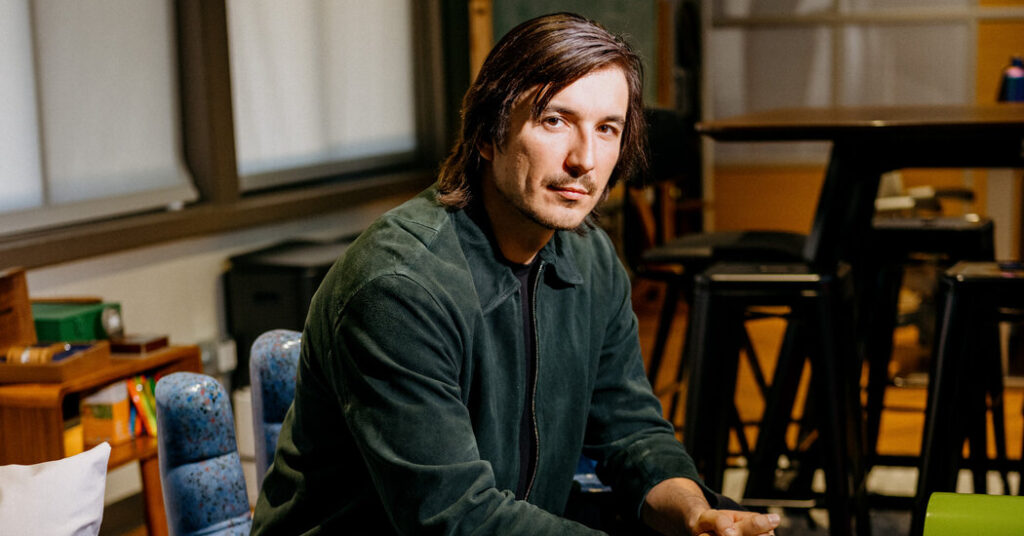
Vlad Tenev, who founded Robinhood in 2013 and serves as chief executive, sees the partnership as another way to expand financial access more broadly.
An immigrant from Bulgaria, Mr. Tenev grew up with parents who emphasized financial stability. The obstacles he saw to investing and building wealth led him eventually to create Robinhood. The app’s 27.7 million users can trade stocks, options and crypto without paying commission. Two years ago, the company expanded its offerings with the Robinhood Gold Card, and this year it introduced a $695 platinum-plated credit card, which competes more directly with American Express.
“The aim is to serve our customers across every asset class and every financial transaction anywhere in the world,” Mr. Tenev, 39, said.
This interview was edited and condensed for clarity and length.
Robinhood is building the infrastructure for Trump accounts. How did that partnership happen?
We were pitching Brad Gerstner from Altimeter Capital for our I.P.O. in 2021 and he had the idea. I thought the odds of it actually happening were pretty low. Brad surprised me.
There was an event at the White House last April when they announced the initiative. We brought some mock-ups of what we thought the app could look like. I had a chance to speak with the president and I was like, “If there’s a way we could help, we’ll put our best people on it and we’ll make sure that we can get it delivered under budget and ahead of schedule.”
Has President Trump used Robinhood?
We didn’t discuss that specifically, but I remember giving him a Robinhood Gold Card.
A lot of business leaders are trying to figure out how to navigate Washington in a polarized political climate. How do you think about that relationship?
Trump accounts, I think, are among the least political ideas in principle. We’ve heard from many state governments, including Democratic states, that want to figure out how to plug into the program or do similar things. There are few things people agree on, but seeding children with an investment portfolio of the S&P 500 is universally popular.
How do you deal with the fact that half your consumer base is probably skeptical that a plan coming out of Washington will work for them?
I think our free market system is under attack from lots of angles. A lot of people are like, “Well, is this a good system? Is it working for everyone?” And I think the answer is, it’s not working for everyone. But the way to make it work for everyone is to get more people invested.
Robinhood really broke through during the height of the pandemic. What was 2020 and 2021 like for you?
The pandemic put an extra focus on investing and self-directed trading, and Robinhood exploded in popularity, which I think had some good aspects and also some negative aspects.
The good is that you start reaching more people and growing. The negative side is growing too fast in a highly regulated space where money is involved. At that time, we were not as ready for that type of growth as we would be now.
One of the main criticisms of Robinhood is that it blurs the line between investing and gambling.
There are some people who think any type of trading is gambling and that moving in and out of positions is inherently a bad thing. I don’t think that’s true. Some of the traders that actively trade have strategies, and they have well-reasoned positions and trades that they’re making.
I think to some degree, people have levied this criticism on the financial markets as a whole. When futures markets were first introduced, they said, “Well, that’s just gambling.” Someone’s betting on the price of gold or oil, but I think what’s missed is that in any derivatives market, you need speculation.
Some folks conflate speculation with gambling, and I think it makes it sound much more salacious. If nobody puts in money, with the point of view that a certain thing is going to have a certain price in the future, you just wouldn’t have a functioning market.
You were born in Varna, Bulgaria, and immigrated to the United States as a child.
I came when I was 5 in 1992. It was right after the fall of the Berlin Wall and the collapse of communism in Eastern Europe.
My father, who was a professor of tourism, got an opportunity to come to the U.S. to the University of Delaware to get a master’s, so he moved in 1991. Then my mom and I joined him.
My parents started from scratch. They didn’t have any money. They didn’t really have savings. My dad was a student. I was a latchkey kid — we couldn’t afford babysitting.
What did your parents do for a living?
My mom worked at a diner for a while; then she worked in a travel bookstore. And after a while, my dad paid for her to get her M.B.A. at Georgetown, and they both joined the World Bank. He basically worked there for his entire career.
How did watching your parents’ financial situation influence you?
Our status in the country as visa holders always seemed a little bit fragile. There was this pressure, exogenously, to succeed, which I think helped quite a bit. I had to learn to be self-motivated and to really look after myself.
Do you think your independence at a young age led you to becoming an entrepreneur?
I didn’t really intend to become an entrepreneur. My parents took this giant risk moving the family across the world. After that, they were ultimately security seekers. They really valued pension benefits and retirement benefits.
I got into Stanford and my desire was to study physics. I thought I would be a theoretical physicist.
When did entrepreneurship enter the picture?
My co-founder at Robinhood, Baiju Bhatt, was also a math and physics guy. We met through the physics department at Stanford. After he graduated, he got a job at a hedge fund. His first month, Lehman Brothers went under. He called me up and he was like: “This might be a good time to start our own financial company.” We got a little house in South Mission in San Francisco, and we were just hacking on trading algorithms.
What attracted me was, it’s really just your efforts. You don’t have a boss. You don’t have to deal with bureaucracy. Your energies can be 100 percent dedicated to the product and you get this infinite feedback loop of writing software, which is very similar to what I like about math. For math, if the proof is working, you immediately validate your idea.
Our business was a trading firm that was ultimately not very successful, but I liked being an entrepreneur.
How did this lead to Robinhood?
We were in this interesting position where we had one leg in New York finance and the other leg in Silicon Valley — the mobile start-up scene — right around the time that the iPhone was really becoming a mobile platform for applications.
One of the big unlocks we had for Robinhood was putting both of these together. Can we make a financial company that’s also a great consumer product that feels really good in your mobile device, much like an Uber or an Instagram?
We’ve been talking about the American dream in different ways. A lot of young people graduating now don’t feel that they’ll have the financial stability of previous generations. If you were a guest speaker at a college finance class today, what would you tell them?
I’m more optimistic. I think that a lot of the fears of job destruction by A.I. are overblown. Of course we’ll see some job disruption like we’ve always seen, but I think what you’re going to see is a huge amount of job creation — not just more jobs being created, but entirely new classes of jobs that didn’t exist before.
It’s time for the lightning round. What is the single best piece of leadership advice you’ve received since taking your company public?
Be authentic to what you believe. I think the company’s values need to be the leader’s values.
What’s your personal investment portfolio look like? Is it weighted in mortgages, stocks, bonds, E.T.F.s, crypto?
Ninety-plus percent of my net worth is in one stock, which some would consider very risky and irresponsible. But here I am.
Do you prefer emailing or texting as your form of communication?
I mean, I do both. Slack is a big one. Signal. I use them all.
What is one thing you’re trying to learn about right now?
I think probably, like many people, I am trying to find the optimal multiagent work flows. How can I make my A.I. agents do work without me having to micromanage them too much, but also make sure that they don’t go off the rails?
What’s the biggest geopolitical issue that keeps you up at night?
I am concerned about the level of spending and generally the size and complexity of governments around the world, including our state and federal governments and how efficiently those could be running.
Best investing tip?
Just do it as early as possible.
The post Robinhood’s Chief on Trump Accounts and Why Trading Isn’t Necessarily Gambling appeared first on New York Times.