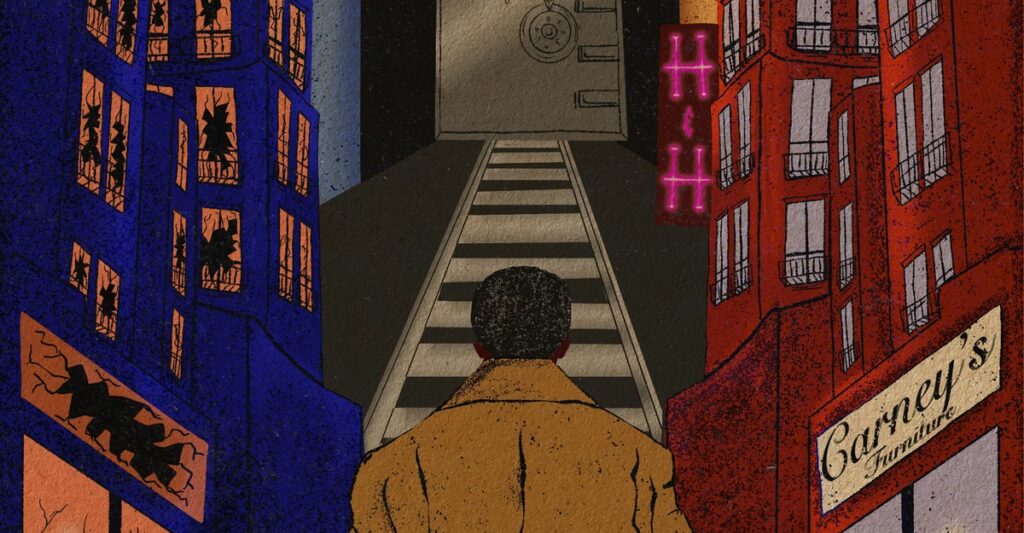
Sturdy, steady, and as reliable as a well-tooled construction, Ray Carney, the “cool machine” that powers the third volume of Colson Whitehead’s Harlem Trilogy, is a time-worn but still fully functional version of the man in the first two books. Carney, a furniture salesman who fenced stolen goods and navigated the consequences in Harlem Shuffle and Crook Manifesto, faces a few last scores in the new novel, Cool Machine. Although Whitehead is good at literalizing metaphors (as he did in The Underground Railroad, which won the first of his two Pulitzer Prizes), Carney is, of course, a machine only in the figurative sense. In reality, or in the fictive realm that Cool Machine occupies with palpably true-to-life resonance, he is a crook in his fragile, aging bones.
“It was in the man’s blood” to be a cool machine—“ruthless and cunning,” thinks Uncle Rich, a totemic elder of the Black underworld who lords with quasi-godly authority over the seriocomic goings-on of the second and third books. Uncle Rich maps out the setups and oversees the jobs—in Cool Machine, a series of heists that culminates in a byzantine plot to steal treasures from a vault in the Waldorf Astoria by way of abandoned secret train tracks under the hotel (another literal underground railroad). But only Whitehead gets to set up the larger questions that animate this multilayered conclusion of the Harlem Trilogy—what’s at stake, why it matters, and who’s really in charge.
The primary characters have aged over the course of the books; roughly a decade separates each volume. Transformations in New York during the years leading up to Cool Machine’s Reagan era have failed to deliver on the promises Carney and his circle had been given in both crime and straight life. On the night before a big operation, Uncle Rich reminisces with the crew about his first and only incarceration years earlier, for stealing piles of newspapers. His crime was to try to learn about the world and, somehow, by extension, himself. “I had to figure out what kind of crook I was,” he says. “I’m still figuring it out and I’m about to retire. It doesn’t matter what line you’re in, we all have that moment when you have to face yourself. Who are you now and who do you want to be? How are you going to live your life? What’s next?”
This is what the reader has been wanting to know about Carney since Harlem Shuffle. Is he just an engine of ruthlessness or something different, perhaps something more than what Uncle Rich wants him to be? These questions of identity and purpose, principles and value, are the core concerns of Whitehead’s genre device, a sleek crime novel with blood pumping from its fast-moving, smooth-running machinery into its brains.
Like each of its predecessors, Cool Machine tells three related but essentially free-standing stories in chronological sequence. The first, “City at Night: 1981,” finds Carney and his Harlem furniture store reborn after the devastation of an arsonist’s fire at the end of Crook Manifesto. He has not only rebuilt the showroom but also taken over the space next door and the former apartments on the second floor. Between books, Carney had also been busy broadening “his idea of himself, of what he was capable of. He had stared down recessions and mobsters and come out the other side. Expanded and broken through to a new space.”
[Read: What is crime in a country built on it?]
Carney’s store was established with seed money from his father’s low-level thievery, and its growth owes in part to his talent for moving stolen goods, but now he has all the trappings of the straight world. Whitehead handles the gratifications of Carney’s legit business success with a light touch—“heady furniture talk made his blood rush”—and holds back snickers, though just barely, as Carney celebrates being named Northeast Regional Dealer of the Month (August) by the Sterling Furniture Co. The honor had never before been granted to a Black dealer, notwithstanding one who might have been passing as white.
Although content with his stature in furnishings retail and proud of his wife Elizabeth’s parallel blossoming as the proprietor of a thriving travel agency, Carney gets wrapped up with Uncle Rich once more. This time, he is not a fence but an active player in an elaborate, multistage caper that takes the crew first to monolithically bland warehouses thrown up on New Jersey marshland and, last, with exquisitely paced crime-fiction drama, to a vault in a ritzy Manhattan hotel. I don’t think I’m spoiling anything by sharing that the big payoff at the warehouse is something I could not have predicted, and that the culmination of the hotel heist is beautifully moving. It lands on a matter that Uncle Rich and Carney had been debating: “‘There comes a time,’ Uncle Rich said, ‘when you have to ask yourself, What’s worth stealing? Truly of value.’” They find an answer through an act of moral repatriation, stealing something others had stolen once before—something that could not be recovered by legal means.
The subject of reparations, more prominent today than it was during the 1980s, laces through the second section of Cool Machine, “Here Comes Sue Simmons: 1983.” The story centers on a lovably brutish old misanthrope first introduced in Harlem Shuffle: Pepper—no surname ever given. Once a small-time robber, Pepper is now crumbling from advanced age and damage inflicted by many malefactors, including Pepper himself. When an acquaintance of Carney’s wife needs to venture to an unfamiliar section of Lower Manhattan to buy a work of art—a rare, historic African mask—Elizabeth connects him with Pepper for protection, and the plot moves to the East Village, where everyone in the United States under 25 seems to have moved. I was living on East 11th Street and First Avenue in the early ’80s, and I can’t help seeing my sorry young self in Whitehead’s descriptions of the pretentious would-be bohemians in the after-hours clubs of Alphabet City. He has written knowingly about this world before, in his collection of impressionist essays, The Colossus of New York—“Hipsters seek refuge in church, Our Lady of Perpetual Subculture,” he snarled. But the fuller consideration of the downtown scene in Cool Machine has a richer, more sordid majesty:
Every so often in the hustle and bustle of the city a newcomer, out on a late-night quest for roach killer, dawdled before the sidewalk bazaar and found themselves staring into the scabby face of a future self. Before and After, like in a TV commercial. Look at how much the city had debased this pilgrim in six months, a year.
[Read: Colson Whitehead loses the plot.]
In this second story, Whitehead pans out from considering the identity of his hero to asking what a whole city is all about. Enlarging his fire-scarred domain as aggressively as Carney did his refurbished retail operation, the author takes on the whole of New York from Harlem downward—and across, east and west, from the repurposed swamps of Jersey to the political swamps of Queens. “The city that year was true to its personality, as malformed across the centuries—a monstrous entity powered by innate miseries, operated by brute will, and held together by pluck, fury, and rebar,” he writes.
If writing fiction about New York in the 1980s invites comparisons with Tom Wolfe’s The Bonfire of the Vanities and Jay McInerney’s Bright Lights, Big City, Whitehead should have the invitations embossed in gold relief. Cool Machine is definitive not only for its sweep but also for the rightness, the evocative precision, of the details that fill its paragraphs like the mystery mix inside the skin of a Gray’s Papaya hot dog. Whitehead conjures New York with the deeply experienced intelligence and acuity of Claude McKay in his exultant, picaresque novels of Black life in the early 20th century.
James Joyce’s Dublin is another parallel, not least for the allusive poetry in Whitehead’s language, which makes understanding all of the references a treat but not a prerequisite. It’s fun to pick up on the many details Whitehead employs casually, with no self-congratulation: H&H Bagels! Used to be the best in New York. Fowad! That was a dicey, run-down discount-clothing store on Broadway, around 96th Street. I went in once, and a salesman hit me up for a payoff before I had a shirt in my hands. Whitehead mentions the place in passing, with no explanation, and the sheer weirdness of the name, processed with our knowledge that it must mean something weird, is all we need.
In the third section, “No Radio: 1986,” a character from Crook Manifesto reappears—or fails to. Robert, the son of a more-like-a-brother cousin of Carney’s, disappears, and Carney sets out to find him, navigating the dual underworlds of Harlem crime and Queens politics. This detective-story setup feels something like an homage to Walter Mosley and his famous Black gumshoe, Easy Rawlins, a veteran of the missing-persons business in Los Angeles. In the climax of this final story, Carney finds himself challenged to combine his expertise in the criminal mind and his expert salesmanship. Whitehead, meanwhile, crystalizes his sense of what makes the city run, where Carney fits in, and how the straight and crooked worlds are entwined in one strange ecosystem with laws that only the lawless can enforce.
As any scholar of 1980s New York would recognize, the story’s title, “No Radio,” is a reference to the signs that car owners with removable stereo systems would put on their dashboard before leaving their vehicle parked on city streets. Carney finds the signs offensive, a mark of submission. “To join those sad little New Yorkers with their meek ‘don’t hurt me’ NO RADIO signs—it was degrading,” he thinks when he spots a specimen. “NO RADIO said, You can’t steal from me because I have nothing left.” Pepper, noticing another such sign just a few pages later, objects that they disrupt the moral order of criminality: He “shook his head, affronted by this attempt by the prey to communicate with the predator. It was best to be content with one’s place in the universe; to do otherwise invited imbalance.” Carney uses a sign that proudly taunts YES RADIO.
[Read: Nickel Boys is an audacious experiment]
Moral order is vitally important to both Carney and his creator. As Whitehead once said in a talk at a writers’ workshop, “The writer of fiction must embrace a moral vision, or else he is little more than a cheap Fleet Street haberdasher.” He stressed that this was an “aesthetic imperative,” and we find it resonating throughout Cool Machine—in the kinds of jobs that Carney and his associates choose to do (heists, not hits), in their obedience to weird old codes (who sits where at the bar where they meet), and in the fantasies they attach to their aspirations (long vacations far away). They’re not angels by any stretch, but they have hearts. After all, they are not actual criminals; they’re just imaginary. They do crime, but they’re fiction.
Whitehead has a reputation for hopping among genres—zombie horror, media satire, historical fantasy—with a flair for entertainment value. But in its subject matter, form, and style, the Harlem Trilogy is crime fiction without apology and little interest in irony or distancing effects. It’s not a cheeky parody of crime fiction or piercing commentary on crime fiction. It’s crime fiction: propelled by narrative; populated by colorful but believable characters larger enough than life to fit into life if only life were larger; and written in tight, muscular prose designed to entertain and, in the process of entertaining, provoke for the sake of a moral imperative. Whitehead could put a sign on the covers: YES CRIME FICTION.
The post The Unapologetic Crime Fiction of Colson Whitehead appeared first on The Atlantic.