It was well before dawn on Oct. 14, 2023, when a team of law enforcement officers met up with four army platoons near the town of Caldono, in southwest Colombia. The officials, led by a mild-mannered investigator named Leonardo Prieto, were preparing to raid a facility suspected of producing counterfeit U.S. bank notes. Some of the most realistic fake bills in dollar denominations come from Colombia, which is one of the world’s top producers of counterfeit currency.
Ordinarily, such a raid would have been a straightforward operation for law enforcement, but Prieto and his colleagues needed military support in this part of the country, where the government is only notionally in charge. In Caldono, the National Liberation Army, a far-left insurgent group, and the Clan del Golfo, a right-wing militia regarded as Colombia’s biggest drug cartel, have been fighting for years over who controls illegal mining in the area and the illicit farming of coca.
On the day of the raid, a convoy of vehicles with armed troops escorted Prieto’s team, which traveled in several pickup trucks. Soldiers on motorbikes led the caravan in the morning twilight, driving along a dirt path to a cannabis farm, the site of the suspected counterfeiting plant. At a large house on the premises, six people still slept — until the motorcycle roars woke them. They tried to escape, Prieto later told me, but five of them were caught right away. The one who fled was never captured.
Inside the house, Prieto and his colleagues found counterfeit currency with a face value of $1.6 million in uncut sheets of $50 bills printed on high-quality paper. Prieto’s team seized the printing plates used for the forgery, as well as an inkjet printer, a paper cutter, a bill counter and an assortment of inks. The officers, while videotaping themselves so they would have evidence to present in court, then took a sledgehammer to the lithographic printing press the counterfeiters had been using. Investigators sometimes do this because an offset press, weighing around 1,000 pounds and usually bolted to the floor, can be too difficult to cart away as evidence. “It was left as scrap metal,” Prieto says.
In parts of Latin America, producing fake dollars is widely seen as a low-risk, high-reward crime. While some of the counterfeit currency is smuggled into the United States, a larger share ends up circulating in local economies across the region. Ecuador, El Salvador and Panama — Latin American countries where the U.S. dollar is the official currency — are especially attractive destinations. Counterfeit notes function as real money, changing hands for goods and services, until the forgery is detected. Whoever ends up in possession of the note at that moment of discovery, which often happens while someone is trying to make a bank deposit, suffers the loss.
Counterfeiting in Colombia had been significantly curtailed by the early 2010s, after years of efforts by specialized units in the Colombian National Police and the Office of the Attorney General of Colombia that worked with the U.S. Secret Service. But the crime has been proliferating in the country in recent years, driven by technological advances. “Most counterfeit that we see produced in the United States tends to be amateurish — somebody buys a Xerox machine over at Walmart, and then they start Xeroxing $100 bills in their hotel room,” Benigno Pereda, a Secret Service agent who was based in Bogotá at the time of the raid, told me. “But the counterfeit down here is very sophisticated.” The proceeds sometimes finance other criminal activities like human trafficking, drug smuggling and terrorism.
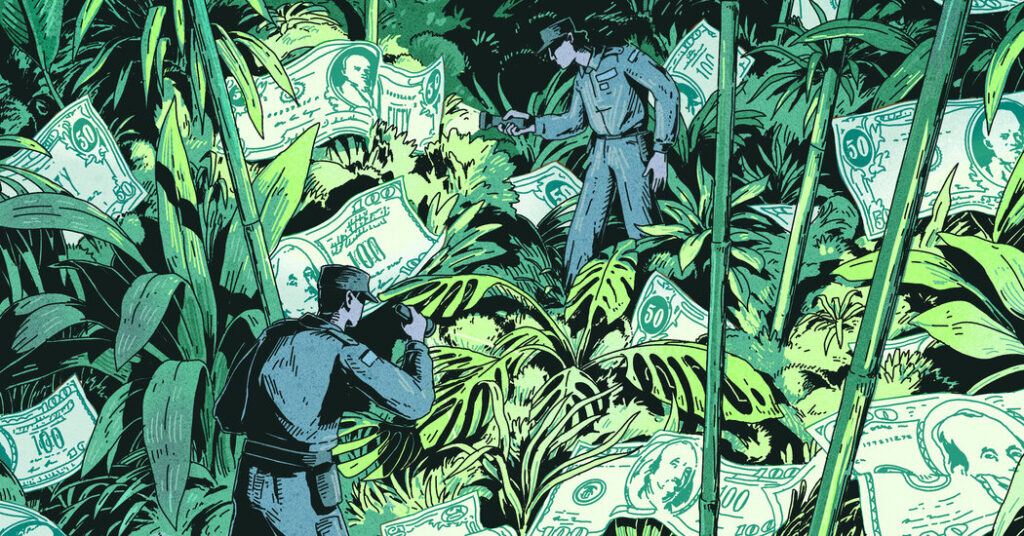
Counterfeiters have been setting up their operations in jungles and remote areas controlled by Colombian rebel groups, which collect a protection tax from the criminals in return for providing them a haven. These are parts of the country where law enforcement faces considerable risks. As Pereda puts it: “No one wants to get killed over funny money.”
At the house on the cannabis farm, Prieto’s team had to work quickly. Though it already had some air support — a military helicopter that accompanied the team was keeping watch overhead — the local army command feared an imminent attack and called in more support to escort the officers out of Caldono. Together with the troops, Prieto and his colleagues left the farm at 7 a.m., barely 40 minutes after arriving.
Two of the five people arrested on site were Colombian men, one of whom was a former police officer. The other three, including a 23-year-old daughter of an Indigenous leader and her boyfriend, were from Ecuador. The investigators learned that the counterfeit currency produced in Caldono was being printed on high-quality paper smuggled into Colombia from the United States and then, once it had been turned into fake American bank notes, taken to Ecuador, where it was exchanged for genuine currency at a bank there with help from an insider.
Pereda and his colleagues at the Secret Service, which keeps a record of every counterfeit bank note seized in the United States, discovered that an identical forged $50 had been passed in Miami only months earlier, in July 2023. The notes were “very sophisticated,” Pereda told me, “and that’s kind of what caught my attention.” It was clear that the forged bills were the handiwork of a skilled artist who wasn’t among the people arrested at the farm. Prieto’s next task was to find who that was.
The Bureau of Engraving and Printing fortifies dollar bills against forgeries in several ways. The sheets of specialty paper used are made from a blend of 75 percent cotton and 25 percent linen and incorporate randomly distributed tiny red and blue synthetic fibers. Security features designed to be difficult to replicate include watermarks, embedded threads that glow under ultraviolet light, color-shifting ink that changes from copper to green when the bill is tilted from side to side, intricate geometric patterns and microprinted text. There’s also the sandpaper-like texture of raised print. That roughness is the result of recess printing, on what’s known as an intaglio press, whose engraved steel plates press down on blank sheets of currency at a pressure of up to 20 tons, physically denting the paper into the incised grooves of the plate and causing the ink to dry on the paper’s surface rather than be absorbed into it.
Counterfeiters have nonetheless found ways to fake these features with enough sophistication to pass casual handling. One afternoon not long ago in Bogotá, Maj. Cristian Guevara Ali of the Colombian National Police, a compact man with a shaved head and a face so boyish that it might get him carded at a liquor store, spread out several stacks of $100 bills on a desk in front of me. His cavalier handling of the fake cash gave the impression that it had spilled out of a mobster’s vault and that there was an endless supply of it at his disposal. While the bills from one of the bundles didn’t look or feel real, the rest would easily have fooled anybody not well versed in the distinctive features of a genuine $100 bill.
Ali told me that some counterfeiters print on high-quality bond paper with a feel that can resemble that of a crisp new dollar bill, while others use legitimate bills they buy in bulk from countries whose currency has depreciated. The Venezuelan bolívar is an appealing option, he explained, because of the blue and orange microfibers embedded in its paper, which give it a resemblance to the blue and red flecks in the fabric of the dollar. “They wash it with a chemical process,” Ali said, “and cut it to the size of the dollar bill.”
The shiny security ribbon woven into the $100 bill is forged in different ways. A common technique, he said, is to print the strip’s text — an alternating pattern of the letters “USA” and the number “100” — on a plastic material that is cut to size and then glued onto the note. Another method involves using special high-quality inks to print the ribbon on the bill, so it looks as if it’s made of a different material. The texture of raised print isn’t beyond replicability either, Ali told me: Counterfeiters mimic it with varying degrees of success using electrostatic plates on offset printing machines, which makes ink particles bunch up and create a bumpiness on the note’s surface.
Counterfeit money dilutes the value of real money, leading to inflation and eroding trust in cash, which is why there’s a history of forging an enemy’s currency during warfare. Although several thousand counterfeit dollar bills circulating in the United States are reported every day to the U.S. Secret Service, fake dollar bills make up a minuscule portion of the total volume of dollar bills circulating in the country. Only one in 40,000 bank notes in the United States is counterfeit, according to an estimate published last year by an economist with the Federal Reserve.
The counterfeiting of American money remains a significant problem overseas, however. Because about half (or more) of the approximately $2.3 trillion worth of dollar notes currently in circulation is in use outside the United States, the dollar is an attractive target for counterfeiters in other countries. There are no official figures available for the volume of dollar bills forged overseas, but Secret Service officials told me that in their approximation, it was substantially greater than the amount counterfeited domestically. “I once visited the treasury in Mexico, and there was a roomful of dollars,” Edward Martinez-Olarte, who heads the Secret Service’s Bogotá office, told me. “I have never seen so much money. It was all counterfeit.”
Many counterfeiters in Colombia start out as owners or employees of legitimate printing shops, Ali told me. Tapped by criminal organizations, they begin dabbling in the trade, often using their presses after working hours to produce small batches of forged currency. The high profitability of the enterprise — by one estimate, it costs less than $4 to make a counterfeit $100 bill — can be irresistible. Once these printers realize how much easier it is to make money from fake money than from printing cards and posters, they expand the counterfeiting side of their business — “until, over time, they dedicate themselves full time to counterfeiting money,” Ali told me.
While I was in Bogotá, Colombian investigators introduced me to a former counterfeiter who now works as an informant and goes by the name Julio. In a video call, Julio told me he had worked in printing until 1995, when a friend took him to a counterfeiting plant in a suburb of Cali in southwest Colombia. Julio began working there for a daily wage of about 60,000 pesos (then equivalent to around $66). “I would prepare the inks,” he told me, “and I would bleach the 10 bolívar notes of Venezuelan currency.”
He said that five other men worked with him there, from 8 to 5, with an hourlong break for lunch. Attention to detail was required, and quality control was important. Julio would mix inks in different ratios, he said, and they would run tests to get the colors right. Although he was caught and spent six years in prison in the 2000s, Julio went back to counterfeiting because he couldn’t get a job in the printing industry. Employers were nervous about hiring him. “You get stigmatized,” he said. After he was arrested again in 2018, he stopped counterfeiting and began collecting intelligence for law enforcement.
I asked Julio, a genial man with dark-rimmed glasses who is now in his 70s, how counterfeiting in Colombia had changed over the decades. When it first started, he said, the skills needed to produce high-quality counterfeit currency were held within certain families who dedicated themselves to the craft. Now, advances in digital printing had made it easier for others who didn’t have the benefit of generational knowledge to try it. Most of the veterans were dead, he told me, but a younger crop of counterfeiters had taken their place. “Every day, every day,” he said, “they are forming new groups and trying to start new plants.”
In May 2024, several months after the raid at the farm, Prieto and his colleagues shut down another counterfeit plant in the town of Villavicencio in central Colombia, roughly 380 miles northeast of Caldono. They seized about $500,000 worth of $50 bills. The notes were identical to the ones they found in Caldono, as were the lithographic plates discovered at the site, which was camouflaged as a real estate company. Pereda told me he was “ecstatic” when he saw the evidence from the raid: Now he was optimistic that the investigators were closer to finding the artist.
Prieto’s team had in fact been homing in on a suspect — a man whose number had surfaced in the phone contacts of the Ecuadorean woman arrested in Caldono. The investigators had learned that the suspect, who went by the nickname Ysraeli, was a graphic artist.
When I visited the U.S. Embassy in Bogotá one afternoon, Pereda, a square-jawed man with a goatee and an air of unflappability, ushered me into a conference room inside the offices of the Secret Service to show me what was special about Ysraeli’s counterfeit $50 bills. “One of the common ways of people telling if a note is real is they’ll run their fingernail against the president’s portrait and they’ll feel a texture,” Pereda told me. Although the bank notes in Caldono had been forged on a lithographic offset press, the counterfeiters had reproduced the textured feel by layering a special kind of ink on the note using an inkjet printer. Moreover, the notes had sequential serial numbers on them, as genuine dollar bills do. “That’s a nice feature,” Pereda explained, “because most counterfeit has the same serial number over and over on all the notes.” This, too, was made possible by combining inkjet with offset printing: Using a computer program, the counterfeiters could easily generate different serial numbers to print on every note.
Pereda first heard about counterfeit currency from his mother, who worked at a bank in Miami when he was growing up. Driving him to school every day, the two would talk “about everything under the sun,” Pereda said. While describing her work one day, she recounted how bank employees would occasionally discover forged notes in cash being deposited by customers. “She told me: If you ever run into counterfeit, you have to call the Secret Service, because the Secret Service is the police in charge of counterfeit money,” Pereda said.
Most Americans think of the Secret Service as the agency that provides protection to presidents and other high-profile political figures, but the agency was founded in 1865 to combat counterfeiting. Its sole original mission was to stamp out the proliferation of forged bank notes, which at the time made up nearly a third of the currency in circulation. After the assassination of President William McKinley in 1901, the Secret Service was tasked with presidential protection. But stopping counterfeiters remained one of its core responsibilities.
After a cashier at a Manila bank detected a high-quality fake $100 bill in 1989 — the forgery would come to be called the superdollar — Secret Service agents traced its origins to North Korea. The U.S. government has since accused the North Korean government of having pumped several million dollars’ worth of these fake bills into global circulation, a charge that North Korea has consistently denied. Since the 1990s, the Secret Service has focused most of its anti-counterfeiting efforts on Central and South America.
The adverse effects of counterfeit dollars circulating in that part of the world are felt most directly by those who live there. In Panama and Ecuador, small businesses that depend heavily on cash transactions often end up taking a big hit when they have been paid in fake dollars. Yet even though these losses are borne by individuals and entities that may have nothing to do with the United States, the U.S. government cares about the problem because it can have a long-term financial impact at home.
Printing currency is a moneymaking enterprise for any government, in more than just the literal sense. When the Federal Reserve puts new currency into circulation — shipping the physical notes to commercial banks that have asked for the cash — it is able to buy Treasury securities (or other assets) of matching value from the open market. These securities are loans to the government that earn interest. The same principle applies to bills in a wallet. A $100 bank note held in your wallet is, in effect, a free loan you’ve given to the government to enjoy the privilege of liquidity — for the ability, that is, to exchange that bank note instantly for goods and services worth $100. As long as that $100 bill remains floating around in the economy, the government keeps earning interest that it gets to keep, revenue that is known as seigniorage. The more popular or widely used a currency is, the greater the seigniorage earned.
Because so much American cash is held overseas, the U.S. government’s earnings from printing money depend to a large degree on how strongly the dollar is trusted abroad. This gives the U.S. authorities a strong economic incentive — worth tens of billions of dollars every year, by one estimate — to try to stop counterfeiters like Ysraeli.
In the Secret Service conference room, Pereda pushed his chair close to mine and directed my attention to some other distinctive features of the counterfeit bill. “Let’s grab a magnifying glass,” he said, springing up from his seat. He returned minutes later with a jeweler’s loupe. Placing it on the fake bill, he asked me to inspect Ulysses Grant’s coat collar. “Look at all the detailing,” he said. “You’ll see it’s a crisp image.”
My intuitive reaction was to view this as another mark of high-quality counterfeiting, but in Pereda’s eyes, it was a conspicuous giveaway. I understood as much when I compared it with a genuine bill. Under the magnifying glass, tiny hairs were visible in the same details on a genuine note. This is the “feathering” effect produced by the intaglio process, a unique pattern on every genuine bank note that results from tiny amounts of ink spilling out of the metal plate’s grooves when they are pressed into the paper. (Before I handed the loupe back to Pereda, he pointed out another flaw in the forged note: the absence of a fulcrum for the “balancing scales” in the green Treasury Department seal.)
The absence of feathering in the forged bill showed that it had not been created by photographing a genuine bank note and converting that image into a lithographic plate, in which case the same pattern of hairlike feathering would have been reproduced on every fake note. “It doesn’t have any of that — which means this image was recreated using digital software,” Pereda told me. It suggested that Ysraeli had expertise in designing bank notes on a computer, unlike the older generation of counterfeiters in Colombia. Very likely, this person was involved in other counterfeiting operations across the country, which made it urgent for investigators to trace him.
For months, Prieto and his team gathered information about the artist known as Ysraeli. They learned that he wasn’t from Israel but was a 39-year-old Colombian named Asher Ariayu Rodriguez who had recently embraced Judaism and added Ysraeli to his name. The Office of the Attorney General of Colombia gave the investigators permission to wiretap his phone, which finally enabled them to pinpoint where he lived in Cali. Early one morning in July 2024, well before the sun came up, the officers knocked on his door. Rodriguez was at home, and he let them in without any resistance.
A strong smell of ink permeated the house. Rodriguez willingly showed the investigators his equipment. In the living room, he had a lithographic printing press, an inkjet printer, an assortment of commercial-grade inks and other paraphernalia. Prieto and his officers also discovered more than $900,000 in counterfeit $50 bills.
A bearded, heavyset man, Rodriguez was recovering from an ankle injury that forced him to walk on crutches. He showed the investigators the computer and USB drive on which he kept the digital designs for producing the counterfeit notes. Searching through his computer, investigators saw that Rodriguez was a methodical and meticulous artist.
“He kept a notebook with different notes on each version of counterfeit he was making,” Pereda told me. Rodriguez was continually making improvements to the $50 bank note, like removing a shadow that appeared in an early version and filling in part of the “0” in the “50,” which had been left blank in his earlier designs. “He was working on a new version of the 50 that was going to be a little stronger,” Pereda said. The investigators also found that he had begun making designs for a fake $100 bill.
Rodriguez’s phone included photographs and videos from the farm in Caldono, where he had traveled a few months before the October 2023 raid by Prieto’s team. Jeanet Pelaez, a prosecutor with the Office of the Attorney General of Colombia, told me that the counterfeiters in Caldono had sought Rodriguez’s help after an early batch of counterfeit currency had been rejected by the people in Ecuador who commissioned it. “He was contracted to come out there, bring his artwork, fix their process to improve the counterfeit so it could pass the test with the Ecuadoreans,” Pelaez said.
It was clear that Rodriguez took pride in his work as an artist. “He wanted to make the perfect bill,” Prieto said. Trying to design a flawless bank note, he told investigators, was a passion that helped him relax. He said that achieving perfection was, in fact, his primary motive and that the resulting bills were meant to be used only as movie money — the kind used as props on film sets. (That defense is not uncommon among counterfeiters.) A court rejected those explanations. In 2025, he was sentenced to eight years in prison on charges of counterfeiting currency. He has appealed the verdict.
The arrest and conviction of Rodriguez was a victory for Colombian law enforcement. But an examination of his activities from the past few years also gave investigators new cause for concern. The case revealed how the use of digital technology was making it easier for counterfeiting operations to proliferate and scale up, Pereda told me.
Pereda explained that the previous generation of counterfeiters had to use photographic equipment, chemicals and darkrooms to transfer the image of the bank note onto lithographic plates. The process was cumbersome and required expertise. That was no longer true today, Pereda said, because a digital photograph could be directly burned onto a lithographic plate by laser technology, a process known as computer-to-plate imaging. That’s what Rodriguez was doing: He was making lithographic plates directly with his digital files at a printing shop in Cali. He could then pass those plates to other counterfeiters.
The digitization Rodriguez had taken advantage of helps aspiring counterfeiters enter the business, turning what was traditionally an artisanal craft into an industrialized and easily adopted criminal activity. “You’re basically lowering the bar now,” Pereda said, “where anyone can go and produce these lithographic plates.”
Counterfeiting has always been a challenge for law enforcement to detect and prosecute, but the new methods make it even harder. Compared with criminal acts like kidnapping, homicide and drug trafficking, the forging of currency is far less visible as a crime, Ali told me. “If a policeman were to come in here and find a million dollars on the table and doesn’t know what the intent of it is, or how to investigate it, or understand that it is counterfeit currency, you can’t detain anybody,” Ali said.
Merely possessing or printing counterfeit money is not a crime in Colombia, as it is in the United States. “You have to have the presence of the plates and the printing press, combined with the materials used to produce counterfeit,” Ali said. That often proves to be a high bar for prosecution.
This might help explain why counterfeiters see the risk as one worth taking. Last September, the Colombian and U.S. authorities announced yet another seizure — this time, $12.7 million in counterfeit money from a currency factory in Bucaramanga in north-central Colombia. The counterfeiters were selling the currency through social media. Some of those forged bank notes most likely would have flowed into the economy of Colombia, and into the economies of neighboring Panama and Ecuador, potentially causing huge losses to small businesses. Law enforcement officials celebrated the seizure, even as they knew that more fake money was probably still being printed somewhere else in the Colombian jungle.
Yudhijit Bhattacharjee is contributing writer for the magazine who reports on transnational crime, national security and science.
The post The Hunt for the Counterfeiter Trying to Make the Perfect Bill appeared first on New York Times.