THEY STOLE A CITY: Wilmington’s White Supremacist Coup and the Families Who Live With Its Legacy, by Lauren Collins
When Philip Gerard published “Cape Fear Rising” in 1994, he was met with angry letters, prank calls and a bloody deer’s head, deposited on his neighbor’s front lawn. The fury was bewildering. It wasn’t as if he had written a polemic, or even a work of nonfiction; his book was a novel set in the North Carolina port city of Wilmington, and the events that inspired it took place way back in 1898.
“I wrongly imagined that the events were historical,” Gerard would later recall, “that they were far in the past, removed from present passions and agendas.” Gerard, who died in 2022, makes a cameo appearance in “They Stole a City,” a powerful new book by Lauren Collins. He had moved to Wilmington in the late 1980s. His novel broached “the thing that no one in Wilmington talked about,” Collins writes, and he used the actual names of the principals involved — all long since dead.
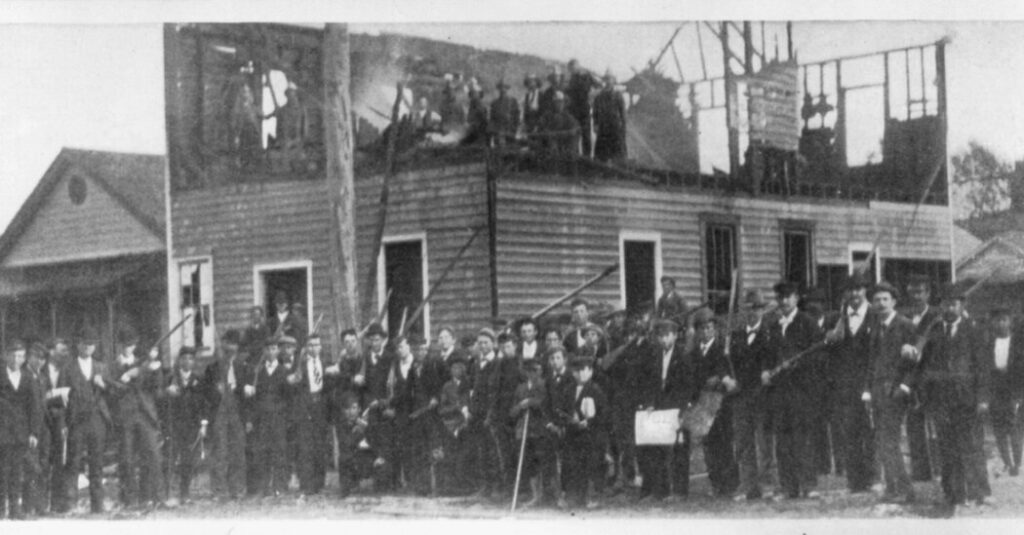
What happened in Wilmington on Nov. 10, 1898, has been variously called a riot, a massacre and — by the white people who perpetrated it — a revolution. Collins calls it both a massacre and a coup.
The violence that day — estimates of the death toll range from a dozen to several hundred — was ostensibly sparked by an editorial in a Black newspaper rebutting a white woman’s call for more lynchings of Black men. But the bloodshed wasn’t just a spontaneous outburst; it was ultimately strategic.
By 1898, Wilmington’s population was about 60 percent Black, and the city was one of the most integrated in the South. Its so-called Fusionist government brought together white populists and Black Republicans. The afternoon of the massacre, white Democratic leaders brought a group of armed men to City Hall and seized control.
“The most critical phase of the so-called 1898 revolution had been achieved,” Collins writes, “replacing an interracial coalition with a new regime whose singular goal was to make Wilmington white again.”
Collins is a longtime staff writer for The New Yorker who is known for pieces that are often witty and delightful. In 2016, she published a memoir, “When in French,” about falling in love with her French husband. Needless to say, “They Stole a City” is a categorically different kind of book. Collins, who lives in Paris, was born and raised in Wilmington. Her parents had moved there in the 1970s, “white, upper-class newcomers” who were welcomed into the fold as long as they didn’t ask too many questions. Collins may not have any ancestral ties to the massacre; she didn’t even know much about it until a decade ago. But she still considers herself an “implicated subject.”
“They Stole a City” follows “Wilmington on Fire,” a 2015 documentary by Christopher Everett, and the Pulitzer Prize-winning “Wilmington’s Lie,” by David Zucchino, published in 2020. Everett and Zucchino took a history that had been distorted and forgotten and brought it back to light. Collins builds on their work. Soon after starting her research, she realized that the massacre couldn’t be contained to its particular time period. It had numerous antecedents, and its effects continued to reverberate across generations: “The event begged to be examined in its longitudinal fullness.”
Her book traces the experiences of four families: the Moores and the Bellamy/MacRaes, who are white; and the Howes and the Halseys, who are Black. Collins begins with a scene on a Wilmington-area plantation in the 1770s and ends with pointed commentary about the “white nationalists of 2026” who nurture “a narrative of victimhood” in order to justify cruelty.
In between she shows how white Wilmingtonians were particularly resentful of Black success after the Civil War, complaining of “Negro domination” and “insolence.” The panic was so unhinged that it could border on parody, with unintentionally ridiculous headlines to match: “Negro on Train With Big Feet Behind White,” or “Stole Cheese: Negro Man Boldly Purloins a Cheese.”
The elite planners of the coup meticulously laid the groundwork. They created a paramilitary and placed a notice in The Wilmington Messenger headlined “Attention White Men,” which called for a gathering at the courthouse on Nov. 9, 1898, promising that “business in the furtherance of White Supremacy will be transacted.” There, they signed a new city charter they called “The White Declaration of Independence.” The next day, they attacked the offices of the Black newspaper that ran the offending editorial and proceeded to take over City Hall.
The consequences were enormous and enduring, though the exact number of deaths is unknown. Collins considers the higher estimates more realistic, given the likelihood that some victims were never found. Black survivors were pushed out of Wilmington at gunpoint or else terrorized into silence. The new government codified rules to ensure that nearly all white men could vote and Black men could not. It would take more than half a century before a historian would dare to call what happened “a coup d’état.”
Collins follows her four families through the ensuing decades. “They Stole a City” is bookended by her moving portrait of Cynthia Brown, a descendant of the Howes, one of Wilmington’s pre-eminent Black families at the time of the massacre. She died on Thanksgiving Day in 2023, two weeks after the city held commemorations for the 125th anniversary of 1898. As a child, she had visited her ailing great-grandmother, a survivor of the massacre. The dying woman grabbed young Cynthia’s wrist and whispered, “If it ever happens — run.”
I happened to be reading “They Stole a City” over the July 4 weekend, toggling between Collins’s historical descriptions of a white supremacist paramilitary marching through Wilmington and contemporary news reports of a white supremacist group marching through Washington, D.C. The effect was sobering. As Collins says, “Nov. 10, 1898, is a centuries-long day that isn’t over yet.”
THEY STOLE A CITY: Wilmington’s White Supremacist Coup and the Families Who Live With Its Legacy | By Lauren Collins | Penguin Press | 494 pp. | $29
The post White Supremacists Took Over a City in 1898. The Fallout Continues. appeared first on New York Times.