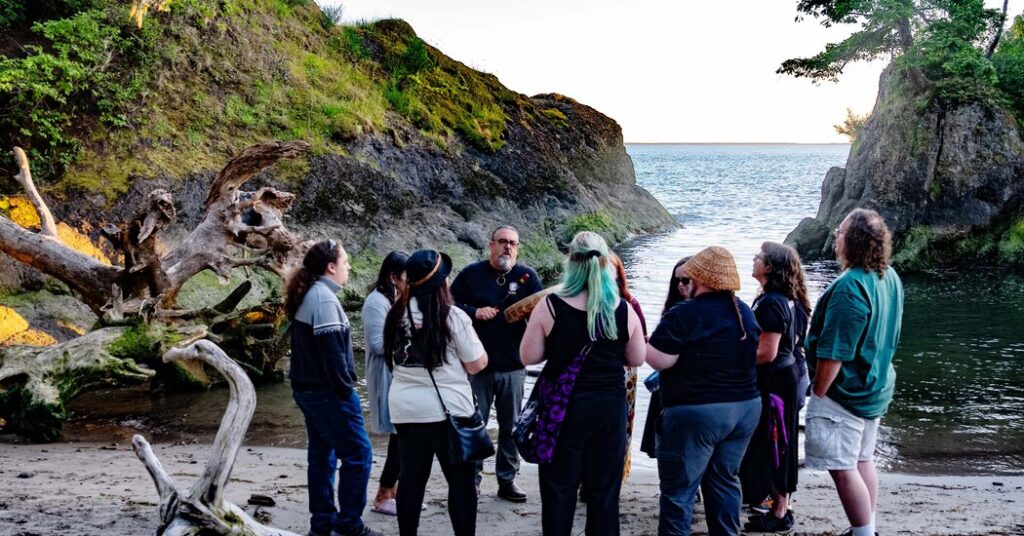
On a scrubby, oyster-shell-cluttered spit of Willapa Bay in Washington, two dozen members of the Chinook Indian Nation gathered to honor the first salmon catches of the year. They prayed, sang and danced, ate their fill and carried the remains to the water as an offering to ensure the fish’s spirit would return and future salmon would come home.
It wasn’t “exactly what you would have seen 150 years ago,” said Tony Johnson, the tribal chairman, but it was in the same spot where his great-great-great-great-grandparents would have performed their own salmon ceremonies.
When federal negotiators arrived in 1851 seeking to consolidate coastal Oregon and Washington tribes on reservations, Chinook leaders chose to remain “with the bones of our ancestors,” Mr. Johnson said. That decision all but ensured Mr. Johnson would fight the same legal battle for official recognition that his father lost, and that his children expect to inherit.
The Chinook, a handful of other Northwest tribes, and perhaps as many as 400 Native groups across the country remain outside of the federal recognition system. And in an era when tribal sovereignty, treaty rights and casino revenue have transformed many Native nations into political forces, the stamp of acknowledgment from the very government that subjugated them still matters.
“We refuse to say we don’t have federal recognition; the federal government cannot tell me we are or are not Chinook,” Mr. Johnson said. Yet in almost the same breath, he acknowledged that recognition would mean “everything.”
This spring, the Supreme Court declined to hear the Chinook’s petition, reinforcing a new reality for tribes still seeking a formal relationship with the federal government and the accompanying benefits: money for health care, education, housing and, in some states, gambling rights. Recognition has become a political battle, more than a legal or administrative one.
Nearly all of the tribes recognized over the past 20 years succeeded through legislation rather than the administrative process, including the Lumbee of North Carolina, which won recognition last year when it was included in an expansive federal defense bill signed by President Trump. For smaller tribes, that path means weathering both the federal government’s labyrinthine acknowledgment process and opposition from neighboring tribes with more money and political influence — and a fear of competition for finite resources.
“Tribes that don’t have federal recognition simply don’t have the resources to play this game,” said Josh Reid, a historian at the University of Washington and a member of the Snohomish Tribe of Indians another unrecognized Washington state tribe. He called it “a zero-sum game” caused by “ongoing settler colonialism.”
The stakes of that game grew significantly in the Pacific Northwest after a 1974 court ruling reaffirmed treaty fishing rights in Washington, establishing tribes as co-managers of the state’s salmon fisheries and guaranteeing them up to half of the harvestable catch each year.
Four years later, the Bureau of Indian Affairs established a formal acknowledgment process requiring tribes seeking recognition to prove continuous community and political authority stretching back to the start of the 20th century.
For tribes with longstanding reservations and treaty relationships, proving continuity was relatively straightforward. For tribes that never had treaties ratified or signed treaties that the federal government later broke, the burden was heavier, especially in the Northwest, where dozens of Native nations traded, intermarried, and sometimes fought over territorial boundaries that could be as fluid as the Columbia River and its tributaries.
The Chinook had occupied parts of the lower Columbia region for centuries before federal negotiators arrived and repeatedly tried to force them east of the Cascade Mountains or fold them into what became the Quinault Reservation on Washington’s Olympic Peninsula. The Chinook’s refusal led to generations of bureaucratic limbo that, federal officials later concluded, left gaps in the record needed to prove continuous political and social existence.
In January 2001, after years of review, the Bureau of Indian Affairs granted the Chinook recognition in the final days of the Clinton administration. After objections from other tribes, the incoming Bush administration rescinded the decision months later.
“We had all these plans for what we could do,” said Gary Johnson, Tony Johnson’s father and predecessor as tribal chairman. “And then, with really no reason in the moment, they were gone.”
A similar fate befell the Duwamish, a Puget Sound tribe that traces its ancestry to the people led by Chief Si’ahl, for whom Seattle is named. The Duwamish also won and then lost recognition as President Bill Clinton’s appointees made way for President George W. Bush’s team.
Opposition from other Native groups to requests for recognition can be subtle; the Muckleshoot Indian Tribe’s objections have been anything but. A Muckleshoot website argues the tribe is “the real Duwamish” and accuses Duwamish leaders of deception.
Cecile Hansen, the Duwamish tribal chair, said people insult her when they suggest her community is after the money recognition brings. Kristina Pearson, Ms. Hansen’s granddaughter and the tribal services executive director, said the federal government was forcing Native people to fight each other.
“We’re not talking about strangers either,” Ms. Pearson said. “We’re talking about family.”
Last year, the Chinook worked with Representative Marie Gluesenkamp Perez of Washington on recognition legislation. But that effort broke down when Ms. Gluesenkamp Perez insisted the Chinook relinquish claims to hunting and fishing rights and asked Mr. Johnson to repair relationships with tribes that had opposed Chinook recognition in the past — tribes he had accused of participating in slow-motion genocide.
Members of Congress say conversations have resumed, and Mr. Johnson says he wants to cooperate. Still, he asked, “why is it that the oppressed people keep being the ones asked to do the work?”
The burden grows heavier with each generation; elders die, and records disappear. Many of the 3,300 people Mr. Johnson considers Chinook also have ancestry in federally recognized tribes. A few have enrolled elsewhere, accepting the benefits of recognition even though doing so may require relinquishing their Chinook claim.
“If it’s somebody from a fishing family, and the other tribe has clear fishing rights, why would I discourage them?” Mr. Johnson said. “It’s a terrible choice to have to make, but that is the system we’re under.”
At the salmon ceremony last month, his 26-year-old son, Tahoma Johnson, cleaned the fish, setting aside a thick orange egg sac for later, and cooked it, duties he learned in childhood.
“Our grandmas taught us this, and their grandmas taught them,” he said.
He expects to inherit another family responsibility, working for recognition.
“If I have to, of course,” he said. “It’s basically the government saying we’re not here, we don’t exist, when we clearly do.”
The post Small Tribes Say They Lack the Clout to Secure Federal Recognition appeared first on New York Times.