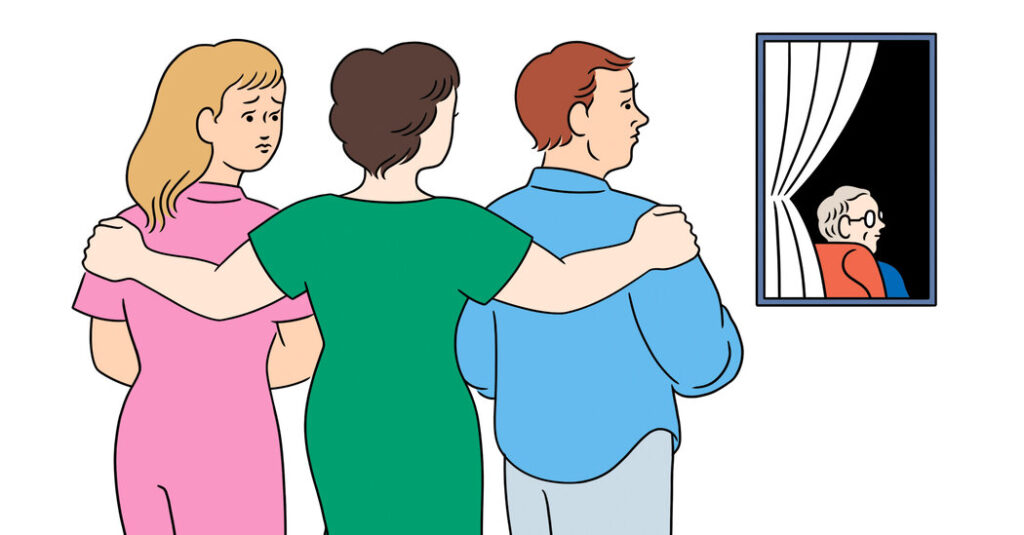
I am the mother of two adult children. Their father and I divorced when they were both under 10, but we shared custody, and they were close to him until their teens, when they chose to live only with me. During college, they cut ties with him altogether. And not without reason: He is self-absorbed and has sometimes been verbally abusive. I believe he has undiagnosed personality disorders. Once brilliant, he now seems to hover somewhere between brilliance and madness. I sometimes receive dozens of manic messages from him in a row about his anger toward the children, his plans to live forever, rebirth, interstellar travel and other subjects. He is also homebound, in precarious health and in his mid-60s.
Over the years, I have encouraged my children to reconnect with him, as has their paternal grandmother, with whom they are close. My younger child has always said, reasonably, that it took years to establish the necessary boundaries and has professed to be “not ready.” I respect that. Still, I worry that he will die and that the children will live with regret.
Their father sometimes texts me that his days are numbered, that his memories are gone and that his mind is going. My children know he has health problems, but I’m not sure they fully grasp that death can come suddenly. At the same time, I know that seeing him could be deeply painful. He might be ranting, bitter or broken, and the visit itself could become a painful memory they have to live with.
They come home to my house for holidays and family events, and one such occasion is coming up. They will, of course, make their own decisions. But I wonder what my role should be. Should I encourage them to see their father, so that they do not later regret staying away? Or should I keep my fears about time running out to myself? — Name Withheld
From the Ethicist:
There are two distinct arguments for encouraging your children to visit their father. One is that it would be kind to him. Kindness is a virtue, of course, and it is especially apt when directed toward people to whom we have a debt of gratitude. Whatever else he did, their father did help bring them into the world, and it sounds as though they have good lives. So they may have reason to be grateful for that. (True, reasons for gratitude could be swamped by reasons for resentment.)
The second argument is the one you’re emphasizing: regret prevention. Were their father to die while they’ve severed ties, they may be sorry for what they weren’t able to say or hear. If they were to discuss with him why they have kept away, for example, he might have the opportunity to acknowledge some of his failings as a father. Unresolved conflicts with the dead can be burdensome. So your position is a plausible one.
Now, when your younger child says, “I’m not ready,” it could mean, simply, “I don’t want to see him,” which is a decision an adult child is obviously entitled to make. Then again, it could mean, “I want to see him, but not yet.” That makes sense as a feeling, but if it’s predicated on the father’s remaining alive and somewhat lucid, it might not make sense as a plan.
Dealing with family members who are in decline is easier when you have a happy history of engagement with them when they were younger. For one thing, you can distinguish new problems from their longer-term character traits. For another, you can think of the challenges of dealing with them as part of a package that includes pleasanter moments. Your children may have no such history to draw on and no fondness for their father’s longer-term traits. Even so, you don’t seem to think they would be unable to manage a little time with him, however uncomfortable.
So, without pressing too hard, why not have another go? Tell your children plainly why you would like them to consider visiting their ailing father. To your younger child in particular, you can say that you’re not asking anyone to feel ready, only to recognize that it’s impossible to know how much time this man has left. They may remain unmoved. Fair enough. You’ll still have done something a loving parent does: pointed out an option that you think your kids haven’t taken seriously enough.
Readers Respond
The previous question was from a reader dealing with uncomfortable family dynamics. He wrote:
For some time, I’ve known that my adult cousin struggles with drug addiction. …The problem is that her parents do not simply pretend nothing is wrong; they actively supply cover stories. The last time I saw my cousin, she looked like a zombie, hunched over with hollowed eyes. My aunt explained that she had been having trouble sleeping. I feel we’re in an “emperor’s new clothes” situation. My aunt gaslights the rest of the family about her daughter’s condition, while my uncle meekly acquiesces. … I am sick of the charade we are expected to maintain around them. At the same time, I do not feel it is my place to challenge my aunt’s lies or confront my cousin about her addiction. When I imagine myself in their position, I know I would not want to discuss my child’s drug addiction openly with relatives. How should I handle this?
In his response, the Ethicist noted:
You’ve conducted a useful thought experiment by asking what you would want of your family if your own daughter had a substance-abuse problem. But you’ve come to the wrong conclusion. Indulging this pretense does nobody any good. Family discussions, while potentially embarrassing, can actually help people think through how to help someone who is struggling with addiction. … Your aunt’s charade is pushing you toward putting real distance between yourself and her. If that’s where you’re headed, what’s the risk in telling your aunt that you think it’s pretty obvious that her daughter is using drugs and needs help? Unlike your policy of avoidance, speaking your mind at least stands a chance of improving the situation. Because drug addiction affects families, there are organizations, including SMART Recovery’s family-and-friends group and Nar-Anon, that help them share the challenges of dealing with loved ones who are in trouble. So if you’re feeling family-minded, you could even offer to join a local meeting of such a group. … Even if your aunt’s first response is denial and resentment, there’s a possibility that she will come to see that there are better alternatives to her current see-no-evil strategy.
(Reread the full question and answer here.)
⬥
As the mother of a heroin addict, I have learned one thing: You can’t change anyone except yourself. If you feel it necessary to express your thoughts about your cousin and her parents, say your piece once and drop it. Unless they live in a cave, they are all aware of what addiction is and how to get treatment. Unless and until that happens, your words fall upon intentionally closed ears, and you accomplish nothing beneficial to anyone. When I realized what my son was doing, I got help for myself with Nar-Anon. Just try to keep in mind that this is a sickness and not merely moral weakness. Addicts need help, not our judgment. — Jennifer
⬥
I’ve found that some relationships work best at a distance, and this would be one of them. This sounds very much like a cousin of mine who has been using drugs for many years, in and out of rehab with no change in behavior. Sometimes you just have to let go and live your own life. You can’t heal the world, or a flawed relative. — Ken
⬥
The letter writer should supply the aunt and uncle each with a dose of Narcan and instructions on how to use it, saying something to the effect, “Lets not talk about it, but lets be prepared just in case.” — JT
⬥
The cousin is an adult. Why not talk to them personally and leave the aunt out of the loop? Let them know you are aware they have had some struggles and if they would like to talk to someone about their addiction, you would help them find a professional or physician to discuss it with them. Sometimes the person’s family dynamics are actually more harmful than helpful, and the cousin could appreciate talking to a neutral party. — Judith
⬥
It is admirable that you have concern for your cousin’s addiction. But ultimately, only she can deal with it. As for her parents, they are not your responsibility, and there is little you can do to change their minds. You can either choose to maintain your relationship with them and accept your difference of opinion about your cousin, just as you might disagree about politics or religion, or you can step away from that relationship as well. — Phil
The post I’m Worried My Kids Will Regret Cutting Off Their Dad. Should I Say Something? appeared first on New York Times.