The number of confirmed cyclospora infections nationally has nearly doubled in a matter of days, increasing to 1,645 on Tuesday from 843 on Friday, according to the latest data from the Centers for Disease Control and Prevention.
The agency said that many states were reporting higher than usual case counts of the parasitic illness and that 141 people had been hospitalized. The C.D.C. is also reviewing an additional 5,100 suspected cases.
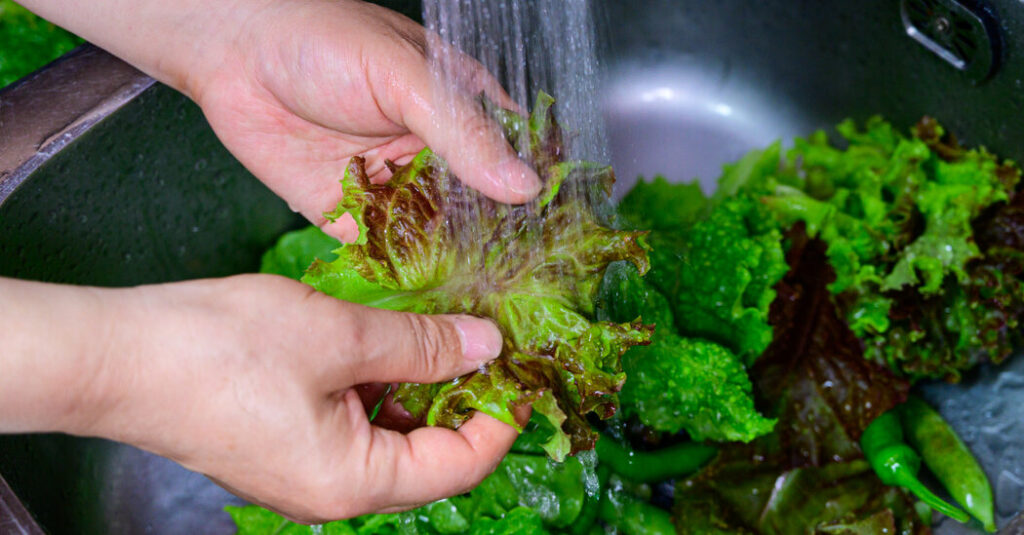
On Monday, health officials in Michigan announced that lettuce or salad greens were possibly contributing to the cyclospora infections in their state, which is reporting the most cases in the country so far. But Michigan and C.D.C. officials have said that the investigations are ongoing and that other foods could still be implicated.
The lag in identifying the source, or sources, behind the surge in infections is par for the course with cyclospora outbreaks, health experts say. The parasite is uniquely challenging to investigate, in part because of its biology, said Craig Hedberg, a professor of environmental health sciences at the University of Minnesota School of Public Health.
And insufficient funding for state and local health departments, along with recent cuts to federal surveillance programs, haven’t helped, said John Guzewich, who worked at the Food and Drug Administration between 1997 and 2011.
Tracing cyclospora, a parasite that spreads through contaminated food or water, back to a particular food is a labor-intensive project. And federal, state and local health departments “are understaffed to do this work,” Dr. Hedberg said.
These investigations involve interviewing thousands of infected people about everything they ate and drank over weeks — or, in some cases over more than a month — and then researching ingredients and suppliers behind those foods.
Last summer, the C.D.C. quietly scaled back the country’s most comprehensive system for tracking food-borne illness outbreaks — called the Foodborne Diseases Active Surveillance Network, or FoodNet — which meant that none of the 10 states within the network were required to test for and report cyclospora infections back to the C.D.C.
While this didn’t stop the reporting — states still test for and report the infections to the C.D.C. through other routes — it did result in blind spots.
“We’re probably missing an awful lot of cases,” said Dr. Glenn Morris, a professor at the University of Florida’s Emerging Pathogens Institute who helped establish FoodNet at the Department of Agriculture. “But we will never know because we don’t have the surveillance system in place to really look for it.”
Health departments at the state and local levels rely on federal grants for much of their funding, said Barbara Kowalcyk, director of the Institute for Food Safety and Nutrition Security at George Washington University. In 2026, she said, those departments received just 40 percent of what they asked for to monitor, detect and respond to food-borne illnesses.
During the coronavirus pandemic, state health departments received a stream of emergency funds to assist with their response, and many of those departments used that money to start enhancing their ability to handle future outbreaks, including those related to food-borne illnesses, Dr. Kowalcyk said. But that funding has since ended, leaving many of those projects in limbo and their staffs eliminated.
Dr. Natasha Bagdasarian, chief medical executive for the state of Michigan, said that significant decreases in funding for the state’s health department in recent years had resulted in cuts to important programs and staffing. “The work is only growing, and the resources we have are only declining or diminishing,” she said.
When Angie Onofre, 25, posted a video on TikTok about her experience with cyclospora, hundreds of people commented on her post, wanting to know what, exactly, Ms. Onofre had eaten before she got sick.
“I feel like this is a Scooby-Doo episode,” said Ms. Onofre, who lives in Brooklyn. She thinks a store-bought bagged salad may have been to blame for her monthlong bout of watery diarrhea. But as with many of the thousands of people across the United States who have contracted the parasite, Ms. Onofre doesn’t know how or when she got it.
Unlike many other food-borne pathogens that cause symptoms within hours of consuming them, cyclospora can take weeks to make someone sick, said Matthew Moore, a food safety microbiologist at the University of Massachusetts Amherst.
Someone must ingest the parasite’s eggs, which then take days to weeks to infect the intestinal lining and reproduce, causing cramping and diarrhea.
When public health investigators try to figure out what caused someone’s illness by asking them to list everything they ate over the past few weeks, most can’t remember, said Felicia Wu, a professor of food safety, toxicology, and risk assessment at Michigan State University.
Items that may contain cyclospora — including basil, cilantro, lettuce, berries and scallions — are often mixed into salads or salsas, or added to sandwiches and burgers. Dr. Guzewich called them “stealth ingredients.” Someone might remember eating salsa on a taco, for instance, but they may not recall whether that salsa contained cilantro.
When someone visits a doctor with symptoms like diarrhea or vomiting, they’re often sent home to rest, hydrate and wait for the bug to pass without any diagnostic testing. In that case, their infection wouldn’t be logged and counted.
If their symptoms are unusual — such as if their diarrhea lasts for more than several days — their doctor might recommend sending their stool to a laboratory for routine testing. But not all laboratories automatically include cyclospora in those tests, Dr. Hedberg said — a doctor might have to specifically ask for a cyclospora test.
It’s also challenging for laboratories to identify the strain of cyclospora that’s causing the infection, Dr. Hedberg said. Because cyclospora is a parasite, scientists can’t culture it the way they would bacteria like Salmonella or E. coli. This means they can’t easily link the source of a given infection with others, so investigators often have a hard time figuring out if various illnesses are related to a single source.
Alice Callahan contributed reporting.
The post Cyclospora Cases Rise Rapidly, With No Source Yet Confirmed appeared first on New York Times.