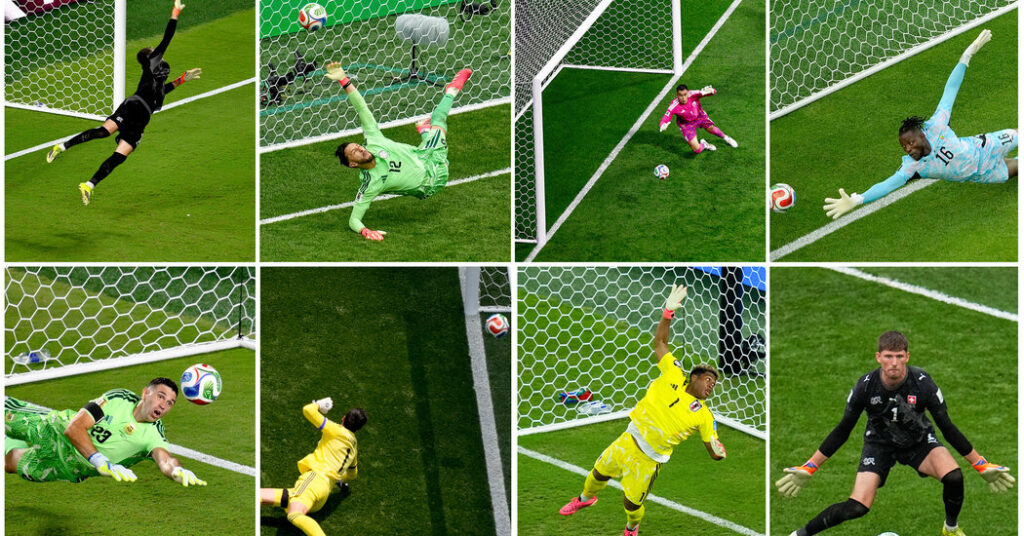
As a goalkeeper, you are full of anxiety. You’re standing there waiting to make a play. You’re the only player on the field who has to wait for the game to come to you. Everyone else can go and chase. Even players who don’t get the ball can at least make a 40-yard run and affect the game. They can challenge opponents, head or throw the ball in from the sidelines. As a goalkeeper, at least traditionally, you just had to wait for the action to arrive.
Today’s game, though, gives keepers more chances to insert themselves into the action. This new approach has changed the psychology of goalkeeping. This point was illustrated starkly last week, in the space of an hour, in the World Cup round of 16 match between the United States and Belgium.
In the second minute of the game, the U.S. goalkeeper Matt Freese vaulted his 6 foot 3 inch frame across the goalmouth to make an acrobatic save against what looked to be a sure goal — a testament to his athleticism. Then, in the 57th minute, he came rushing out beyond the security of the 18-yard box to chest down a long Belgian pass. He deftly swept past the opposing striker, Charles De Ketelaere, and, with the ball at his feet, kicked the ground as he tried to figure out where to pass it. That allowed De Ketelaere to poke the ball to Hans Vanaken, who then scored on the way to a 4-1 Belgium win.
It turned out to be a fraught decision to try to pass from that spot on the field. I know that sinking feeling. But that’s always been part of being a goalie — as the last line of defense we are blamed for every goal scored against the team. But we don’t need your sympathy. Making us more vulnerable has made the game better. The way soccer is played today puts goalkeepers farther up the field and having to make more decisions than we did when I first started my pro career. That means more pressure on keepers and more opportunities for mistakes. That makes the game more exciting to watch, and, for goalies, there’s the payoff of being more integrated into the team.
When I first began playing in the Premier League for Manchester United and then Everton, team managers would have taken my head off if I had tried to play the ball with my feet, dribbling and passing like goalkeepers routinely do today. For me, the choice wasn’t about who was I going to pass to if I came rushing out of the box to get the ball. I was going to kick it 10 rows deep into the stands. There were no decisions to be made. Safety first. That’s what I was supposed to do.
The goalkeeper’s life began to change dramatically when Pep Guardiola became the manager of Barcelona in 2008. Guardiola and other managers made the goalkeeper the start of the offense, someone who should be dribbling and passing the ball as opposed to always booming it long. He brought in the style of being expansive, of having his team take risks with the ball, because he saw that the risks would pay off. In Guardiola’s strategy, if his team held onto the ball, dominated possession, they would have a better chance to win.
That applied to the keeper, too, who was expected to be an active part of the new system. Barcelona won everything in sight with his approach, although it didn’t hurt that Barca had megastars such as Lionel Messi, either. When Guardiola moved to Bayern Munich in 2013, his goalkeeper, Manuel Neuer, took the idea of an active goalkeeper to higher level: a position that came to be known as the sweeper-keeper. The sweeper is typically the deepest lying outfield player, a defender who also has license to create counterattacks. Neuer became that player as well as the goalie; the attack could now start with him.
As a keeper, you then start to believe you’re one of them. You’re supposed to be a very good player with your feet. But you’re not one of them. And so, that’s the hard part for the keeper, particularly when you get outside of your box, outside of your element. Guardiola is one of the greatest managers ever, but I’ve often joked that he ruined the game. Because he made people believe that anyone can play his system, even goalkeepers.
The risk factor that used to scare the bejesus out of me doesn’t seem to scare the new generation of goalies, which is also why more mistakes are made. We have, as a footballing culture and as team managers, accepted the increase in mistakes as an acceptable price to achieve the tactical advantage this new way of playing affords. Fans are, or course, a little less forgiving, especially when it happens on the big stage like the World Cup. A few days after Freese’s slip-up against Belgium, Belgium’s keeper made an error that surrendered the winning goal to Spain.
What creates a successful goalkeeper in this riskier environment? When you make a horrendous error, you have to act like it hasn’t happened. When you make a bad mistake, let’s be honest, it hurts. To try to convince yourself otherwise is actually a bit psychotic. But keepers have to do that. You have to make a brilliant save, and stand up and say, “Yeah, that’s just sort of what I do.” You have to pretend that the extraordinary is ordinary. There’s a mental balance, which is so difficult.
I was always willing to take that risk. You know there’s a vulnerability to being in the arena. Fight or flight is a real thing. You have to get back in the nets, put yourself in a position where, yeah, I want to face more shots from world class strikers before 80,000 people at the World Cup. You could be made to look stupid again. It feels terrible.
But because I knew the other side of failure was glory, and I wanted that, I chased it. The allure of glory was always big enough to make me want to play in the biggest matches. That’s the art and the angst of goalkeeping today.
Tim Howard is now a studio analyst for NBC Sports and its English Premier League broadcasts, and co-hosts the podcast “Unfiltered Soccer.”
Source photographs: Marta Lavandier/Associated Press; Ulises Ruiz/Agence France-Presse — Getty Images; Gregory Bull/Associated Press; Nick Didlick/Associated Press; Mark Stockwell/Associated Press; Jeenah Moon/Reuters; Paul Childs/Reuters; Jeff Chiu/Associated Press; Reed Hoffmann/Associated Press; Gregory Bull/Associated Press; Ulises Ruiz/Agence France-Presse — Getty Images; Matt Rourke/Associated Press; Reed Hoffmann/Associated Press; Mark J. Terrill/Associated Press; Moises Castillo/Associated Press; Gregory Bull/Associated Press
The Times is committed to publishing a diversity of letters to the editor. We’d like to hear what you think about this or any of our articles. Here are some tips. And here’s our email: [email protected].
Follow the New York Times Opinion section on Facebook, Instagram, TikTok, Bluesky, WhatsApp and Threads.
The post How I Stayed Sane as a World Cup Goalkeeper appeared first on New York Times.