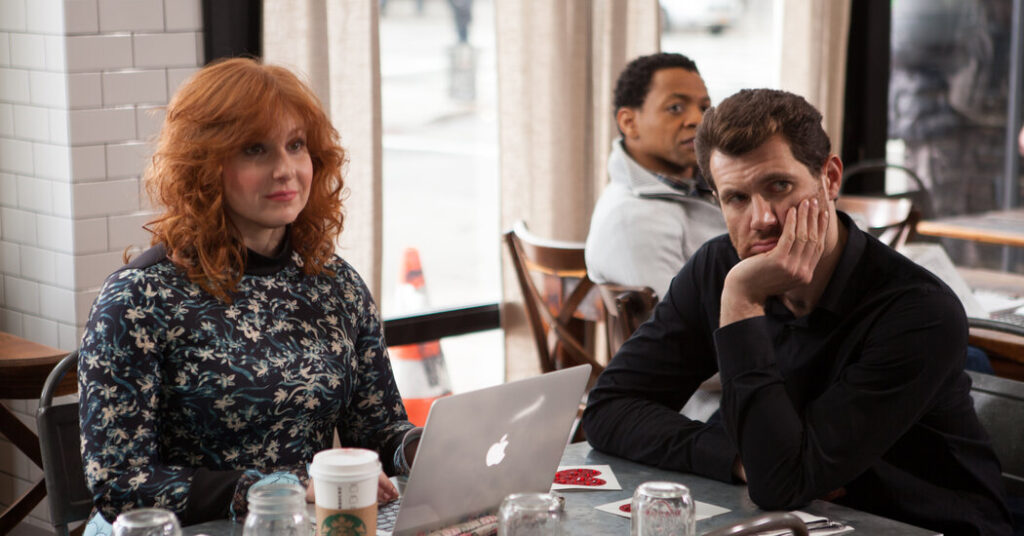
“Difficult People” ran on Hulu from 2015-17, and arguably no show before or since has packed as many jokes, takedowns and pop culture references into each episode.
Julie Klausner and Billy Eichner star as Julie and Billy, judgmental New York comedians whose obsession with showbiz is rivaled, in intensity, only by their contempt for it — mostly because it excludes them. The series’s punch lines-per-second rate is in “30 Rock” territory, but its esoteric inventiveness stands alone. Hollywood, Broadway, Brooklyn hipsters, Manhattan yoga moms, Scientology, PBS, Kevin Spacey — all those and many more are targets for the show’s Gatling gun of insults.
Or as Billy puts it in Season 2: “We learned when Scarlett Johansson recorded an album of Tom Waits covers that literally anything is possible.”
Executive produced by Amy Poehler, the series also stars Andrea Martin and James Urbaniak, as Julie’s belittling mother and patient boyfriend; Gabourey Sidibe as a caustic cafe owner; and Shakina Nayfack as a truther waitress. Celebrities like Tina Fey, Nathan Lane and Lin-Manuel Miranda send up themselves, and others, like Julianne Moore and Debbie Harry, have fun in offbeat cameos.
“It was important to show a star-studded New York City to juxtapose how pathetic Julie and Billy were,” Klausner, who created the series, said in a recent interview. “They were surrounded by people who were extraordinary and succeeded for both talent and hard work reasons, when our characters didn’t have much of either.”
There were also newer performers who are now stars themselves. A baby-faced John Mulaney turns up as a twee aesthete and Nazi fetishist. Cole Escola, currently the toast of Broadway and beyond for “Oh, Mary!,” co-starred as an unhinged actor-waiter.
In that way and others, “Difficult People” now functions as a kind of time capsule. As Julie and Billy mock and tweet their way through an insular Manhattan full of creative-class strivers and eccentrics, the show captures a blithe era right before Donald Trump, tech lords and social media scolds generally made life less fun for such people.
Klausner recently undertook a time capsule project of her own, producing a Blu-ray edition of the show that includes all three seasons, audio commentary for several episodes and an essay by the critic Matt Zoller Seitz. Klausner worked for years and called in many favors to make it happen, all for a show still freely available to anyone with a Hulu subscription. But when media companies started dumping even their own titles from streaming platforms, she panicked about the fate of her proudest creation.
“The biggest nightmare is that you work on something forever, and no one gets to see it,” she said. “But I’m so grateful to Hulu for keeping the show up.”
“Difficult People” will also hold a reunion this fall. On Nov. 3, Election Day, Klausner, Eichner and other cast members will stage a table read of a never-made movie spinoff at Town Hall in Manhattan. In an interview, Klausner discussed the show’s formula, Richard Kind and why she hopes to return to the world of “Difficult People” one day. These are edited excerpts from the conversation.
Julie and Billy spend their days being baroquely spiteful and having various entertainment gigs not work out. What do you think the show was really about?
Focusing on things that piss you off and being funnier than those things when you make fun of them. That’s the recipe. And it should be done in the spirit of love, because if we didn’t care this much about entertainment, then why bother making fun of it?
But it’s still a friendship at the center of it. Those two people love each other more than anyone, and there is something universal about that. And the way that our characters are putting it out there, you’ll know it’s a joke and hopefully you’ll enjoy it. And if you don’t like that reference, there’s another one coming a second later.
Did anyone you made fun of on the show ever confront you?
Most people could take a joke. Richard Kind did the show in Season 2, but in Season 1 we have a joke where Billy says offhand, “I’d love to [expletive] Richard Kind.” Then Richard Kind sent us an email that says, “I too would like to [expletive] Richard Kind.” Ultimately it’s flattering, or I hope it would be. No one’s ever cornered me at a party.
“Difficult People” came out not too long ago, but seeing it now, it seems set in a bygone era. What seemed most different to you when you rewatched it?
You mean besides my body? It was pre-Trump, pre-MeToo. The words “woke” and “canceled” weren’t really in the vocabulary. Rewatching it, it’s almost kind of feckless and foolish, how we didn’t see the wave coming — the pushback against people who are marginalized or maybe a little too comfortable with their place. It’s kind of a charming exercise to go back to a time when you weren’t afraid of these little dinosaur eggs that would soon chomp you.
Social media used to be fun — you’d do it for your friends and dance like no one was watching. Now everything is weaponized, monetized. At this point it’s just too volatile; the internet is not fun and it’s more addictive than ever. So it’s sort of the worst of both worlds.
At the same time, the show was prescient about some of that, like people being extremely online or Shakina Nayfack’s character being obsessed with conspiracies.
In the Blu-ray commentary, Billy points out this is kind of the first series that shows how on our phones we are in daily life, which is interesting. I’ve heard a million times that the show was ahead of its time, but from where I stood, it was very much of its time. Because we could have a character that was a truther, and in that world that made Shakina’s character, Lola, difficult. Everybody was difficult in their own way.
Another example of foresight was in recognizing the fabulousness of Cole Escola.
Cole was someone I loved watching around town, going to their shows in the backs of bars or, like, downstairs at Stonewall. We wrote Matthew for Cole. We knew Billy needed a nemesis, and we thought Cole would be a great self-satisfied theater queen. And then Matthew became crazy and went down that Kramer route where you’re like, OK, this character is not grounded in any human sense at all.
How did you get all those guest stars?
That was all hands on deck: Anyone who had anyone’s phone number, who could text them and say, “Hey, Debbie Harry, are you around Friday at 4?” It was incredibly scrappy. I think there was something appealing about making fun of yourself but being smart when you’re doing it. “Larry Sanders” has always been my favorite show, and it was so good about celebrities poking fun of themselves — being jerks, being fallible.
Did you have a favorite?
Chris Elliott made me laugh so much that I broke during almost every take. Debbie Harry was absolutely captivating. Julianne Moore was so game. But I’m going to say Austin Pendleton. He really made me laugh when I watched all his cuts in the edit, and then he stuck around for lunch and told us great stories about shooting “The Muppet Movie.”
When people approach you about the show, are there references you get more often than others?
I’ve been signing these Blu-rays for people, and I had someone ask me to sign “Our lives are garbage, and it’s the world’s fault.” It’s very sweet whenever people say, “This is my Billy” or “This is my Julie.” I’m getting emotional just thinking about that, because friendship is so important to me. So when people come with their friends and they say that, it’s very moving.
You recently had Billy on your podcast. Are you still in touch regularly?
Oh yeah. I texted him a few times yesterday. Anytime there’s an insane news item — and by “news” I mean pop culture garbage clickbait on the internet — we’ll have something to say about it.
You have the table read in November. Have you ever talked about bringing “Difficult People” back?
I would love to do it. We did this show before Covid — there wasn’t a chance for Lola to comment on masks and the lab leak. And R.F.K. Jr. has a podcast apparently? What a sentence that is. Nepo babies. There are all these things I’m dying for these characters to weigh in on, but as people who are bitter outsiders at this point, 10 years older. It’s an irresistible notion, and I really hope I get to revisit this world in some way.
The post ‘Difficult People’ a Decade Later: A Sarcastic Time Capsule appeared first on New York Times.