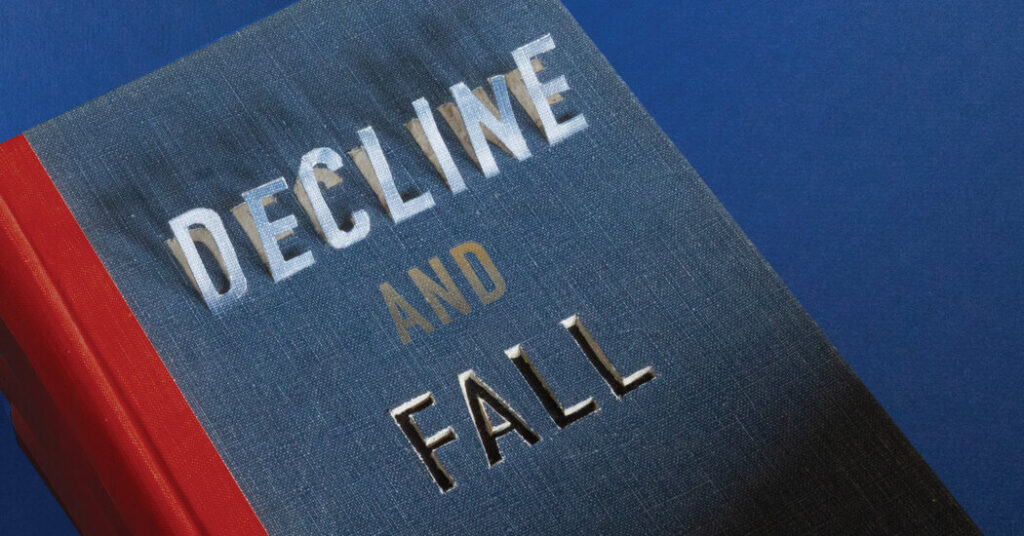
The first volume of Edward Gibbon’s “The History of the Decline and Fall of the Roman Empire” was published 250 years ago, in 1776, just a few months before the American Declaration of Independence. Gibbon, who was 38 at the time, would devote the rest of his life to completing what is still the most influential work of history ever written in English: six volumes in all, with the last of its million and a half words heading to the press 12 years later, in 1788, the year George III became manic and delusional and France suspended payments on its huge national debt.
The questions at the heart of his project are as resonant and unsettling today as they were centuries ago. Why does the arc of civilization seem to bend toward barbarism? If everything that rises must fall, how can we fall better, so that future generations will regard our own achievements as an inheritance rather than as a warning?
Gibbon’s answer was, in short, that the mark of greatness is not how long a civilization endures but how well it passes on its best qualities to the societies that come after. The great constant of history, he believed, was self-delusion: the willful inability of people to recognize how much the habits, rituals and laws they took for granted had slowly changed — until it was too late to bend them back into shape. Mankind “is governed by names,” he wrote, and Romans seemed willing to “submit to slavery, provided they were respectfully assured that they still enjoyed their ancient freedom.” Chronicling Rome’s decline was also a way of understanding the principal challenge of any civilization: how to keep the old ways from dying once they are inherited by future generations whose ideas, beliefs, memories and appearance will inevitably be different from your own.
Anyone living in the 18th century could see the contemporary relevance of Gibbon’s Rome — just as we can see it today, during the year of America’s sesquicentennial. “Substitute the word America for the word Rome,” Henry Adams wrote after reading “Decline and Fall” in 1860, “and the question became personal.” Adams could sense the work’s significance for the United States, which was then mired in sectional conflict and preparing for civil war. In the century and a half since, Gibbon has been reliably cited as the perennial prophet of what happens when a good country goes bad.
What exactly one gleans from Gibbon, though, has always depended on who is doing the gleaning. Cosmopolitans read him as a defender of tolerance against religious extremism. Anti-authoritarians see him as a champion of republican government over one-man rule. Nationalists quote him on the perils of immigration. The current manosphere cites him as a seer on the dark power of women and the effeminate.
But in our present era of competing certainties — nationalism and religious zealotry on one side; self-assured claims to justice and expression on the other — the quiet heroism of “Decline and Fall” is its insistence that the past will not confirm your most deeply held beliefs. It will probably confound them.
To write well about the past is not to mine it for eternal truths, or worse, reduce it to the familiar. Analogies are the first refuge of the bewildered, but they can also be traps. If we’re stuck arguing about whether our current circumstances are more like first-century Rome or fifth-century Rome — or, for that matter, Germany in 1933, the Soviet Union under Stalin, or some other era from our own country’s past — we’ve already gotten the enterprise wrong.
Gibbon was skeptical that history had any definitive lessons. Corpses turned out to be terrible tutors. But knowing about the past, he believed, can help place the here and now in the proper light. Among other things, this knowledge improves our ability to live well by keeping us from mismeasuring the present. Praising our own times as a golden age, or mourning them as uniquely bad, are recipes for either disastrous overconfidence or paralyzing despair.
Because Gibbon has become a universal sage, it is easy to miss this principal fact about him and his great work. He was an honest historian who, in an age of political division, fading empires and revolutionary upheavals, scribbled a long book with a large and surprising message at its core. Gibbon’s singular insight was that the whole point of reading a history book — or writing one — is not to come away with one big truth. The stealthy purpose of studying history is to get you comfortable with changing your mind.
Gibbon was an unlikely bearer of this message and hardly a candidate for fame. He was the only surviving child of an English country squire and, by his 30s, had made little mark in business or letters. He was under five feet tall, with twig-like limbs, a painfully enlarged testicle that sometimes made walking difficult and a face that gathered his eyes, nose and mouth in a tight scrum. A shock of red hair topped his overlarge head. In the cruel view of one acquaintance, he was quite simply “an ugly, affected, disgusting fellow.” He sat as a member of the British Parliament throughout the entire American crisis but never found the courage to make a speech. The person often seen as the cultish, confident originator of “big history” was in fact frequently ill, unsure of himself, and what would now be called disabled — all of which became his secret superpower.
To anyone who encountered him on the page, he was an astonishment. Gibbon’s prose was electric, his sourcing exquisite. The book’s impressive title actually undersold its ambition. Gibbon sought to narrate a full 1,500 years of Roman imperial history, from the origins of the empire in the first century B.C.E. through the fall of Constantinople in 1453, with forays into the wider European Middle Ages and early Renaissance.
For America’s early leaders, Gibbon became necessary reading. James Madison used his notes on Gibbon to shape the Federalist Papers. John Quincy Adams recorded his impatience to see the final installments of “Decline and Fall” as if waiting for a serialized novel. When British forces burned the U.S. Capitol in the War of 1812, Thomas Jefferson sold his library, including his copy of Gibbon, to the government to help restock the Library of Congress. Today, a more-than-lifesize statue of Gibbon — rendered as lean and handsome — looks down on the library’s Main Reading Room, right next to Christopher Columbus.
“Decline and Fall” represented the coming-of-age of history writing not just as a profession but as a practice of living. For Gibbon, modesty, skepticism, a preference for evidence over authority and a view of every conclusion as provisional were essential traits of a good historian. They also turn out to be useful skills for getting through your day. We live the present ignorant of the tectonic movements beneath our feet, so we study history in order to pay closer attention. Historians should be in the business of defending the past from the totalizers: the people, factions and ideologies — the ones we despise and, more difficult, the ones we agree with — that want to take the dead, too, into their empires.
At its most basic, making the chaotic events of the past into a coherent thing we call history is an act of intentional, purposeful understanding. History forces us to confront things we don’t comprehend, decisions we can’t fathom, and ways of being and believing that seem utterly bizarre. It makes us look for evidence in unlikely places. It requires that we think like grown-ups, drawing conclusions that we know will change when the available evidence does.
“I cannot determine what I ought to transcribe,” Gibbon wrote at the end of his first volume, “till I am satisfied how much I ought to believe.”
Faced with internal and external dangers — bad government within, enemies without — old civilizations will fade. New ones will spring from the people our great-grandparents called barbarians. But for Gibbon, knowing how everyone’s story ends should be an impetus to living more bravely and energetically.
All the things we consider normal, dear and true will one day pass away, as they did for the thousands of emperors, queens, citizens, soldiers, philosophers, priests and parents who populated “Decline and Fall.” Yet the possibility of happiness, meaning and a legacy that matters lies not in a disembodied hope for a better future. It lies in the hard evidence — here, let me show you, Gibbon tells us across the centuries — that the dead managed these things, too.
Charles King is a professor at Georgetown and the author of a forthcoming book on “The History of the Decline and Fall of the Roman Empire.”
The Times is committed to publishing a diversity of letters to the editor. We’d like to hear what you think about this or any of our articles. Here are some tips. And here’s our email: [email protected].
Follow the New York Times Opinion section on Facebook, Instagram, TikTok, Bluesky, WhatsApp and Threads.
The post What the Definitive Book on Empires Says About America Today appeared first on New York Times.