The spiciest topic of conversation at Major League Baseball’s annual All-Star Game in Philadelphia this week will be the future of someone who isn’t even there: the Detroit Tigers left-hander Tarik Skubal, arguably the best starting pitcher on the planet. Skubal carried Detroit to two straight playoff appearances after a decade in the wilderness, but now his contract is expiring, and M.L.B.’s richest teams will line up this winter to offer him deals worth nearly half a billion dollars.
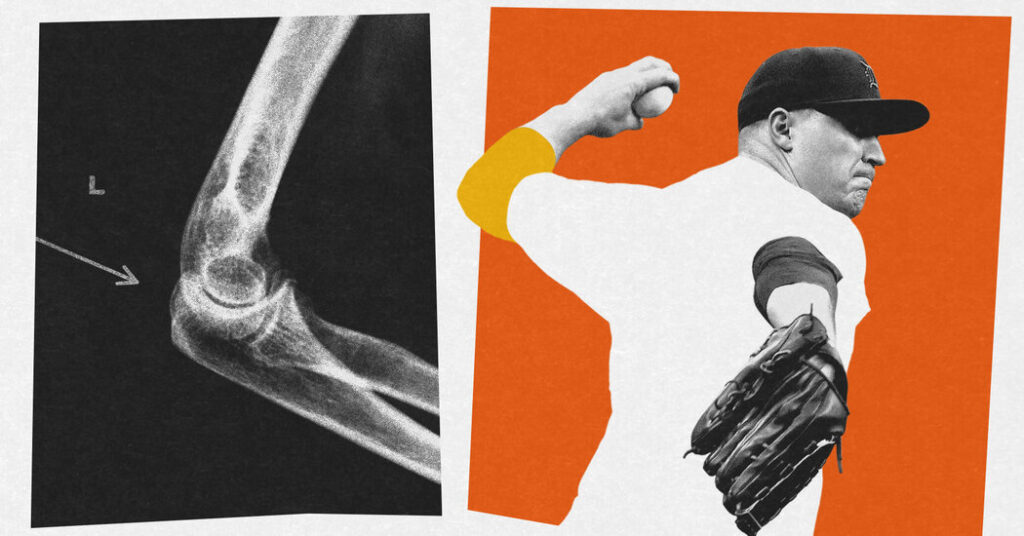
Just three months ago, this kind of talk about Skubal went suddenly quiet. He left the mound after shaking out his arm, and subsequent imaging revealed that a lima-bean-size bone fragment had broken off and become lodged in his elbow joint. He had avoided the worst-case scenario — a second ruptured ulnar collateral ligament, or U.C.L., which would take more than a year to heal — but he’d still need arthroscopic surgery to remove the bone spur. Recovery time: three months. Detroiters were crestfallen. It was possible their superstar had already thrown his last pitch in a Tigers uniform.
Pitching injuries have soared over the last decade in parallel with a rise in average velocity, which seems intuitive: The harder you throw, the more likely you are to get hurt. The same seems true for swinging: According to The Athletic, the league’s hardest swingers have missed more than twice as many days because of injury since 2023 as players who swing 10 miles per hour slower.
Within baseball, the rise in injuries is often described in bleak terms like “epidemic” and “crisis,” but the same conversation is happening across sports. This spring, Jalen Williams, the Oklahoma City Thunder’s all-N.B.A. wing, re-aggravated a hamstring tear during Game 2 of the Western Conference finals, joining Kevin Durant, Anthony Edwards and Luka Doncic on the list of N.B.A. superstars whose absences altered the course of this year’s playoffs. The W.N.B.A. is witnessing a surge in high-profile anterior cruciate ligament tears that have recently ruined rookie seasons (Cameron Brink) and breakout years (Rickea Jackson); the league is on pace for a record number of injuries this season. Many of these are noncontact issues — a direct byproduct of the increased speed, power and sheer physical strain of elite modern sports. The kind that are, in theory, preventable. But as Eno Sarris of The Athletic put it in his analysis of hard swingers, “you can’t really tell a person to swing softer when they see all the money out there.”
Whenever athletes need surgery, says Glenn Fleisig, the director of biomechanical research at the American Sports Medicine Institute, “they ask two questions: What’s my chance of making it back? And how long will it take?” Almost regardless of the injury, it seems, the first number keeps going up while the second number keeps going down. A generation ago, an A.C.L. reconstruction would have gotten someone like Rickea Jackson back on the court but most likely not at peak form. Two generations ago, her pro career would have been over the night her knee gave out. Now, thanks to advances in physical therapy, there’s every reason to believe she’ll resume her ascent next season.
A week after Skubal walked off the mound, Detroit fans got some stunning news. In place of the standard four-millimeter-diameter arthroscopes that doctors have been using to remove bone spurs for half a century, his orthopedic surgeon used an innovative device called the NanoNeedle Scope 2.0, which is just 1.9 millimeters and causes less bleeding, scarring and inflammation. Six weeks later, Skubal was back in a Tigers uniform and flinging 99.9-m.p.h. fastballs. Overnight the procedure acquired a new nickname: the Skubal Scope. He missed too much time to make his third All-Star appearance this week, but his impending free agency looms over the whole event, and the rest of this month, until M.L.B.’s Aug. 3 trade deadline.
So which is it, an injury epidemic or a recovery revolution? In reality, they’re inseparable. Chicken and egg. More athletes are pushing themselves to their physical limits and beyond because they’ve grown confident (maybe a bit too confident) that no matter what breaks, modern medicine can fix it. At the same time, those fixes make them more likely to get hurt again. Science is slowly eradicating the career-ending injury — and replacing it with a revolving door of surgery, rehab … and reinjury.
In the annals of legendary athletes whose careers were cut short by injury — Sandy Koufax, Bo Jackson, Rebecca Lobo — Larry Bird rarely comes up. He played 13 N.B.A. seasons after all. But chronic back pain began to derail his career when he was just 32, and he retired at 35. It’s impossible to say for certain that modern medicine could have fixed his back, but we do know this much: There are no N.B.A. superstars calling it quits anymore at age 32 because of a routine injury. Even 35 is rare. Kobe Bryant tore his Achilles’ tendon in 2013, when he was already 34 and that particular injury was still considered an N.B.A. career killer. Thanks to a pioneering surgical and rehab approach, he returned to the court after eight months, missing just 25 games and playing for three more years. “People are dedicated to finding newer and newer ways to solve those problems,” says Dr. Neal ElAttrache of the Cedars-Sinai Kerlan-Jobe Orthopedic Clinic in Los Angeles, who performed Skubal’s scope as well as Kobe’s Achilles surgery.
Around the same time Bird was struggling to stay on the court, ElAttrache was at the University of Pittsburgh teaching himself how to perform arthroscopic elbow surgery, because in the late 1980s, “scoping an elbow was considered nearly impossible,” he says. “It’s a very small, very constrained joint with no room, and you’re a few millimeters away from nerves and blood vessels.” A slip-up could damage feeling and movement in the hands. Dr. Frank Jobe performed the first successful U.C.L. reconstruction — a.k.a. Tommy John surgery, named after its original recipient — on a big-league pitcher in 1974, which sounds like a long time ago. But before that, pitchers simply pitched through (undiagnosed, undocumented) injuries. “They played until they couldn’t play,” Fleisig says, “and then they were done.”
This is how a culture of injury omertà began in sports. You couldn’t do anything about it, so why complain? That information could be used against you — by an opponent exploiting a weakness, a teammate who wanted your job or maybe a general manager who wanted to replace you with someone younger and cheaper.
A few decades of soaring player salaries and surgical advancements gradually flipped the mental equation, though. In just 10 years, baseball’s highest average annual compensation — the number every pro is chasing — has more than doubled, from Zack Greinke’s $34 million in 2016 to Shohei Ohtani’s $70 million in 2026. The W.N.B.A.’s new collective bargaining agreement this March more than tripled the league’s minimum salary overnight. Now there’s simply far too much money at stake to play in a compromised condition and risk turning a minor injury into a major one, when you can just shut it down for a few weeks, or months, or even a year, and come back as good as new. “When a baseball player blows out his elbow right now,” Fleisig says, “everyone from the owners of the team to the players are like, ‘Well, OK, this is not great, but we know the road map here.’” And the journey keeps getting less daunting. A full “T.J.” procedure remains necessary for full tears, but a new approach using a device called a U.C.L. internal brace has become a popular alternative with incomplete tears because it cuts that recovery window from 12 to 14 months to as little as seven months.
The new methods are changing how players push their bodies. In the early days of Tommy John, when recovery took closer to two years and was far from assured, pitchers threw their absolute hardest for only a few pitches per night, and they saved those bullets for critical moments. Now it’s “max velo” on every single pitch. The Milwaukee Brewers All-Star Jacob Misiorowski doesn’t just throw an astonishing 104 m.p.h.; he tops 100 m.p.h. dozens of times in each start. His average fastball is 100.5 m.p.h. In basketball, a boom in 3-point shooting has stretched the geometry of defense. Every corner of the floor must be protected. Every “step-back 3” pushes a shooter’s ankles and Achilles’ tendons into red alert, a phenomenon that correlates with skyrocketing calf tears. The pace of the action, meanwhile, keeps accelerating, and it doesn’t matter if it’s the doldrums of the second quarter — you’d better not take off a play or you’ll get roasted on social media. Major injury is all but inevitable: the price of playing pro sports. And the reality is that a surgically repaired body part still isn’t as durable as mint condition.
Elbow surgery has become so routine for elite pitchers now that M.L.B. front offices often price a lost year, at minimum, into their contract projections. They’re making a risk calculus, Fleisig says, that if they sign a pitcher for five years and he’s healthy all five, “then we get a bargain — but we accept the fact that we might get three.” Case in point: Jacob deGrom, who was already 35 years old when he signed a guaranteed five-year, $185 million contract in 2023 with the Texas Rangers — a huge bet on an aging starter with two past major arm surgeries. DeGrom blew out his elbow again in the first month of the deal. He missed most of the season and nearly all of 2024. But he was an All-Star again in 2025, and he’s throwing 100 m.p.h. this year at age 38. If you ask the Rangers’ front office, they’d surely say he’s been worth every penny.
In the past, being a successful pro athlete all but required a delusion of invincibility. Now it’s more like the reverse: If anything, athletes have grown too comfortable with the high likelihood of their body parts’ exploding. “They’re not trying to avoid injury at all cost,” Fleisig says. “It’s an accepted trade-off,” even though research abounds showing that the strongest predictor of future injury is a previous one. The ESPN reporter Jeff Passan, author of “The Arm: Inside the Billion-Dollar Mystery of the Most Valuable Commodity in Sports,” once told me he considered the way baseball people shrug at surgery to be “diabolical.”
And it is sort of diabolical! Surgery is medically productive torture, and rehab is a multimonth sentence in sports prison. And sorry to be the killjoy, but yes, someone has to ask: What about the children? What about the boys chasing “velo” and pronating their wrists for max spin rate and shredding their elbows by the time they’re in college? Adult professionals and teenage amateurs should not be expected to obey the same risk thresholds. Yet the data is undeniable: Kids are throwing harder than ever, and getting hurt more than ever.
Surgeons like ElAttrache are essentially using the very best athletes in the world as guinea pigs for innovative techniques that someday soon could be as common as hip replacement. “In a few years,” he predicts, “I’ll look back on the Skubal Scope and think: OK, well, that was pretty rudimentary. It was a nice start. Because people are going to be doing a lot bigger things with those little instruments.”
The incentives are in place. Athletes are willing to accept the risk, teams are willing to foot the bill, doctors keep fixing people when they break, and everybody is making lots of money and having a grand old time. If the 24-year-old Misiorowski is at peace throwing dozens of 100-plus-m.p.h. pitches a night, knowing the scars that almost certainly await him, are we supposed to avert our eyes in moral horror as he breaks M.L.B. records just about every time he takes the mound? What’s so terrible about any of that?
“There are things that are worse, OK?” Fleisig says. “These injuries are not life-and-death.” But fans want to see their favorite athletes play, and injuries have become so common in pro sports that “a lot of the best athletes are not out there for us to watch.” Tigers fans know they’ll lose Skubal eventually — he’s now worth more than the team can pay. But just ask them how it felt when they thought they’d lost him five months early.
Source images for illustration above: David Berding/Getty Images; odla3D/Getty Images; Kevin C. Cox/Getty Images; ZEPHYR/Getty Images.
The post There’s an Injury Epidemic in Pro Sports. There’s Also a Recovery Revolution. appeared first on New York Times.