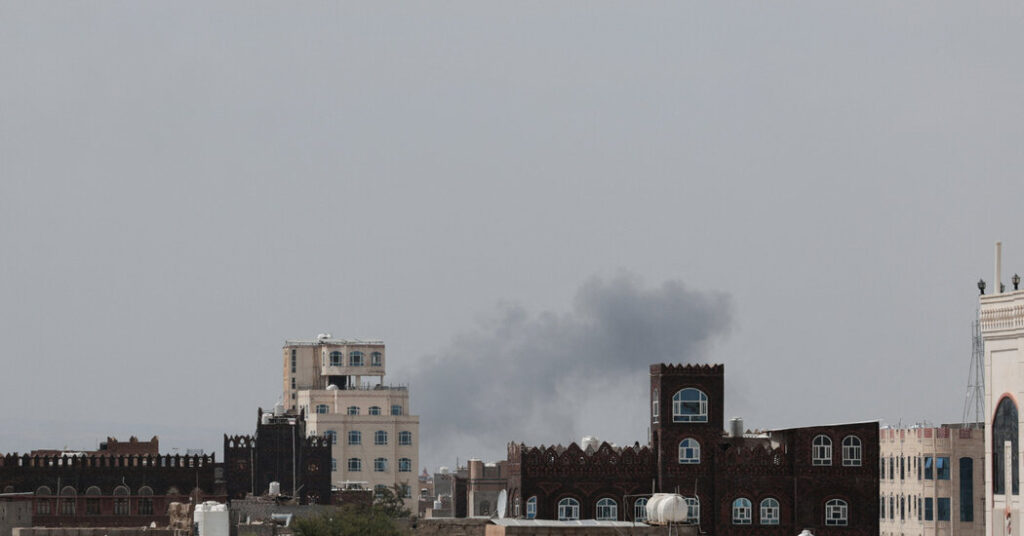
The Iran-backed Houthi militia in Yemen accused neighboring Saudi Arabia of bombing Yemen’s main international airport on Monday, escalating a dispute that has imperiled a fragile peace.
The bombing appeared to be in response to an Iranian plane that was attempting to land in the country.
A Houthi military spokesman, Yahya Saree, warned that the attack on the airport in the Houthi-controlled capital, Sana, “will not go unanswered.” He said in a statement that this signified the end of a “de-escalation phase” between Saudi Arabia and the Houthis — which had been at war for nearly a decade until a truce took hold several years ago.
The Saudi government did not immediately respond to a request for comment.
Yemen’s internationally recognized government — which is backed by Saudi Arabia — said on Monday that it had carried out the Monday attack on the airport in order to prevent an Iranian plane from landing there. The Yemeni government does not have a functional air force and relies heavily on military support from Saudi Arabia.
Iran’s state broadcaster later said that an Iranian aircraft had successfully landed in Yemen’s Hodeidah airport, near the Red Sea, without providing details.
Hans Grundberg, the U.N. special envoy for Yemen, said he was following the developments and was “deeply concerned about the risk of wider escalation.” He added that he was in touch with the parties involved.
“We are urging them to de-escalate and refrain from any actions that would risk a new cycle of violence in Yemen,” he said.
Tensions between Yemen’s Saudi-backed government and the Houthis started to spike after another Iranian plane landed in Sana’s airport on July 3 — shortly before funeral proceedings began in Iran for Ayatollah Ali Khamenei, the slain supreme leader.
At the time, Mr. Saree, the Houthi military spokesman, said that Saudi fighter jets had entered Yemen and attempted to prevent the plane from landing. He said that the Iranian aircraft was a civilian plane that was bringing Yemeni medical patients home from Tehran, and that when it took off again, it was carrying a large Houthi delegation to Tehran to participate in the state funeral.
It was not immediately clear why Saudi Arabia might have objected to the two Iranian planes landing in Sana. But Iran in the past has supplied the Houthis with weaponry and military training.
Mr. Saree warned Saudi Arabia that any violation of Yemeni airspace could prompt a Houthi attack on Saudi airports and vital interests, and pledged that flights between Sana and Tehran would continue “regardless of the consequences.”
The next day, on July 4, Yemen’s government issued a statement saying that the “Iranian regime’s operation of a direct flight” to Sana had been “a flagrant violation” of Yemen’s sovereignty.
The same day, a Saudi-led military coalition said that the Houthi militia’s allegations were “nothing but an attempt to divert attention from its grave violations against the brotherly Yemeni people.” The coalition did not mention the Iranian plane, but said that it would respond harshly to any attempts to violate Yemen’s sovereignty.
Yemen’s grinding civil war began in 2014, when the Houthis swept into Sana and ousted the country’s internationally recognized government, forcing its officials to flee to the southern city of Aden. The next year, Saudi Arabia and the United Arab Emirates began a bombing campaign in an attempt to restore the government.
That campaign failed to displace the Houthis, and Saudi Arabia eventually pulled back from Yemen. The Houthis have since cemented their control of the country’s north, effectively dividing Yemen into two states.
While the internationally recognized government claims to be based in Aden, many of its most senior officials are actually based in Saudi Arabia, and they depend on the kingdom, both financially and politically. Yemen, a deeply impoverished country, remains mired in one of the world’s worst humanitarian crises.
A shaky truce between the Saudi-led coalition and the Houthis took hold in 2022.
But in recent days, ground clashes have broken out between the Yemeni government and Houthi forces in the province of Hodeidah, threatening to reignite the war.
Mohammed Abdulsalam, a Houthi spokesman, on Monday called the attack on Sana’s airport “a major breach of the 2022 truce.” He accused Saudi Arabia in a statement of delaying and rejecting solutions to resume operations at the airport, which had been halted for much of the war under a blockade by the Saudi-led coalition.
Mr. Grundberg, the U.N. envoy, said his priority was to prevent any further deterioration at this sensitive moment.
“Any step that risks widening the confrontation would only deepen Yemen’s suffering and undermine the calm that Yemenis urgently need preserved,” he said.
Saeed Al-Batati contributed reporting from al-Mukalla, Yemen, and Ismaeel Naar from Dubai, United Arab Emirates.
The post Conflict Over Iranian Planes Imperils Yemen’s Fragile Peace appeared first on New York Times.