

Microsoft’s latest round of layoffs has become a familiar corporate ritual.
Last week, the software giant said it would eliminate about 4,800 jobs, marking another workforce reduction, as it remains profitable and invests heavily in AI.
Similar layoffs, from Amazon to Meta, have rippled across tech over the past several years, while many of those same companies amass big AI budgets.
In May, Cloudflare eliminated more than 20% of its workforce. CEO Matthew Prince, in a Wall Street Journal op-ed following the layoffs, said the firm hadn’t seen another US public company cut as deeply while growing by more than 30%.
“Yet what we did is likely going to become the norm over the next year,” Prince said.
It appears other companies got the memo. In May, Cisco reported record revenue for its fiscal third quarter and said it would cut nearly 5% of its workforce. In announcing the reductions, CEO Chuck Robbins said the firms that will win in the AI era are those with the discipline to “continuously shift investment” toward areas with the greatest long-term potential.
Rather than waiting for certainty, many firms are making waves of job cuts as they figure out how AI will reshape their businesses.
For employees, looming cutbacks are becoming less a recession-era concern and more a regular feature of working in tech.
‘Continuous tuning’
Companies are talking about cuts more often, especially in the name of technological advancement. Mentions of layoffs alongside AI on corporate conference calls have climbed from fewer than five per quarter in 2022, when ChatGPT launched, to more than 100 per quarter this year, according to an AlphaSense analysis of calls across industries.
Microsoft said its latest cuts aren’t related to AI. Amazon has likewise said AI hasn’t been the reason for the vast majority of its cuts over the past two years.
A Meta spokesperson referred to a statement the company issued about its May layoffs, in which it said changes varied by team and included moving thousands of workers to other priorities.
Some firms in the information sector — which includes tech and media — are cutting back after high levels of pandemic-era hiring. And, because AI can help automate some work, a certain amount of restructuring can help companies operate more efficiently. Those savings can, in turn, go toward costly AI investments.
While some firms have made deep cuts as they try to chart a path forward, companies aren’t likely to announce sweeping layoffs unless they face an obstacle such as serious financial trouble, said Joseph Fuller, a Harvard Business School professor.
Overall, Fuller expects many companies to make smaller, recurring adjustments — what he calls “continuous tuning.”
One reason, he said, is that companies have spent roughly the last quarter-century relentlessly cutting costs, leaving relatively little fat left to trim.
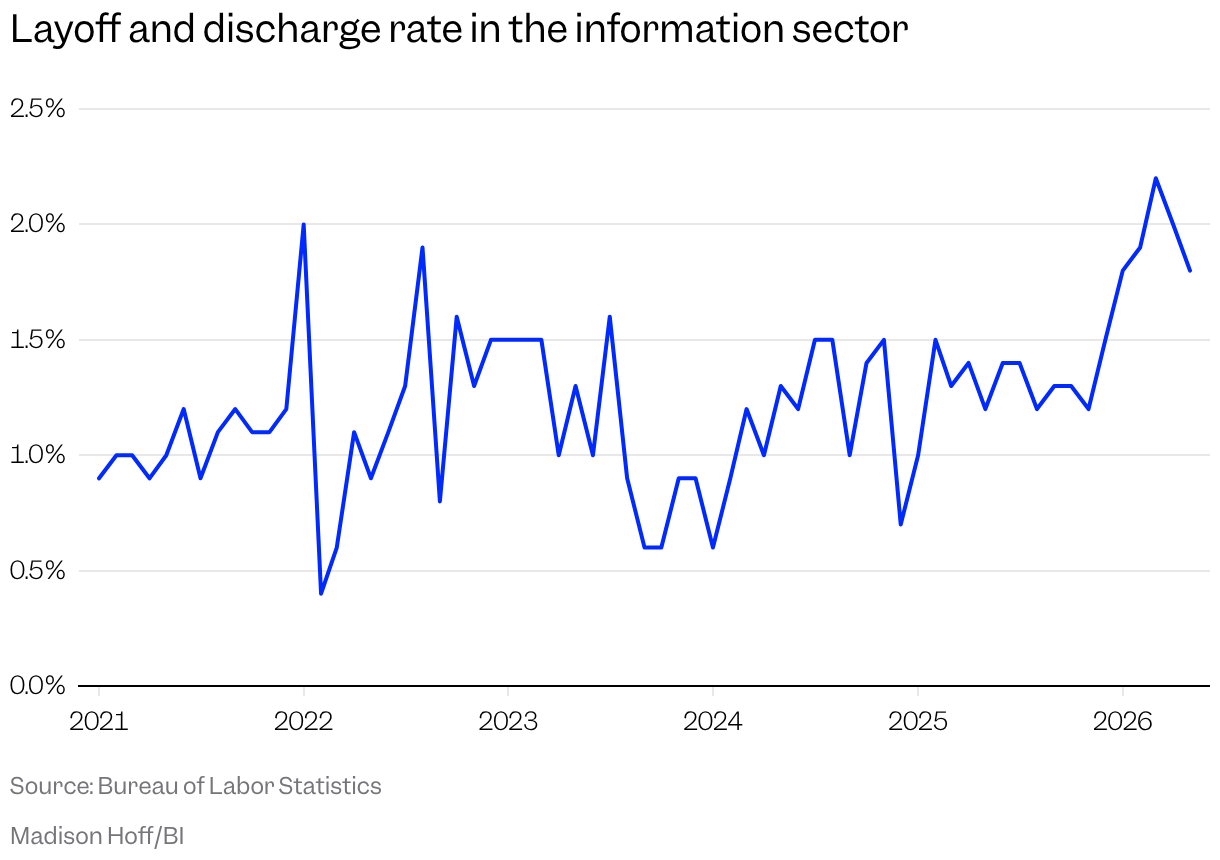
Another is uncertainty. Companies don’t yet know how AI will play out, and for all the talk of companies mustering agents to take on loads of employees’ work, not much has changed, he said, because many tools are still in development.
At the same time, CEOs’ worries about rivals are also feeding a need to “constantly reevaluate,” Fuller said. “If they keep just doing incremental things, and they’ve got a key competitor that goes all-in, they can wake up one morning and be down 21-nothing before kickoff,” he said.
That competitive pressure is pushing executives to make workforce decisions. “This uncertainty, I think, will tend to skew to layoffs,” Fuller said.
Finding rare AI talent
In many cases, the layoffs aren’t because employers are entirely replacing workers with AI, said Carrol Chang, CEO of Andela, which connects AI engineering talent to companies. Instead, she said, many boards are increasingly pressuring management teams to demonstrate AI-driven productivity gains without dramatically increasing spending on, for example, tokens.
Yet few big firms have reached the point where AI allows them to operate with a substantially smaller workforce, she said.
Instead of assuming AI can immediately replace workers, Chang said companies would often be better served by helping existing employees learn how to use the technology effectively. In part, she said, that’s because it’s hard for companies to hire the talent they want.
“Truly AI native and AI-fluent workers are incredibly scarce, and when you can find them, they’re incredibly expensive,” she said.
Regardless of the cause, workers are feeling the impact of looming pink slips. After leaks prompted Meta to announce in April that it would lay off workers about a month later, one worker described the interim period as “28 days of hell.”
Moyan Chen, a data scientist who was laid off from Meta as part of its May cuts, previously told Business Insider that when the layoff she’d been fretting over finally came, “It was more like relief than pain.”
The cost of perpetual cuts
Smaller teams can reduce inefficiencies and layers of middle management. However, some companies are realizing they’ve gone too far and have had to rehire for roles they eliminated, hoping AI could do the work.
Repeatedly laying off workers and hiring replacements can be an expensive cycle, given the costs of severance, recruiting, training, and extra contractors, said Jeffrey Pfeffer, a professor at Stanford University’s Graduate School of Business.
If recurring layoffs remain a management strategy rather than a recession tactic, companies could be underestimating what they’re giving up, he said.
Pfeffer said repeated rounds of layoffs create lasting uncertainty inside organizations, encouraging top performers to leave while weakening the relationships and institutional knowledge that make companies effective.
When a company rehires people, he said, “the coordination and communication is not going to be what it was if you had worked together for a while.”
Harvard’s Fuller said that as AI takes on more work, companies will need more, not fewer, people with a strong contextual understanding of company processes, markets, competitors, customers, suppliers, and industry regulations.
“You need to keep people who know what they’re talking about,” he said.
Read the original article on Business Insider
The post Welcome to the era of the forever layoff appeared first on Business Insider.