Terry Ellis’s fixer wore an overcoat, a multicolored ascot, a Rolex. He had a husky voice and a good suntan. He reminded Ellis of the English actor Ray Winstone, best known for playing hard men in films like “Sexy Beast” and “The Departed.” Ellis, who was himself a hard man, sought inspiration from crime movies, the way an artist scrutinizes the canvases of the great masters; it was a viewing of “Ocean’s Eleven” that had led to the most successful phase of his criminal career. By the winter of 2007, Ellis had become one of his generation’s most dependable, and accomplished, heistmen.
The fixer — Ellis called him Ray and won’t reveal his name — met him in North London near Hampstead Heath for coffee and cakes. When it came time to discuss business, to avoid being overheard, they strolled into the park.
Ray had brought Ellis a few jobs before. But this job, he warned, was of an entirely different order. As Ellis claims in “The Art of Robbery,” a self-published memoir written after his release from prison, he eventually learned that Ray had been contacted by a consultant employed by “some influential bankers from America.” The bankers “were involved in prime mortgages” and had “circumnavigated” certain regulations. Damning evidence of these circumnavigations could be found in banking files held in the King’s Cross area in a giant building known as a data center.
This data center was operated by the business division of Verizon, which had inherited the facility, and about 20 other data centers, through a recent series of corporate mergers. Among the corporations that rented server space from Verizon were various major financial institutions, including one of the world’s largest banks.
Ellis’s assignment was to break into the data center and steal around 80 servers that hosted the incriminating files. Ellis usually worked with a crew of four other professional thieves, but none of them knew much about computers. For this job, he concluded, he would have to smuggle in four computer technicians who could disable the servers without destroying the data they held. Ray also insisted that another man affiliated with his client join the operation. To break 80 servers out, Ellis would have to break 10 people in.
There were additional challenges, Ray noted. Surveillance cameras monitored nearly every square inch of the facility, inside and out. Every door was reinforced with steel and opened outward, making it impossible to force entry. The windows were sealed shut. The glass was bulletproof. The excessively lit front entrance led into an airlock vestibule secured by biometrics and swipe-card readers. Eleven security guards patrolled the building at all times; an independent security firm monitored the surveillance feeds remotely. Three police stations, which could be alerted by various panic buttons, stood within a 10-mile radius. It was, Ray observed, “a high-risk heist.”
Yes, Ellis agreed. That did seem to be the case.
Ray added that his clients would pay “one and a half bar” — 1.5 million pounds in cash — the equivalent, today, of about $4.82 million.
Ellis liked the sound of that. But as he sat with the idea, he began to realize that the job’s appeal extended beyond the potential financial windfall. A data center heist promised to be a legacy job, one that would distinguish him from his peers — a bid for criminal immortality. His “criminal Mount Everest,” he would later call it.
“It was all about doing something that was so different, taking our robbery to the next level,” he said in a recent interview. “It was sublime.”
The world’s most valuable commodity is not stored in banks, jewelry boutiques or the Louvre. It lives in giant, anonymous, energy-devouring warehouses filled with fiber-optic cables, industrial-scale cooling systems and server racks.
The latest generation of data centers will mainly be used, at a cost of several trillion dollars, to power artificial intelligence. Until now, however, the primary function of data centers has been to store the world’s information. The entire searchable internet, for instance, lives in data centers. But that’s not all. Data centers also store most private digital systems: your email accounts; your medical, pension and educational records; every book and archive ever digitized; every social network and dating app; every government and corporate database. Nearly any time you access electronic data — any time you swipe or scroll or speak a voice command — you rely on the services of a data center.
The public fogginess about data centers is not an accident. It is the product of a willful strategy by the world’s largest tech corporations, whose business models rest on the public assumption that the internet, and all the data it holds, is as immaterial as air — or as a cloud, to borrow the metaphor commonly used to describe the sum of information stored on servers. As the digital-media scholar Tung-Hui Hu writes in “A Prehistory of the Cloud,” the cloud “hides its physical location by design.”
This use of “cloud” dates back at least as far as the mid-1990s, but it didn’t enter the public consciousness for another decade, after the chief executives of Amazon and Google began to market the wonders of “cloud computing.” Information, they declared, had been liberated — emancipated from the prison of the desktop computer and evaporated into the atmosphere. The cloud soon became a permanent feature of the cultural landscape. Many of us began to believe that digital information had actually become vaporous. The metaphor evoked mantras that tech boosters recited with religious zeal, like “Everything is connected” or “Information wants to be free.”
But information does not float in the air. It is encoded on servers: computers without monitors or keyboards, rectangular boxes dotted with blinking LEDs, stacked in vast grids held in warehouses. Our phones and tablets and laptops are so light because they contain little more than a screen, a battery and an antenna. Their powers are merely borrowed, at up to 1,000 megabits per second, from data centers.
By the time Ellis learned about the Verizon job, data collection had quietly become the most critical economic force in modern life. “Data is the new oil,” the British mathematician and data scientist Clive Humby wrote in 2006, an expression that quickly assumed the status of an adage. In the last two decades, data storage has grown into the core business of some of the world’s most valuable corporations. Amazon, for instance, is not, primarily, an e-commerce business. It is a data storage business: Amazon Web Services, the data server provider it started in 2006, accounts for more than half of its profits, and in some quarters as much as 74 percent of its profits. A.W.S.’s clients include, among others, the Library of Congress, the U.S. Treasury, the National Security Agency, the I.R.S. and The New York Times.
Google Cloud represents 15 percent of Alphabet’s income, but it is its fastest-growing division. Microsoft recently disclosed that its own fastest-growing revenue source was its data storage services, which it groups together under the rubric Intelligent Cloud; it hosts the British government, Starbucks, Shell, OpenAI and the U.S. Department of Defense.
Amazon and the other data behemoths speak of the value of their data center operations about as openly as they do their internal algorithms. For two years after building its first data center, Google refused to acknowledge it existed; to this day, it requires visitors to all its centers to sign nondisclosure forms. Amazon and Microsoft still do not disclose the exact number or size of their data centers, indicating their locations only by region or “availability zone.”
Why the secrecy? It’s hard to tell exactly. A guardedness about proprietary business operations is part of the explanation. An effort to conceal the environmental cost is another: Between the energy consumption of the servers and the cooling systems that prevent them from bursting into flames, data centers are responsible for the release of monstrous quantities of greenhouse gases. The largest data centers can consume the energy of two million homes. If the world’s data centers made up a 51st American state, it would rank second in energy consumption, just behind Texas.
But the most likely rationale for the tech companies’ reluctance to discuss the details of their core business is related to security. The anonymous warehouses we call data centers are the lockbox of the global economy.
“You could blow up Wall Street tomorrow, and it would have a minimal impact on the stock market,” says Brian Higgins, who teaches disaster management at the John Jay College of Criminal Justice and directs the security consultancy firm Group 77. The New York Stock Exchange in fact trades at a data center in Mahwah, N.J. If you want to bring the global financial system to its knees, Higgins says, bomb Mahwah.
“People think that information has no value, that it’s just in the air,” says Maryam Farboodi, a professor of finance at Cornell University who studies the economics of big data. But when mountains of data are concentrated in a single facility, they are susceptible to being stolen. And not just by hackers. “We tend to think of data breaches in terms of cybersecurity,” Farboodi says. “But there is not much appreciation that data are physically somewhere. And someone can actually go and steal them.”
Someone, actually, already has.
Ellis’s lieutenant was Denis Carr, known as Dez. Micky, dependable and fearless, was the crew’s procurer, capable of obtaining forklifts, passports, uniforms and anything else a job might require. The Tall Fella was a 6-foot-4 confidence man. Frankie was very short and very strong. (Ellis and Carr ultimately served prison sentences; the rest of the crew was never caught, and neither Ellis nor Carr revealed their real names.) None of Ellis’s crew used guns. All were trained kickboxers. “We were prepared to use violence,” Ellis says today. “We were quite well versed in violence. But we didn’t have to. Because we were capable.”
Ellis was the most capable of all. He grew up in a freezing flat in Camden Town, three blocks from the squalid tenement that Charles Dickens lived in as a boy. He struggled with writing in school, a condition he later understood to be dyslexia. “It gave me frustration, anxiety and embarrassment,” he says today. He knew he was intelligent; he just needed to find a subject that suited him better than English. At age 8, he found it.
His first theft was a package, stolen while working as a delivery boy. He soon began sneaking into the warehouses along Regent’s Canal, a stone’s throw from his apartment. He has a vivid memory of the first time his mother caught him. She awoke him in the middle of the night, he said, having discovered a box of crystalware he’d pilfered. She would not punish him, on one condition: that he return to the warehouse and steal the lot. Until dawn, Ellis crawled back and forth through a warehouse window, filling a room in their flat with hundreds of boxes for his mother to pawn. “I learned a valuable lesson that night,” Ellis later recalled. “It was OK to steal but bad to get caught.”
In his memoir, Ellis describes embarking on his life’s path with youthful immoderation. He disemboweled parking meters with a sledgehammer. He stole radio cassettes from slow-moving freight trains. He nicked lead flashings off the roofs of stores, churches, his elementary school. He sneaked with friends into a walled-off parking lot, hot-wired MG convertibles and, his eyes barely peeping over the dashboard, played bumper cars. He escaped department store guards by disappearing into one of the tunnels that linked a London Underground station to an abandoned air-raid shelter. Before long, he had more cash than he could hide from his mother. When he was 11, he said, she allowed him to be committed to a home for juvenile delinquents.
Ellis exhausted most of his teenage years as a ward of the state, apart from a dozen brief escapes, including once from a courthouse after his own arraignment. By his 20s, he had developed an expertise in robbing customs warehouses and trafficking cigarettes from all over Eastern Europe. When not incarcerated — he served two multiyear sentences for armed robbery and drug possession — he lived well. He bought his own house in Camden Town and took his family to Disney World and his girlfriends to the Andalusian coast.
By 2007, Ellis had developed a relatively secure business model, working almost exclusively with his four trusted associates. His crew, he claims, had stolen half a million pounds from a locked safe buried beneath a drug dealer’s house; three pallets of computers from a warehouse in Antwerp, Belgium; and $100,000 of looted cocaine. The jobs paid reasonably well and satisfied Ellis’s appetite for elegant, intellectually challenging work. After several years atop the industry, however, he grew restless. No matter his crew’s expertise, their implacable professionalism, he knew that sooner or later their luck would run out.
“We needed a once-in-a-lifetime job that would set us up for life,” he writes in “The Art of Robbery.” “But that elusive job was yet to materialize and I was starting to wonder if it ever would.”
That’s when Ray suggested they meet for cakes.
Ellis didn’t think he’d ever seen a data center until Ray indicated their target. It was a three-story complex between St. Pancras Way and Regent’s Canal, occupying two acres of King’s Cross in central London, just around the corner from his childhood home. Ellis knew the building well: It was one of the few along the canal that he had never broken into. The ground floor was red brick, mounted by opaque vertical windows, metal siding and air vents; the upper floors were clad in gridded metal panels interrupted at regular intervals by small dark windows. There was absolutely nothing distinctive about the building. That, Ellis came to realize, was the point. You don’t advertise where you store your treasure.
Verizon had made it difficult to even look at the building. No street parking was permitted beside the property, and the rear of the building abutted Regent’s Canal. How, the crew wondered, could they get close enough to surveil the site without drawing suspicion?
With a telecommunications van, Ellis decided. Nobody would question on-site repairmen; no cop would shoo them away.
Micky, the procurer, obtained a BT van from a friend who worked in public auctions. The crew drilled holes in its flank and parked it in front of the data center. For several weeks, eating cold sandwiches and urinating in plastic bottles, the men observed the entrance in five-hour shifts, marking the number of security guards and janitorial staff members and the timing of their schedules. They failed, however, to spot a single vulnerability. The only part of the building that was not continuously filmed by surveillance cameras was a small section of the roof that was inaccessible, except by helicopter.
Carr told Ellis that he had been crazy to even consider the job. The Tall Fella called it a suicide mission. After three weeks, Ellis began to concede that they were right. He had walked away from jobs before and would do so again without regret. Ray had advanced them 30,000 pounds to cover their expenses and time during the surveillance period; they would pocket the remaining amount and move on to the next job. Ellis decided he would tell his crew that the heist was off. He figured they would be relieved to hear it.
But the weekend before they next planned to meet, Ellis went to visit a friend in West Hampstead and found that the police had sealed the street, blocking traffic. They didn’t look at him. They were busy looking up — at the roof of a library across the street. A man stood there, threatening to jump. That gave Ellis an idea.
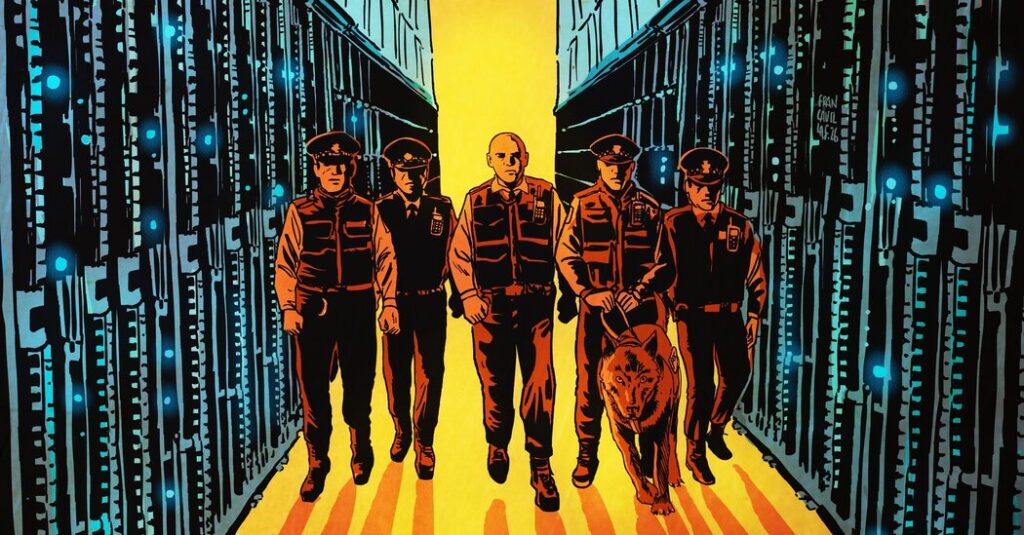
The next day, Ellis and his crew arranged to hire an Alsatian dog named Buster — “as big as a barn door,” Ellis writes in his book — who had a loud, menacing bark. They set the job for the following Thursday. On Monday, they received duffel bags with five sets of police uniforms — flak jackets, vests, boots, caps, handcuffs and even a fluorescent dog-handler jacket — and tried them on. Tuesday was “ritual day,” a day for families. Ellis took his three daughters to the London Zoo and bought them teddy bears. “We convince ourselves that the reason we are doing this final job is for them,” Ellis writes, “so we can retire and sail off into the sunset.” The reality, however, “is we only do this to ease consciences. … Yes, we love our kids and wives, but do we love them more than we love money and living this life? The answer has to be a resounding no.”
On Wednesday, Ellis’s crew ran a dress rehearsal, driving the route and adjusting the timing. On Thursday morning, after ducking into a church to say a prayer for his family, Ellis made his way to Carr’s house, where they were joined by the others. A police van, which Micky bought from a film prop house, was parked out back. Buster could be heard from within it, maniacally barking. The men changed into their uniforms and ate sandwiches and cakes. They toasted to success.
At 9:12 p.m. on Dec. 6, 2007, the police van bounded over the curb at St. Pancras Way, skidding to a stop in front of the Verizon entrance. Two other cars pulled in close behind them, blocking off the view from the road. Five men in police gear, and one dog, leaped from the vehicles. When the critical moment arrived, Ellis displayed the poise and calm of an elite athlete. “We’d addressed every possible situation, every fear, a thousand times,” he says today. “All the ways it could go wrong. So when it goes right, it goes really easy. In that moment, we really were police officers, just doing our job. We were the pictures of equanimity.”
Ellis spotted a security guard through the glass. He buzzed the intercom and demanded that the door open. The guard asked what was going on.
Flashing his police identification, Ellis said he’d received a report of a person on the roof. The Tall Fella stepped forward, Buster straining his leash.
When the guard didn’t immediately respond, Ellis slammed on the window. That did it: The guard swiped his key card, and the door opened.
Impersonating police officers was one of Ellis’s favorite ploys. “The security guard who is ex-police or ex-army will always respect authority,” he says. “That’s why I use uniforms.”
Ellis strode past the guard and into the security control room, where three additional guards sat behind surveillance monitors.
“Have you got a camera positioned on the roof?” Ellis asked, according to his memoir.
One of the guards said they did, but it captured only the fire escape door.
“Have any of you been up on the roof in the last hour?” Ellis asked the men.
None of them had.
Ellis pointed at the head of security. “You,” he ordered. “Take me.”
Once they were out of sight, Ellis explained that he had received a report that the person on the roof of the data center was dressed up as a security guard. “For my protection and my officers’ protection, I’m going to handcuff you all, until I have established who you are,” he says he told him.
After their boss complied, the rest of the guards follow suit. Ellis handcuffed them to the metal stair rail. “Getting them all to stand up felt brilliant,” he says.
On the CCTV monitors, Ellis spotted more guards on the upper floors. He ordered one of the guards to call them down. They, too, agreed to be handcuffed — though only after the Tall Fella threatened them with Buster.
Ellis confiscated the guards’ key cards and admitted the five men who had been waiting outside. One of them cut the live surveillance feed that was being monitored by the independent security company. The phone rang.
Ellis picked up. Identifying himself as Verizon security, he explained to the independent analyst that an electrical surge had knocked out the monitors. But repairs were already underway. The cameras would be back online by about 10 o’clock — within 40 minutes.
This seemed to satisfy the analyst. He told Ellis to keep him updated.
While Ellis and his crew cuffed the data center’s remaining employees, their technicians went to work. They swiped the guards’ key cards to enter the room on the top floor that held the targeted servers. They removed mounting screws, disconnected the servers and put them in laundry bags — 20 bags in all, each large enough to hold four or five servers. The members of the heist team hauled the bags down the stairs and lay them in the back of the police van.
The technicians drove off in one car, Micky and Frankie in the other. Ellis and the Tall Fella climbed into the van, with Carr behind the wheel. At the corner, Carr hairpinned right, up Royal College Street, speeding past Ellis’s childhood flat. Several blocks later, as they neared one of the local police stations, sirens began to blare. It was 10:06 p.m. They had been inside the data center for less than an hour.
Four police cars and two police vans, blue lights flashing, raced onto Royal College Street. But they either didn’t see Ellis’s van or mistook it for one of their own. They sped off.
Carr continued about 10 minutes north to Parliament Hill, where he dropped off the Tall Fella and Buster, then an additional 15 minutes to Muswell Hill, where the men loaded the servers into a garage. They dropped the van and the second car at another location (never revealed), where Micky, as far as Ellis knows, lit them on fire. They had stashed a separate car there; this they drove to Carr’s house, where the rest of the crew had already begun to celebrate. Ellis was asked to give a speech.
“I never thought in a million years that we would do this,” he remembers telling his crew. “When I wake up tomorrow and for the rest of my life, I will always remember this moment.” He expressed the deep sense of honor he felt for sharing the achievement with such fine professionals of high moral station.
“Now,” he said, “let’s get pissed.”
The Independent and The London Standard each ran headlines about an “Ocean’s Eleven” heist the next morning, but the reported haul seemed relatively modest. Yes, the thieves made off with more than $1 million of computer hardware. But the general tone of the press reports was reassuring. The data center’s employees were unhurt (though one had to be treated for shock). And despite the scale of the theft, the articles repeatedly emphasized that no valuable information had been stolen. “A huffy Verizon publicist admitted that there had been a ‘service interruption,’ but that none of the servers had gone down,” The Independent reported.
This is the standard response from companies to incidents of physical data theft. The attackers, it is usually claimed, were after only hardware, not information. The value of the hardware is disclosed, but the value of the data it holds is minimized or goes unmentioned. Why, a careful reader might wonder, would a thief go to the extreme measure of infiltrating a data center to steal loaded hard drives — when servers could be much more easily plucked from warehouses or computer stores or freight trucks?
Data center heists belong to that rare class of crime, like blackmail and extortion, in which the victim eagerly participates in the cover-up. Were a data center to admit to flaws in its security, it would only encourage additional attacks and scare away its clients.
When a thief dropped through the ceiling of a Midwestern data center operated by American Insurance Group in 2007 and seized a server containing the medical records of nearly a million people, the value of the theft was reported as $10,000. After a center in Chicago containing data from corporations in 190 countries was robbed by men with tasers, customers were told that the only consequence was a temporary power outage; it was the fourth such incident in a two-year period. In 2015, when five servers containing the personal details of 90,000 donors were stolen from Plan International UK, the charity emphasized that no credit card information had been stolen.
“The data center business is built on reputation,” says John Bekisz, a vice president at the security consulting firm Guidepost Solutions who specializes in data centers. “Data has tremendous asset value. But so does reputation.”
Since Ellis’s day, the physical threat matrix has shifted on several axes. As cloud storage has come to be dominated by abundantly resourced tech giants, physical data attacks have declined. Most successful attacks, Bekisz observes, have been crimes of opportunity: inside jobs by employees, usually looking to pawn expensive hardware, or theft of servers and computer chips in transit. (Last year, losses from cargo theft increased 60 percent to a record $725 million, though some risk analysts believe that actual losses are as much as six times as high.) But the sweeping consolidation of digital information has opened a new field of risk.
Farboodi warns that a single data center might contain secrets that could be used to compromise not only an individual but a company, government or military. “When you collect a large amount of data in a single data center,” she says, “there are increasing incentives to attack them.”
As cybersecurity defenses have grown more sophisticated, physical vulnerabilities have become more enticing to would-be assailants. In 2021, a Texas man was arrested trying to blow up an A.W.S. data center in Virginia with C4 explosives in an effort to “kill off about 70 percent of the internet.” From 2021 to 2023, hackers repeatedly posted on the dark web physical security information for two data center firms based in Asia, exactly the kind of information needed for a physical robbery: a list of 30,000 CCTV cameras and their video streams, identification credentials of staff members and access to the email account used to register visitors. The targeted data centers served 2,000 major corporations, including Walmart, Goldman Sachs, Mastercard, PayPal and Bloomberg.
Bekisz finds it frustrating that so few people understand the physical risks to data centers. He blames, in part, the emphasis placed by governments and the press on cyberattacks. “Our culture, and even our industry,” Bekisz says, “has been so focused on cybersecurity that the physical security is often overlooked. As I always tell my clients, if you put your fancy, state-of-the-art network equipment in an unlocked janitor’s closet, it’s not going to help you very much.”
Micky, the Tall Fella, Frankie, Ray’s man and the four technicians all got away with it. Ellis’s crew split a pot of 1.25 million pounds, with the remaining 250,000 pounds split among the technicians. Ellis reports that they’re happy and rich today, several of them having risen to more comfortable stations in the criminal hierarchy. Ellis might have made it too — were it not for Carr.
The day after the job, Ellis threw out his cellphone; a month later, he rented a 50-foot canal barge fitted out with a kitchen, a television and central heating. For three weeks, he lived in the place the police would least suspect: docked in Regent’s Canal directly behind the Verizon data center. He felt no remorse for the crime, particularly as the ramifications of the international banking crisis continued to proliferate. His crew didn’t hurt anybody, he said. They didn’t even use a gun.
“The banks knew they were sending mortgages to people who couldn’t pay back,” he says today. “That’s what broke the whole system. That was the big con.” Ellis remains convinced that the bankers who paid for the Verizon job wanted to destroy evidence of their involvement in fraudulent subprime mortgages — the inside information that Ellis received about the data center, he believes, “would have had to come from the top” — but he can’t prove it. He never saw what was on the servers.
“Our job was to get the motherboards,” he says. “We were paid quite handsomely. Whatever happened after that was none of our concern.”
A month after the heist, during an investigation of an attempted burglary of a private safe, the police showed Verizon’s security guards mug shots of the perpetrator’s known associates. The guards recognized Ellis and Carr.
A couple of days later, Ellis awoke at a girlfriend’s apartment and went out to the terrace for a smoke. It was barely dawn. A young woman and an older man walked on the street below. As soon as Ellis emerged, the woman glanced up at him.
Ellis panicked. He ran back into the apartment, grabbed a backpack stuffed with 20,000 pounds and raced out a back door that led to the roof. He climbed down a fire escape ladder and dropped to the sidewalk. As he reached the corner, he saw about 20 police officers entering the complex. He ran to the train station.
Using a fake driver’s license (“Eddie Jones”) and bleaching his hair, Ellis took up residence in Luton, a small town about an hour northwest of London. For the next eight months, Eddie Jones managed to achieve a life of quiet anonymous normalcy. He dated a bodybuilder and helped her open a hair salon. As his confidence grew, he began to duck back into London to visit his daughters and even committed a few low-stakes thefts. But after a botched job at a vegan food factory, during which he tussled with a worker in a walk-in refrigerator and left behind his fake ID, he decided he had to flee the country.
He planned to go to Thailand, where a friend offered to put him up. He secured a new passport and said goodbye to his children. But on the day in September 2008 that he was supposed to fly out of Luton Airport, he was surrounded on the street by more than 25 police officers, some of them wearing masks and combat gear. (In response to a request to confirm the details of Ellis’s accounts, a Metropolitan Police spokeswoman said it would not “be proportionate for us to try and locate any officers from the time to try and ascertain these details”; Verizon did not respond to multiple attempts to verify the particulars of the heist.)
Ellis received a nine-year sentence for the Verizon theft and concurrent sentences for the vegan factory robbery and two others. Newspaper articles at the time described the data center heist as a “£5M burglary.” Ellis considered this a lucky break — £5 million, after all, was the replacement cost of the data servers. The value of the data they stole, Ray had told Ellis, was 20 to 40 times as much. Ellis was sentenced to 16 years and released after eight and a half. “The sentences they have received are a clear indication of the seriousness of the offenses they committed,” Raj Mahajan, a Metropolitan Police detective inspector, said at the time, “and should act as a deterrent to anyone else considering a similar type of venture.”
A deterrent — or an invitation. Ellis acknowledges that it would be more difficult to pull off a data center heist in 2026. “Security is a little more up-to-date, a little more professional and secure,” he says, in part because of the vulnerabilities he helped expose. But data centers tend to have the same security systems in place — the same features, the same redundancies, the same routines. They are, Ellis says, highly predictable.
“And we — we’re more advanced too,” he says. “On the dark web, there’s nothing you can’t acquire. Identification, banking details, you name it.” He sounded wistful. “I know guys doing data hacks, nicking hundreds of millions more than we ever did. The reason they’re not getting publicity is because it’s better for a company to lose money than to admit their system might be fallible.”
It was a lot easier to defend data when people didn’t know it existed. The more people learn about data centers, the more they hate them. Polling suggests that the data center has become the physical totem of A.I., a collimator to concentrate A.I. anxieties; a Pew Research poll in March found that a plurality of Americans considers the influence of data centers on the environment, energy costs and quality of life to be “mostly bad.” Since January, legislation to ban data center construction has been advanced in 15 states and dozens of municipalities.
The advent of A.I. has accomplished one thing Ellis couldn’t do. It has turned the cloud into solid matter: into steel, aluminum and concrete. “We were the ghosts in the machine,” Michael Brzozowski, a data center security strategist, said in a recent address to industry professionals. “But that’s over. We’ve become painfully visible.”
Terry Ellis, for his part, can’t imagine that the Verizon job will be the last great data center heist. “Nothing is infallible,” he says. “You can get around everything. And human fallibility trumps any technology. You can have the best security in the world, but if you have a group of determined criminals who have prepared to go to extraordinary lengths, they’re going to get in.”
All it takes is a person with the determination, and intelligence, of Terry Ellis. And a dog as big as Buster.
Nathaniel Rich is a contributing writer for the magazine and the author of the forthcoming novel “Cloudthief.”
The post How a Gang of Thieves Pulled Off a Multimillion-Dollar Data Center Heist appeared first on New York Times.