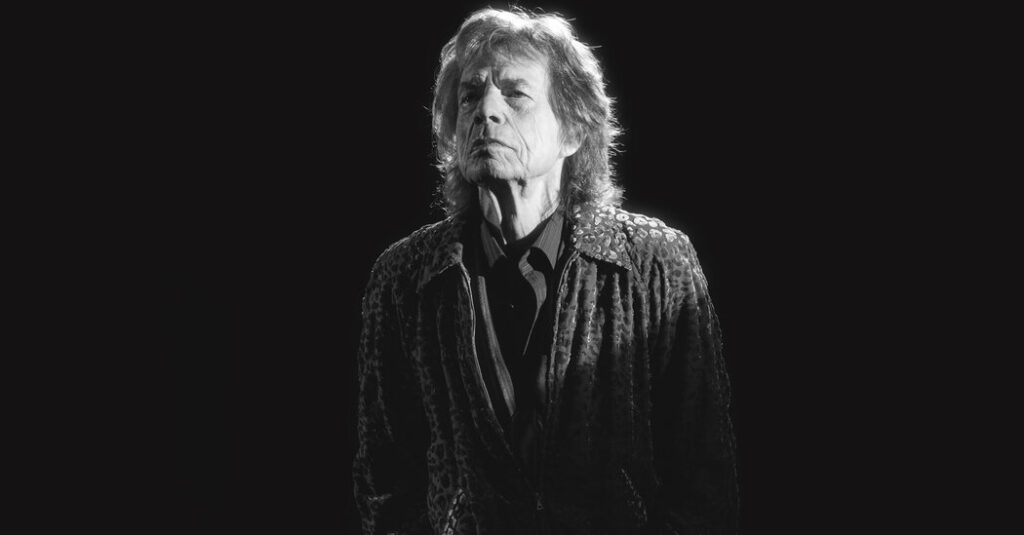
Perhaps you’ve heard of this week’s interview subject. His name is Mick Jagger, and he’s the frontman for a rock ’n’ roll combo that has been kicking around for a while called the Rolling Stones. The band’s 25th studio album, “Foreign Tongues,” was released on July 10.
OK, enough of that. The truth is I’m an enormous Stones fan. I’ve studied each of those 25 albums (1986’s “Dirty Work”? Underrated!), and all the live ones (“Brussels Affair” is secretly the best), and can honestly say I’ve heard all 400-plus songs the band has officially released — and plenty it hasn’t. (At the risk of getting in trouble, I’ll point you to the great “Blood Red Wine.”) I’ve also seen Mick, Keith, Ronnie and the gang — R.I.P. Charlie Watts — in concert a half-dozen or so times. In fact, theirs was the first rock show I ever went to, when they played Toronto on the Voodoo Lounge Tour in 1994. But despite my abiding fandom, one element of the band always remained a mystery to me: What is Mick Jagger really like?
Now, I won’t pretend that the way people behave in interviews is some perfectly pure reflection of their authentic selves, but from reading older pieces about him, my impression of Mick, who is 82, was that he was politely aloof and basically tight-lipped. The person I spoke to at a Manhattan hotel on a drizzly day in May, though, was much chattier and warmer — and more playful — than I expected.
Subscribe: Apple Podcasts | Spotify | YouTube | Amazon | iHeart
I have a bunch of questions about the new album, but I’d like to start with a question that comes from pure personal curiosity: One of my all-time favorite songs of yours is “Sway” from “Sticky Fingers,” and I’ve always wondered about the first line, which is “Did you ever wake up to find” —— “A day that broke up your mind, destroyed your notion of circular time?”
I have not done that. Have you? [Laughs] No, it’s a question.
Do you remember where that line came from? I just made it up at the spur of the moment. We were waiting for Keith to turn up to the session. He was late. Mick Taylor and I were there, and Charlie and Bill [Wyman], and I said, “Oh, let me try this.” I was just making it up as I went along. That’s why it’s a bit random.
It makes sense that waiting for Keith Richards would destroy your notion of circular time. So, some of the songs on the new album are relationship songs of regret or insecurity. It’s interesting to hear you singing those songs at your age. They land differently than if you were singing them at 42 or 32 years old. What are the ways that you can inhabit a song now that are different from how you used to? Well, first of all, I don’t think about it very much. Songwriting is about imagination. It’s not all based on true experiences.
But you’ve got to play the character of the song, right? But the character singing the song, it’s a different character from me. So when I’m singing “Mr. Charm,” it is obviously a joke character, and it’s supposed to be taken with a sense of humor. Some of the incidents in the verses did happen, and I can draw on my own experiences of talking to women in relationships. But the whole thing is not supposed to be taken seriously. You don’t really think you’re Mr. Charm. But then you might have another song which is more heartfelt.
Like “Back in Your Life.” Which is a bit more of a classic theme: You meet a woman, and then she never calls you back.
Has that happened to you a lot? Of course it’s happened to me. I’m not saying it happened yesterday.
I want to put the question in slightly different terms. There’s a movie performance of yours that I love, in “The Man From Elysian Fields.” You play a middle-aged man who runs an escort service. That performance has a lot of regret in it, and I assume that you wouldn’t have been able to give a performance like that earlier in your life. So, similarly, are there things that you can do in a song or did on the new album that make you think, Oh, I wasn’t capable of inhabiting that lyric earlier? That’s a good question. It requires a lot of thought to give a good answer. I wouldn’t have written any of these songs when I was 30, honestly. And I’ve also gotten into this habit of doing songs that are about personal relationships and then I throw a verse about politics in there. That’s a trick that I’ve learned from other songwriters, because nobody wants to hear a whole song about politics or social comment. A blues song like “Rough and Twisted,” you talk about women and everything, but then you throw in stuff that’s obviously political: “The only club was called conspiracy.” “What they wanted was tyranny.” So you find yourself using these tricks.
Have you ever seen the John Mulaney special where he talks about working with you on “Saturday Night Live”? No, I never saw that.
He has this bit where people would ask him, Is Mick Jagger nice? And he says, Of course Mick Jagger’s not nice, or he’s nice for the version of life that Mick Jagger has led. And he points out that when you play to stadiums of people screaming for you for 50-plus years, that’s got to change you as a person. Can you articulate how that’s changed you? Obviously, it’s not normal. It is not like most people’s lives. It does affect you. You can become disassociated.
From other people? From other people. A lot of people in show business only hang around with people in show business, because they’ve got something in common, they can relate to each other, and you get disassociated from what people might call “real life.”
Have you? Oh, yeah, definitely. I mean, you do fight against it. It’s a conscious effort.
How do you fight against it? It’s quite easy, really. You go out and walk on the street on your own and do normal things, go and buy The New York Times. But, nevertheless, that’s only temporary because psychologically your actual state of mind is permanently damaged. Your late 20s and early 30s is a very tough time for people in this business because it’s a big ego trip, and you have to have a huge ego to do this. People that do this that don’t have huge egos have huge problems because they have to manufacture a completely different [personality]. I have a friend whose standing joke is that I behave at a dinner party like I behave onstage.
Is that friend right? It’s absurd what you do onstage. Of course I’m not really like my stage persona. Jimmy Fallon thinks he’s doing me, but it’s such an exaggerated version of me. This overbearing, shouting, ego-tripping person — you’re not really like that. But when you’re in your late 20s and early 30s, you can be like that all the time. And there are people in show business that never switch off. A lot of them are comedians, and sometimes they can’t stop making jokes or they get depressed. That’s a bit of a sweeping statement.
Did you have to learn to switch off? Yeah, I think it comes with age. You’ve heard all these stories about method actors. They take it to the absolute extreme, so they’re like the character all the time, and then after the movie’s over, they’re still in character. It takes a long time to slough off the character. So which character do you go back to? Is he always going to carry some of that character in his “true” character, whatever that is? This is the show business dichotomy and it’s something you learn to live with, and you always hope that you’re a so-called normal person underneath.
It’s nice to have the perks, though! But it’s not about the perks. It’s about being these several characters. You’re the character that plays the theater, you’re the character who does the interview, you’re the character in the stadium, you’re the character in the recording studio, you’re the character writing the song.
Do you ever let the world see the person underneath the characters? I’m not sure. Probably? Songs are pretty direct as a method of communication compared to a movie, where you’ve got someone writing a script and it’s all edited, chopped up in bits. Records are relatively simple compared to that.
There are a handful of political lines sprinkled throughout the new record. You sing about scuttling billionaires “scrambling to their bolt-holes in the sky,” about dirty rat autocrats and rubber-stamping judges. I find it heartening to know that Mick Jagger sees the same problems as the rest of us. Can you tell me more about what you’re seeing when you look around the world? It’s not the first time I’ve done songs with social comment. I like doing it, but in small doses. It’s pop music, you know. “Ringing Hollow” is completely social comment. But even then, I had two songs that were on the same subject, which is my love of America.
And what has gone wrong. That song is a lament about the state of the country. It’s a lament, but it’s a love song about my own experiences in America, which are long and varied and encompass lots of different places, not just New York and living on the Upper West Side. I’ve spent a lot of time in America in places that Americans have never ever been. I spend a lot of time in these weird places. On tour, you see everything. How many people from New York really go to Cleveland very often? And then you’re there for five days. It’s not very long, but you can see quite a lot. New Orleans — I know people go to New Orleans and it’s a tourist place, but it’s a unique town in the United States, not like any other town. So you explore these places and you have a love of the country. I had another song, but the other song was too down and I rejected it and worked on “Ringing Hollow” instead. It’s really a love song to Americans: I fell madly in love with you before we ever met, like a lot of European teenagers. So it was all about that, and then it goes into the America of now and how can we ascertain what’s going on.
I want to ask about how you understand your relationship with your audience. First let me give two examples: On one pole, we have somebody like Bob Dylan. If you go see him live, it almost feels like the crowd is incidental. He’s going to be doing whatever he’s doing, whether or not people show up. On the other end, you have somebody like Bruce Springsteen, who clearly sees his job as engaging in a meaningful back-and-forth with his audience. What does your relationship to the audience mean to you? What do all those people out there represent? It depends where you are and what kind of event it is. At the New Orleans Jazz Festival, they didn’t come to see you. Glastonbury — you buy these tickets because you like that festival. So they’re not your biggest fans, necessarily. I’m not saying that they hate you, otherwise they probably wouldn’t be there, but you have to treat them in a slightly different way. My job in the live music world is for those people that come to have the best time they possibly can and for two hours to forget all their problems and the problems of the world and their mortgages. I know you’re still on the phone like, “Oh, little Danny hurt his tooth.” In the old days, you never had that, really. But my job is to make them have the best time possible. They’re going completely ape-[expletive]. Your job is to make them more ape-[expletive].
I want to dig a little deeper. You’re talking about what your job is, but my question is about what meaning the job has. For example, I have a job that has a basic description, but when it’s working best, it allows me to satisfy curiosity I have about the world, ask questions of people that I would never get a chance to ask, and learn things that are valuable to me as a person. What’s Mick Jagger’s version of that? Am I being naïve to think that there is one? I have thought about this. At the beginning of my career, I didn’t think about it at all. I was just learning how to do it. What’s the next number and is the band going to play it right? Am I going to remember the words? Just getting the basics down. But what you’re saying is, when I get out there, what does it all mean? It’s a lot of joy for me. It’s a huge adrenaline buzz, which must be the same as for a sport, except I don’t have anyone coming at me. Your job is to control that adrenaline buzz, and while you’re doing that, you’re evaluating the audience. How are they feeling? Is it cold? Is it raining? Have they waited too long? Have they had a hard time getting in? A lot of them are a very long way away, because mostly I play stadiums. If you’re playing a theater, you don’t have these problems. You can very quickly become a group. When I was starting out, people would show me how to do that. I toured for a long time with Little Richard. I had no idea that people could do what he did. Performers didn’t do that. They just went out and played their songs and said hello, and that was it. He was embracing them all, getting them all to go along with his version of the world, stand up, sit down, make jokes. So for a small time, it becomes this community. It’s much more difficult to do that in a stadium. You still have to do it. So that’s why stages have to be big. That’s why you have to get down there and pay attention to all these people. You have to talk to them. I mean, I’m not completely answering your question, but that’s a lot of what I do.
You know, I’ve read a huge amount of interviews, and one thing that I’ve noticed is that you almost never tell stories about being in the Rolling Stones. I’m not asking you to be nostalgic or share some intimate details, but there’s got to be some old chestnut that you break out at cocktail parties or when your kids ask something like “What was it like being on tour with Stevie Wonder in 1972?” You mentioned Stevie Wonder. We were playing at Madison Square Garden with Stevie Wonder. We said come up and we’ll play a mash-up of “Satisfaction” and “Uptight,” because they’re both the same beat. And then someone — I can’t remember whose idea this was, it might have been mine — decides that we’re going to throw custard pies at the end, because it’s the last number of the show of the last day of the tour. It’s rather unfair for Stevie. So everyone’s throwing custard pie, including Stevie, and everyone ends up covered in custard pies. I loved it.
So I was just watching clips of you on YouTube, and there’s a great one of you at a keyboard trying to work through “Shine a Light.” You’re playing those gospel chords, and to paraphrase the song, there’s a little gleam right in your eye, and it feels like the apparatus of fame and a crowd has fallen away and it’s just a musician playing music and loving it. It’s very pure and sweet. Can you share a moment or a memory of when you were playing music and the machinery around the Rolling Stones fell away and you felt that love and freedom in playing a tune? What you’re describing really is when you’re writing. You’re not thinking about going onstage or anything. That’s how songs get made, when you’re not thinking about anything else. While your mind is free and you’re having fun with it, that’s the most interesting part of the process — and having fun is not like drinking and shouting and jumping up and down, but your mind is not really being serious. It’s playful. “Playful” is a better word than “fun.” You can let your mind go this way, that way, and don’t be worried if nothing happens. Something will happen.
I was watching the video for the new song “In the Stars,” which uses de-aging technology on the band. I thought de-aging was an interesting choice because one of the life-affirming things about the Rolling Stones is that you’ve been defiant in terms of what aging means. You’re still out there doing it. An opposite view is that you guys all have Peter Pan complexes or something. But I want to know what you find interesting or hard to reckon with in terms of aging. What’s good about getting older, physically or metaphysically? There’s nothing good about it.
Nothing? Wisdom? I forgot all my wisdom. I might have had a couple of pearls drop, but I’ve already forgotten what they are. [Laughs] So no, it’s not particularly pleasant. You can’t do things as quickly as you want to. Physically you’ve got to be more careful. You know, when you’re playing football, they put you in goal a lot. I’m not very good at it!
That’s a metaphor for aging. Yeah, you get put in goal!
I have another philosophical question. This one is about sex. You’ve publicly been identified with sex for a long time. You write songs that are heavily sexual. You’re an avatar of sexiness. You have a reputation as a libertine. How has your thinking about sex changed over time? Because it changes for everyone, so how has it changed for you? It’s a very good question. People always say that when they’re thinking, What the [expletive] am I going to say? If we sat down and we weren’t recording this and we weren’t doing an interview, we could talk. You’d tell me how it worked for you. We could compare experiences.
Could we? Yeah, probably, because that’s how you get insights. The only thing I will say is that throughout your life, your attitude to sex changes and your sexual tastes change. Sex is not a fixed point. Obviously, everybody’s different. This is not my area of expertise. We’re into areas of human psychology, sexual drive, pop psychology, but my observation is that your attitudes to sex are different in different parts of your life. Your sexual orientation may change. It may change completely, or avenues might open up to you that you hadn’t realized, or you might close avenues that have opened up because you don’t like them. It’s like other tastes, like taste in art. When you’re very young, you might like these kinds of pictures. Then when you’re a bit older, you might change your taste. But why has your taste changed? Is it because of knowledge? Is it because you’re bored with it? Or is it a combination of all these things? It’s like when we’re teenagers — we like rock music, but other, more snobbish people say: “You should listen to jazz. It’s more intellectual.” But do I really like that, or do I like Chuck Berry? You know what I mean? I used to go and see the Modern Jazz Quartet in concert. Everyone’s sitting down, very seriously listening to it. No one was standing up.
I asked you about sex and we ended up at the Modern Jazz Quartet. [Laughs] How did I get out of that question?
I want to know about how you see your musical evolution. I think it’s fair to say that the magical period between 1968 and 1972 is when expectations for what a Rolling Stones album sounds like got solidified. When people say the new album sounds like a Stones album, they mean it has the signifiers of the classic Stones album. I know there’s been experimenting over the years, but I think it’s true that there is a Rolling Stones sound. I can argue against that in a way, if I want to.
What argument would you make? I’m going to tell you, Mick Jagger, that you’re wrong. I mean, if we’re talking about musicality, then you’re absolutely right. But I could point to lots of other things. I’m not a huge student of the Rolling Stones oeuvre. Haven’t got it all at my fingertip. But I could point to songs like “Lady Jane,” “As Tears Go By,” “Angie.” I could point to “Paint It Black.” Even “Under My Thumb,” which someone played to me the other day. Vocally it’s very me, but instrumentally the way it’s played is so light. So there are other versions of the band. And that’s what I think makes the band interesting.
With the exception of “Angie,” those songs all came before that period I suggested. But even after that period I can point out other ones. It’s just that I don’t remember them as well. There’s lots of others. “Waiting on a Friend” is a kind of rumba, and very light with an alto saxophone lead. It is not really what you would expect.
But are there styles of music that you wanted to do or dream projects that you had that, because of audience expectations or what you thought the band would be interested in, you didn’t pursue? Yeah, but you can pursue them. You don’t do a whole album of them. I like samba music, so I did “Sympathy for the Devil.” I listen to samba all the time, but no one’s interested in me doing a samba record. I love Latin music of all kinds. There’s so many different rhythms and, yeah, I would like to pursue that and maybe I could have or should have because I’m really interested in those rhythms. If you’re in a rock band, you touch on them, but you don’t get to fully explore them.
You’ve given your creative life to rock music. But in 2026, the biggest rock concert draws are Gen X bands and baby boomer bands. I’ve seen data that suggests that catalog music, older music, has more streaming market share than younger music, and that things are continuing to trend that way. If you think about the buzziest younger rock band of today, which is a band like Geese, even that feels culturally marginal. What do you mean “culturally marginal”?
Not in the center of the culture. Everyone was talking about this band, and when I played them, I thought it was going to be more like an indie band, but it was much more experimental, which I thought was great. It’s very hard for a band as experimental as that to be in the center of mainstream music. Maybe in 1970, but now, I wouldn’t have thought so.
But do you have thoughts about the vitality of rock music as a whole, or its place in the culture now, given that the most popular exponents tend to be older artists? Despite the fact that rock music as a genre is not really the mainstream center of music, it still has a lot of supporters, lots of young teenage people that want to play it, and you hope that it evolves. Rap was the center of our music 20 years ago, and now rap is not the force it once was, but everyone incorporates it into everything. It’s one of the strands of popular music. All these strands in popular music, it’s really rather artificial a lot of times. When you have to market things, you want to tell people what they are: This is mint-flavored, I’m selling mint-flavored products. It’s a bit like that in music so that people know what they’re getting, so you don’t scare them. We’ve cut up all our genres in little slices, but the reality is that most musicians appreciate all kinds of music. What I’m saying is that a lot of music has a lot of history, and intelligent people shouldn’t be slicing it into little bits and saying, “I only like this bit.” It doesn’t mean anything. What’s folk music? All these invented things.
Right, they’re arbitrary distinctions. They are.
I saw a quote from Keith Richards the other day saying that the band is probably not going to be able to do long tours anymore, but there are hopes to do residencies. You must have some doubt about whether or not the Rolling Stones will ever go on a big tour again. I have doubts about it when I hear that! I don’t mind touring at all. If you can’t go anywhere, then you have to do residencies.
But do you think the Stones will do another world-spanning tour? I hope so. I’m up for doing it.
Will you know when you’ve walked offstage with the Rolling Stones for the last time? No. Maybe I have! I could get run over by a bus outside of my house. You never really know, do you? You don’t know what’s going to happen to you in life. But I personally hope to be able to tour. I like going places. I like meeting people. I like to go to weird countries to do shows. I did a show in Indonesia once on my own, which was so crazy. It was so hot. It was unbelievable. I was out there and it was daytime, there weren’t any lights, and I thought, What am I going to wear?
Can I ask you a completely tangential question? I could not find any record of you commenting on singing backing vocals on Carly Simon’s “You’re So Vain.” When did you realize that some people thought the song was about you? Why would it be about me when I’m singing on it? It doesn’t make sense, but people think that’s what it was. That was a big thing, because she would never reveal who it was about.
And then she did. I never thought to ask — it was just a song! I’m just the backing vocalist. I knew the producer, Richard Perry, who phoned me up and said, Can you do the backing vocals? I thought it was a great song. It was a big hit for her and I was never credited with a feature. These days, it would be “Carly Simon featuring Mick Jagger.” I’m louder than her on some of it.
Well, thank you for clearing that up. We’ve now added to the sum total of Rolling Stones history. While we’re talking about clearing things up: The record’s been reviewed, and I’ve gotten lots of nice reviews. I’m really appreciative.
But something’s nagging at you? It’s not nagging, but people hear one word and they don’t really listen to the line. So it’s like, Mick Jagger has a go at Elon Musk. Well, you’re not listening to the line. You’re only listening to “Musk.” Musk — he must be having a go at him. I mean, I do call him “mad.”
And he’s the one person you name on the whole album. Yeah, the funny thing is when I wrote that, I was thinking that because of him, they were able to get those astronauts that were stuck back, because he provided the transportation. So that line of the song is about when I was a kid, we used to want to go to Mars, and then I said, Who would you trust to get you into space? Would you trust Boeing or was it NASA or was it mad mogul Mr. Musk? So it’s really a sidewinding compliment, because he was the one that was able to do that when the others couldn’t.
Well, that’s what you get for using the adjective “mad.” And “mogul.” “Mogul” doesn’t always go down well either.
My favorite Rolling Stones song, which I think is also the best Rolling Stones song, is “You Can’t Always Get What You Want.” It’s a simple sentiment, but there’s something profound in the chorus, which is “You can’t always get what you want, but if you try sometimes, you just might find you get what you need.” What’s the last thing that you really tried to get, that you wanted to get, that you couldn’t? Oh, my god! A song analysis that leads to a personal wish? I can’t recall one that stands out, honestly.
That’s a good life, my friend! I’m sorry, obviously everyone has frustrations. I was very frustrated professionally for years that the Rolling Stones never made any new music. That was a huge frustration for me, and I solved it.
There’s another old clip I saw of you from a press conference. Really old one, because we haven’t had press conferences for hundreds of years.
I think it’s connected to a Madison Square Garden concert in the ’60s. Someone asks you a question like, How do you think about being in the Rolling Stones? And you describe the Rolling Stones as “financially dissatisfied, sexually satisfied, philosophically trying.” That’s just a pat answer to a news conference in New York where people used to throw you really dumb questions.
So don’t give me the pat answer. Where do you stand with those things? My interest in philosophy is superficial. I find it a really hard subject. I need a teacher. I can’t just do it from reading. When I was in college, I did some philosophy courses. That’s hundreds of years ago. In “Jealous Lover,” there’s a Plato reference.
Shadows on the wall? Yes, you got it! Well done. But I find it a hard subject to educate myself into. I’ve recently read a couple of books, and I’m really finding it hard. They’re always having so many arguments, these philosophers, and always disagreeing with their masters. I was reading this book on Kant. They’re quite rude to each other and then they have to make up later, and I can’t understand what they’re really talking about. Was Kant a Christian? Was he an atheist?
I think it’s cool that you’re reading Kant. Well, it’s all vaguely fashionable.
So philosophically, you’re still trying? I’m sticking with that. I’m sticking with that 1965 quote.
Mick, it’s been a gas, gas, gas. Oh, no, David! That’s awful! [Laughs] Thank you so much.
This interview has been edited and condensed from two conversations. Listen to and follow “The Interview” on Apple Podcasts, Spotify, YouTube, iHeartRadio or Amazon Music. Follow us on Instagram and TikTok.
Director of photography (video): Tre Cassetta
The post Mick Jagger Knows He May Have Played His Last Rolling Stones Show appeared first on New York Times.