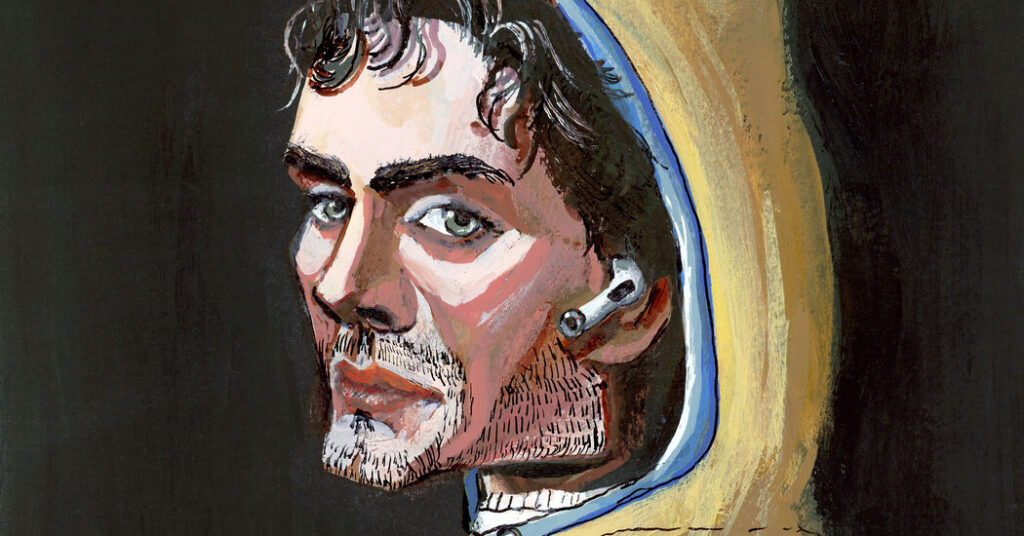
Until recently, cosmetic enhancement was the province of women, while men mostly stayed out of the medspa. The power move for men was flaunting girlfriends with $150,000 face-lifts, not getting work done themselves. But now, the cheek-plumped and chin-sculpted look of Silicon Valley executives and 20-something male influencers alike point to a change: Men are starting to want shiny new faces of their own.
While men still make up only a small portion of cosmetic surgery patients, procedures on men globally are increasing at more than three times the rate for women. Why? Plastic surgeons point to the ubiquity of Zoom and Instagram, and this certainly appears to be part of it. Christia Spears Brown, a psychology professor at the University of Kentucky, explained things this way to STAT News: “With the rise in social media and seeing images that are curated and perfect, men are now living in the same world women have been living in where you’re expected to have perfection.”
Where is this expectation for perfection coming from, though? The tremendously influential online ecosystem known as the manosphere has an accusatory response: Men in these spaces often complain that women have been empowered by dating apps to reject all but the most attractive among them, and the average man therefore needs surgical intervention to stand out. A sociological review of incel forums noted this representative comment: “There are actually high beauty standards for men, and women choose to just go on Tinder” because “they don’t want an average- or below-average-looking guy.”
The way these men see it, picky women are to blame for their masculine anxieties. But a closer look suggests that the social pressure for men to look a certain way is coming primarily from other men.
A 2024 survey of men’s motivations for going under the knife provides useful insight here. The study, which looked at adult men in German-speaking parts of Europe, found a clear overlap between men who had surgery and men who held a traditional view of masculinity. Traditional masculinity was defined by several traits including competitiveness and dominance, having a playboy lifestyle, and pursuing power over others. Men who were highly invested in traditional masculine norms were about twice as likely to get cosmetic surgery, and almost four times as likely to have a hair transplant.
The researchers concluded, “Men increasingly use cosmetic surgery as a means to assert power, success, dominance and sexual success.” No man in the study said he got cosmetic surgery in order to please a partner, they added. Rather, it seemed that cosmetic surgery was a way to increase masculine status.
There have always been men who cared about how they looked — remember metrosexuals? — but grooming used to be more associated with women and gay men. A generation ago, the typical straight man projected indifference about his appearance. He did not buy moisturizer, much less go in for wrinkle treatment. He didn’t need to. How he looked was rarely the deciding factor in achieving power, wealth or even sexual success. Now a straight man’s appearance seems to be an increasingly important expression of his masculinity. One way of explaining this cultural shift is through a familiar feminist idea: the male gaze. I suggest the male gaze, long trained on women, is turning on straight men too.
The male gaze, a concept popularized by the feminist film critic Laura Mulvey, describes the way a woman’s body becomes an object for male consumption, transformed into a collection of body parts to be scrutinized. Women often internalize the male gaze by learning to objectify their own bodies. They perform beauty for other women as well as men, of course. But within a patriarchal system, the men in power are the ultimate arbiters of female beauty standards.
Under the male gaze, men’s faces have become a new playing ground for a familiar sport. The feminist philosopher Marilyn Frye proposed this dynamic long ago in her book “The Politics of Reality”: “All or almost all of that which pertains to love, most straight men reserve exclusively for other men. The people whom they admire, respect, adore, revere, honor, whom they imitate, idolize and form profound attachments to,” she wrote, are, “overwhelmingly, other men.”
Dr. Frye’s insight is not just about who straight men like and love and bond with. It is about whose approval they crave: men’s. There’s a revealing moment in a New York Times interview with the notoriously looks-obsessed influencer Braden Peters, also known as Clavicular, in which he says that knowing he could have sex with a woman might be better than actually having sex, which he describes as a time-suck that “is going to gain me nothing.” I suspect that what he’s really after is access to women — the part he can show off to other men.
Another thing he shows off is his face. Mr. Peters is a standard-bearer for looksmaxxing, an online community made up mostly of young men in which users upload photos of themselves to forums so that other young men can scrutinize and rate their facial features according to a pseudoscientific numerical system called the PSL scale. (“PSL” is taken from the names of three incel forums where looksmaxxing originated.) Once rated by their peers, men can learn to improve their assigned value by watching videos demonstrating supposedly jaw-enhancing tongue exercises or by going to a clinic to remove buccal fat.
Looksmaxxing is very obviously a culture created by men for other men, in which men congregate to compare themselves against a standard of masculine beauty codified by male influencers. As in all online communities, it is hard to separate performance from sincerity. But behind language like “mogging” and dubious practices like “bone smashing” is the real anxiety of boys who are insecure about the width of their shoulders or the prominence of their jawlines.
In an interview with an Australian broadcaster, Jarryd, a 16-year-old in Australia, described how the boys at his school put pressure on each other to build a specific kind of physique: “Women have had that pressure for longer, and it’s always kind of been, girls should be slim. But I feel like now there’s a lot of gym bros,” he said. “If you’re not the strongest guy, if you can’t lift this much, you’re inferior, you’re weak.”
Though the manosphere blames imperious women for their woes, that judgment is largely coming from inside the house. Women’s tastes in men are wildly variable, to be sure, but many prefer a warm smile to bulging muscles and a snatched face. Men who pour money, time and effort into achieving a looksmaxxer’s aesthetic for the sake of attracting women may be in for disappointment. One satirical TikTok video captures the irony of straight men honing their physiques in the gym to snag dates — only to find that their DMs are filled with a chorus of male followers.
It is not easy to escape from under the male gaze. For boys and men, maybe this hard-won feminist tenet can help: You do not have to look a certain way in order to have value.
Kate Manne, a moral, social and feminist philosopher at Cornell University, is the author of “Unshrinking,” “Entitled” and “Down Girl” and writes the newsletter More to Hate.
The Times is committed to publishing a diversity of letters to the editor. We’d like to hear what you think about this or any of our articles. Here are some tips. And here’s our email: [email protected].
Follow the New York Times Opinion section on Facebook, Instagram, TikTok, Bluesky, WhatsApp and Threads.
The post Looksmaxxers Actually Don’t Care What Women Think appeared first on New York Times.