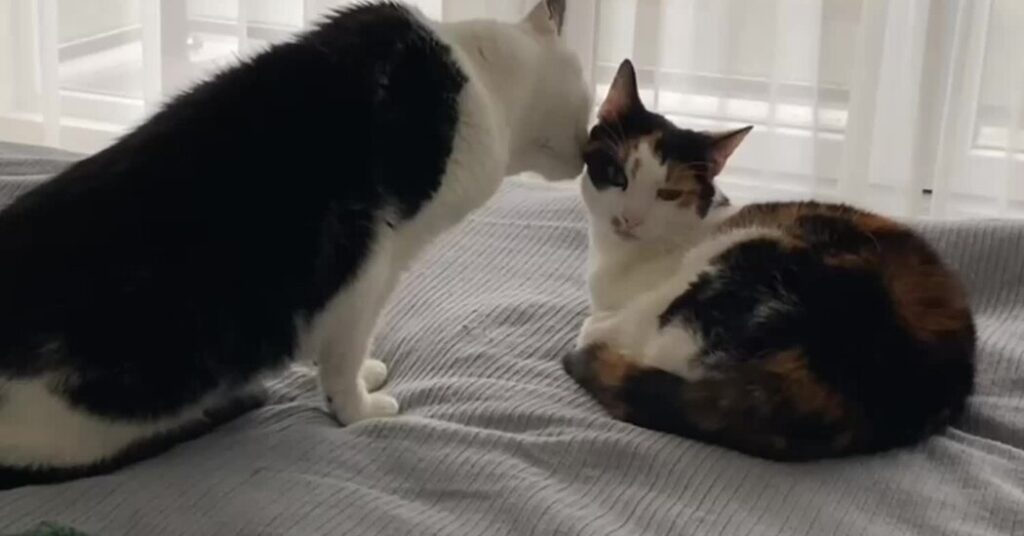
Let’s just say cats have a reputation — of being standoffish, manipulative, maybe even jerks. Here’s more corroborating evidence: Scientists are beginning to think that even seemingly innocent cat behavior — grooming another cat — might not always be nice.
The licking can be a method of subtle torment, according to new research published in the journal Applied Animal Behavior Science.
Mutual grooming, called allogrooming, is widespread in the animal kingdom and found in primates, birds, horses and even insects. The grooming is typically focused on parts of the body that are difficult for an animal to reach on its own, like its back and neck, making the behavior an act of kindness that supports social bonding and wins friends.
Like primates that pick lice from each other’s backs, cats that lick each other have also been considered an indicator of social bonding. “So far, mutual grooming in cats has been categorized as affiliative, or ‘friendly,’ cat behavior,” said Noema Gajdos Kmecova, a cat behavioral scientist at Ghent University and an author of the new study.
Or so we thought.
Morgane Van Belle, another cat behavioral scientist at Ghent University and the study’s lead author, was observing her own cats, Fabio and Giovanni, interacting over a favorite napping spot in the sun and noticed something.
“I saw these weird grooming patterns in my own cats where I thought, This is not super friendly at all,” she said. “Sometimes one cat would lay on the blanket near the window and the other cat would come up and start licking it — but in an annoying way.” The interaction would induce the licked cat to get up and forfeit the sunny spot, she said.
To check whether this behavior was more widespread, Ms. Van Belle and her colleagues looked at 53 households across Europe with two or more cats. After telling the pet owners what to look for, the researchers had them submit videos of their cats’ interactions. The scientists then randomly selected a submission from each participant and used statistical analyses to tease apart the hidden nuance in cat-licking behavior.
“It became immediately clear from the analysis that mutual grooming does not mean the same thing in all contexts,” Ms. Van Belle said.
The results revealed two things. The first was consistent with typical grooming behavior: The cats licked each other on the head, neck or ears. In these videos, the cats were much more likely to mimic each other’s body postures, either cuddling together or sitting next to one another before and after the grooming. The licks were clearly friendly gestures.
The other side of the cat-licking coin revealed something more in line with bullying. A subset of the videos showed that licking often preceded conflict. These interactions were defined by differing body postures, where one cat might stand and lick the other sitting cat. The aggressive licks were followed by signs of stress in the licked cat, including staring, yowling, rotating the ears, licking the lips or swiping at the other cat. The results were inconsistent with the prior conception of cat allogrooming.
“Based on our findings, allogrooming is associated with at least two contexts — not only social bonding, but also social tension,” Ms. Kmecova said.
The researchers suggest that unwanted licks might be an easy way to jab at another cat without getting into a fight. While a full scuffle could result in injury, a precisely placed irritating lick might be a safer way to tell your furry “friend” to get lost.
“I am always excited to see empirical work that increases our understanding of the social dynamics of cats,” said Ashley Elzerman, a veterinary behaviorist who was not involved with the study, “especially in multicat households where subtle, chronic tension can be hard for owners to identify.”
The research offers a new dynamic for veterinarians and cat owners to try to better grasp cats’ behaviors and to pinpoint potential signs of frustration in their households. Future research might also help pet adoption centers and pet owners seeking more than one cat to better match their feline cohabitants. Whether cats will go along with it is another story.
The post Your Cat Is Being Nice? Think Again. appeared first on New York Times.