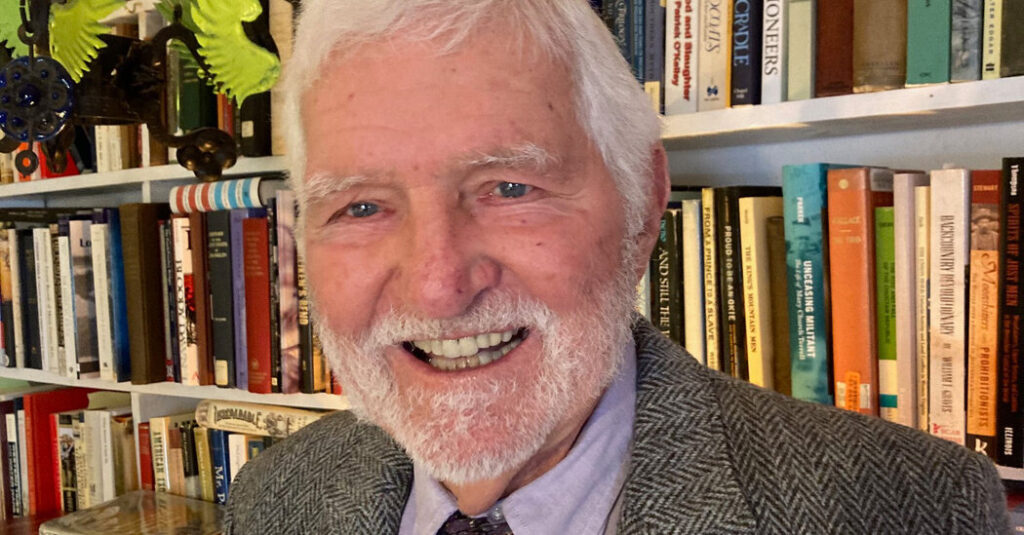
Hershel Parker, a onetime railroad telegrapher who became a towering figure in Herman Melville scholarship, writing a two-volume biography so exhaustively detailed that his long quest to fathom the author of “Moby-Dick” bordered on the Ahab-like, died on June 19 at his home in Morro Bay, Calif. He was 90.
His wife, Heddy-Ann Richter, confirmed the death.
Mr. Parker’s dogged, nearly lifelong devotion to Melville was deep and consuming.
“He was fanatical about his approach to scholarship and infatuated with Melville,” said Anne Gendler, the managing editor of Northwestern University Press, the publisher of the definitive Northwestern-Newberry edition of the writer’s novels, nonfiction, poems and correspondence, a 15-volume project released from 1968 to 2017.
Mr. Parker was an associate general editor for 13 of the volumes and general editor for the final two, taking over from Harrison Hayford, whose graduate seminar at Northwestern in 1960 had inspired him to become a Melvillean.
But Mr. Parker’s magnum opus was his Melville biography. When the first volume came out in 1996, William Cain wrote in The Boston Globe that “every page of this new book attests that Parker is a consummate professional who has hunted down every scrap of evidence and inspected each item rigorously.”
That 941-page first installment of “Herman Melville: A Biography” followed Melville from his birth in 1819 to the publication of “Moby-Dick” in 1851. In a scene that Mr. Parker based on an eyewitness account that he uncovered in an obscure Vermont newspaper, Melville gave the novel to his friend Nathaniel Hawthorne during dinner at a hotel in Lenox, Mass.
“At some well-chosen moment,” Mr. Parker wrote, “Melville took out the book whose publication they had both been awaiting and handed his friend an inscribed copy of ‘Moby-Dick,’ the first presentation copy.”
In The New York Times Book Review, Paul Berman called it “a vivid scene, carefully, even beautifully, imagined by the biographer.”
But Mr. Parker’s “fanaticism for exactitude,” Mr. Berman added, “is such that he gives us not just the tiniest details but the details about the details.”
In The Globe, Mr. Cain wrote that the book lacked “the exaltation and passion that an engagement with Melville’s art would have given it.”
The volume was a New York Times best seller and a finalist for the Pulitzer Prize in biography in 1997.
Mr. Parker could be prickly. “I have the warmest regard for him,” Mary K. Bercaw Edwards, a professor of English at the University of Connecticut, said in an interview. “But he was controversial. He’d have spats with other scholars. Hershel would think they hadn’t done enough research. Nobody could have done as much as he did.”
In 1996, before the first volume of his biography came out, Mr. Parker delivered an angry speech at an event in Manhattan. He took issue with revisionist readings of Melville’s art and life in a recent issue of the journal American Literature, including an article by the scholar Elizabeth Renker that suggested that Melville had abused his wife.
“They wanted to stop the biography because it’s about a dead white male,” Mr. Parker told the audience, according to The New York Times Magazine. “It was a pre-emptive strike to silence me before I come out with it, just because of the mere fact that I celebrate and magnify Melville and regard him as great. For that, obviously, I should be shot.”
In an interview, Ms. Renker, a professor of English at the Ohio State University, said that Mr. Parker “was shaped by a particular devotion to Melville. He is a hero to him. He was threatened by the idea that he would be cast in a different light than that of a hero.”
Mr. Parker had told The Chronicle of Higher Education in 1994 that the biography would discuss Melville’s abuse of his wife and daughters. But, he added, it was painful for him to acknowledge it.
“Once you say ‘wife beating,’ you can never kill that,” he said. “It will become received fact in American criticism.”
Hershel Parker was born on Nov. 26, 1935, in Comanche, Okla., the fourth of five children of Lloyd and Martha (Costner) Parker, who were farmers. They were poor, itinerant and sometimes homeless as they moved between Oklahoma, Texas and Oregon. One winter, the family lived in a tent.
“I was an Okie — not Scottish or English or some European nationality, but a person with no fixed abode, no helpful connections, no healthful diet and a tenuous job,” he wrote in “An Okie’s Racial Reckonings” (2024), a genealogical foray into his ancestors’ encounters with race. One cousin was a politician who in the 1870s argued successfully in the North Carolina legislature that Ku Klux Klan members should be extended amnesty for their crimes.
Hershel dropped out of high school to work as a railroad telegrapher, from 1952 to 1959. As a depot agent in Singer, La., he shut down the “colored” ticket window to force everyone to use the same window, his wife said.
In 1956, while recovering from tuberculosis, he immersed himself in Shakespeare. The next year, he read all of “Moby-Dick” during 11 afternoons in bed, while “writing wonder-struck comments on notecards, hardly believing what I was reading,” he recalled in “Melville Biography: An Inside Narrative” (2012).
He had taken college correspondence courses before graduating from Lamar State College of Technology (now Lamar University) in Beaumont, Texas, with a bachelor’s degree in English in 1959. At Northwestern, he earned a master’s degree in 1960 and a Ph.D. in 1963, both in English.
Mr. Parker’s published books about Melville began with his collaboration with Mr. Hayford on the Norton Critical Edition of “Moby-Dick,” out in 1967, and on “Moby-Dick as Doubloon,” a 1970 collection of reviews and essays.
He taught English at the University of Illinois Urbana-Champaign, Northwestern, the University of Southern California and, from 1979 until his retirement in 1998, the University of Delaware.
In 2002, Mr. Parker published the second, 997-page volume of his Melville biography, describing the aftermath of the publication of “Moby-Dick,” which received poor reviews; the writing of other works, including “Bartleby, the Scrivener” and “Pierre; or, The Ambiguities”; and his time as a customs inspector. Melville died, broadly unappreciated, in 1891.
In The Times Book Review, Richard H. Brodhead lauded Mr. Parker’s thoroughness — calling it “scarcely to be believed” — as well as the “lovingly particularized” portraits of Melville’s family members.
In addition to Ms. Richter, he is survived by two daughters, Alison and Sabrina Parker, from his marriage to Joanne Johnson, which ended in divorce; and four grandchildren.
Little of Melville’s literary output escaped Mr. Parker’s scholarship. He also published “Melville: The Making of the Poet” in 2007 and edited a 2019 edition of the poetry for the Library of America.
Melville was not a great poet, Mr. Parker conceded, but he was determined to make a case for the importance of poetry to Melville. The topic was one that Mr. Parker embraced, he said, because it had been largely unexplored.
“I set myself to chart the terrain,” he wrote in “The Making of the Poet,” “not to hold a pointer to its various beauties.”
The post Hershel Parker, Melville Scholar of Ahab-Like Obsessiveness, Dies at 90 appeared first on New York Times.