Iran is grappling with a devastated economy, a restive population and the ever-present threat of a return to all-out war. And yet, there is a looming absence at the top of the government, with Iranians still waiting to see or hear directly from their supreme leader.
Ayatollah Mojtaba Khamenei was appointed to the role in March, days after U.S.-Israeli strikes at the outset of the war killed his father and predecessor, Ayatollah Ali Khamenei, but he hasn’t been seen in public since. That has led some to wonder not only about the health of Mojtaba Khamenei, who was injured in the attack, but also whether he is really running Iran at this pivotal moment for the country.
He has offered no clear public guidance on a clash between the hard-liners who oppose any diplomacy with the United States, and the pragmatists, including Iran’s president and foreign minister, who agreed to a preliminary cease-fire deal with the United States last month.
Such fissures, while nothing new within the country’s fractured political class, are all the more urgent as Iran and the United States trade attacks and diplomacy efforts falter. They spilled into the open this week when Iran’s president, Masoud Pezeshkian, and foreign minister, Abbas Araghchi, appeared to be jeered and harassed during the elder Ayatollah Khamenei’s funeral procession.
The supreme leader is entrusted with commanding Iran’s military; deciding the head of the judiciary and various key positions; declaring war and peace; and other critical leadership functions. In Iran’s blended system of theocratic and republican elements, it is the office that holds ultimate primacy.
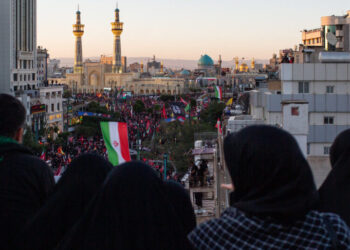
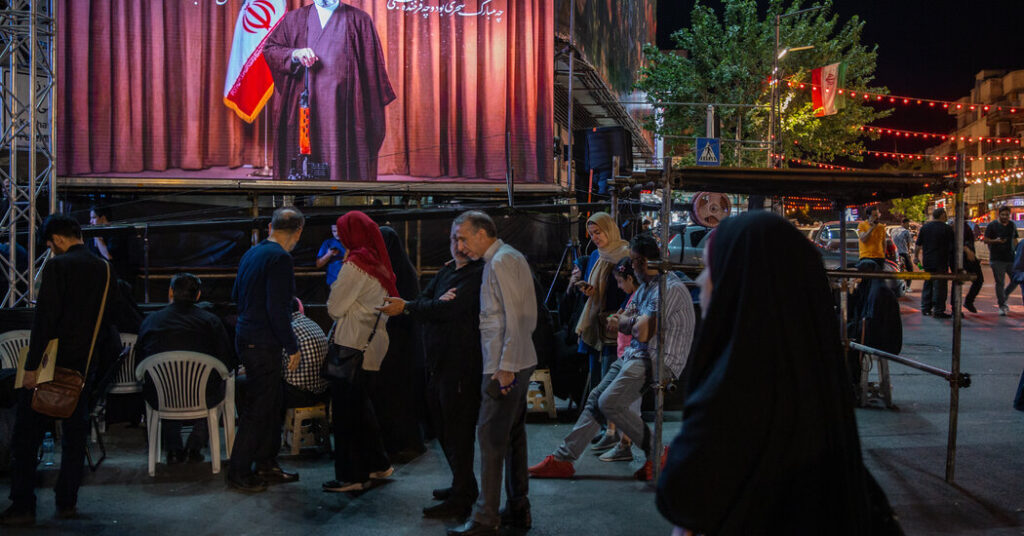
There was some expectation that Iran and the world would get their first glimpse of the new Ayatollah Khamenei this week, during his father’s funeral. But, on Thursday, the ceremonies concluded without an appearance.
Without a strong central authority like the elder Ayatollah Khamenei, it has become even more unpredictable which faction will eventually gain the upper hand — and how the country will navigate its many crises.
Inherent in the peace talks are fundamental questions about the fate of the country. Those include the future of Iran’s relationship with the United States; its willingness to compromise on its nuclear program in order to secure relief from sanctions; and its effort to rebuild a long-struggling economy, now battered by war, that had already led to deep popular discontent.
“There’s no central authority in effect to reconcile the various factions that are fighting for control,” said Ali Ansari, a historian of Iran at the University of St. Andrews in Scotland.
It’s a drastic change from what Iranians became accustomed to over the past 37 years. Ayatollah Ali Khamenei was a constant presence in Iranian political life, giving frequent public remarks that signaled his views and served as implicit direction for the thousands of officials, security forces and politicians that run the government day-to-day.
Virtually the only hint that Iranians have had of Mojtaba Khamenei’s personality, approach or views has been in around a dozen written statements, issued under his name since mid-March, marking official holidays and in some cases, weighing in on policy. Because the public cannot see him or hear his voice, Mr. Ansari said, they cannot know what he actually thinks.
In one statement in June, Mojtaba Khamenei said that he did not agree with signing the deal in principle, but decided to allow it after promises from Mr. Pezeshkian. His statement did little to quell the intense debate within Iran over the agreement, with both sides using it for their own purposes.
One of his early statements acknowledged “long-standing economic and managerial weaknesses,” in Iran, though he left unsaid what those were, and how exactly the country might address them.
Some Iranians are hungry for Mojtaba Khamenei to be more of a presence on the political stage. Fatemeh Mohamad, who joined a mourning ceremony in downtown Tehran this week, said he owed it to the people to appear and help reinforce the message of defiance Iran is projecting to its adversaries.
“None of us are afraid of death,” she said. “Mojtaba Khamenei should show up so that we can all show the world that nothing scares us.”
Others attributed his absence to prudence, given that enemy strikes have taken out layers of Iranian leadership already. “These are bloodthirsty enemies and they can come for him even on sad days when he is mourning his father,” said Mohamad Soleimani, who attended funeral ceremonies at Tehran’s Grand Mosalla mosque.
“I would love to see him but even if he doesn’t show up, we feel his presence in our heart,” he added.
Under Ali Khamenei or his predecessor, Ayatollah Ruhollah Khomeini, the supreme leader would have represented an ultimate, recognized source of authority that could settle disputes and indicate a way forward. But now, Iran’s ideological military, the Islamic Revolutionary Guards Corps, appears to be asserting even more power than it did in the past, and there are some indications of a more collective decision-making process.
“Today, all three branches of government, the armed forces, the people, and civil society organizations have realized the dangers of division and collapse, and have accepted the finality of institutional consensus,” Hesameddin Ashena, an adviser during the presidency of Hassan Rouhani, said on social media last month.
The divisions that do exist do not appear to have hampered the government in a significant way, said Ray Takeyh, a senior fellow at the Council on Foreign Relations.
“People should have different opinions about these cataclysmic issues,” Mr. Takeyh said. “Differences doesn’t mean they’re paralyzed in terms of decision-making.”
Mojtaba Khamenei’s ascendance will likely necessitate an implicit redefinition of the role of supreme leader. Under Iran’s Constitution, the position wields great power, but that authority has typically been defined more by the supreme leader himself and his followers’ zeal.
The first to hold the position, Ayatollah Khomeini, enjoyed enormous authority, largely from the force of his charisma, his religious credentials and the fact that he had led the movement that unseated Iran’s monarchy. He also avoided weighing in on day-to-day decision-making, and tended to seek balance between Iran’s left and right wings. During much of his tenure, for instance, leftists held the prime minister’s office, while conservatives held the presidency.
His successor, Ali Khamenei, was initially underestimated. He had far less impressive religious credentials, and was believed to be less powerful than the president at the time, Ali Akbar Hashemi Rafsanjani.
Over time, he revealed his ambition and agenda, as he drew close to Iran’s security services and proved willing to repress even loyal factions that wanted Iran’s system to become more democratic. That was most evident when he crushed the 2009 Green Movement. Although the two men who led the movement were loyal to the Islamic Revolution, they demanded that Ayatollah Khamenei address serious allegations of election fraud.
By the time of his death, Ali Khamenei had built up his office into a bureaucratic behemoth that inserted itself across Iran’s government, enabling him to oversee the country’s military, intelligence, economy and foreign affairs.
“He has inherited the Office of the Leader, but as with his father, it will take him at least four to eight years to establish his authority and control,” said Ali Alfoneh, senior fellow at the Arab Gulf States Institute, referring to Mojtaba Khamenei.
Mojtaba Khamenei managed the links between his father’s office and the security services, analysts said, and his experience there, along with his religious studies under an ultra hard-line cleric, are among the biographical scraps now being used to divine his priorities and approach. In addition to inheriting his father’s bureaucracy, he also has official control over several wealthy quasi-governmental business conglomerates.
“I don’t think the supreme leader can be neutralized,” Mr. Takeyh said. “There’s so much institutional power and so much money that if the supreme leader is functional, then I think that institutional power cannot be negated by alternative centers.”
To some, the comparison with his father overlooks the fact that Mojtaba Khamenei is taking up the position with distinct disadvantages, including that he hasn’t yet been able to assert himself publicly.
“Unless he’s a character and individual of unusual strength,” Mr. Ansari, the historian, said, “I think he will probably recede.”
Abdi Latif Dahircontributed reporting.
The post Iran’s Supreme Leader Remains Absent, a Void at the Top of the Regime appeared first on New York Times.