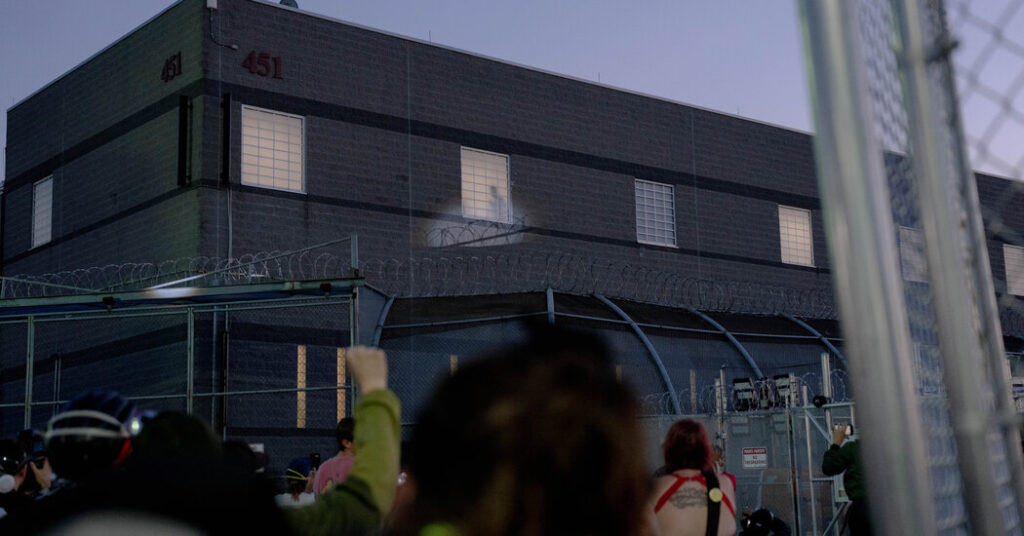
Inside the kitchen of an immigration detention center, potato salad sat at 81 degrees, twice the temperature considered safe. Surfaces that were used to prepare food were left unsanitized. Workers touched open garbage containers as they made meals.
Migrants at the Delaney Hall facility in Newark have complained for months about unsafe meals, dirty living quarters and bad medical care. Because federal officials have restricted access to the detention center, their claims have been hard to verify.
Now, health inspection reports, court filings and other public records reviewed by The New York Times are providing the first documented evidence of conditions inside Delaney Hall, which has been a flashpoint in President Trump’s immigration crackdown. Pleas from inmates have inspired weeks of protests outside the New Jersey detention center and renewed broader concerns about migrant holding cells from Arizona to New York.
To detractors of Mr. Trump’s anti-immigration campaign, the detention centers represent the flaws and excesses of the administration’s mass deportation efforts. Critics have argued that the administration has detained too many people too hastily, leading to overcrowding, maltreatment and abuse.
To the White House and its supporters, the detention centers are a crucial element in the effort to deport undocumented immigrants, and the government agencies that oversee the facilities insist that the care detainees receive exceeds what is provided in most U.S. prisons and jails.
Only three months after the Trump administration began using Delaney Hall to detain immigrants last year, a federal inspection identified deficiencies in food refrigeration and determined that food was not protected from overhead leakage. Inspectors found other contamination sources, including condensation dripping into the food freezers. The findings appeared in a report from the Office of Professional Responsibility at the Immigration and Customs Enforcement agency.
The public records reviewed by The Times included reports from New Jersey state health inspectors. Those records, obtained through a public information request, show that just before midnight on Feb. 9, a tipster wrote to the Health Department that “the bathroom condition is extremely unhealthy and it needs to be looked at.”
State health inspectors, who were granted limited access to Delaney Hall in late May, reported that staff members were not washing their hands in a timely manner, including before work and after using the restroom.
The inspectors, who visited only the kitchen, noted other violations. They found that two covered stainless steel trays holding chicken stew were improperly cooled. Cooked meatballs in a hot holding area had an internal temperature that was nearly 50 degrees below what was needed to kill harmful contaminants. Staff members put cases of soda in the same closet next to chemicals. Sanitizer in a dishwashing machine was below proper concentration levels.
Dr. Novneet Sahu, the deputy commissioner of the Public Health Services Branch of the New Jersey Health Department, received a complaint at the time of the kitchen inspection from a physician about a detainee with an active case of tuberculosis. The physician said that an employee at University Hospital in Newark had told her that the inmate was brought to the hospital and taken back with no follow-up plan to contain the infection. Dr. Sahu’s account appears in an affidavit that is part of a lawsuit filed by the New Jersey attorney general.
While the inspectors had access to food service areas, they were denied entry to the housing and medical units, according to a statement from Raynard E. Washington, the New Jersey health commissioner. The facility has 1,000 beds, according to Geo Group, the private contractor that operates Delaney Hall.
Dr. Sahu said that the Health Department tried to inspect Delaney Hall’s infection control protocols and practices on June 1 but was repeatedly rebuffed. The attorney general had sued to force the center to allow state health inspectors inside so that they can evaluate infection control measures. The suit is pending.
“The department cannot confirm whether Delaney Hall is engaging in protocols or practices that pose a serious risk of harm to both detainees within the facility and to the public outside of it,” Dr. Sahu wrote in the affidavit on June 22.
The Department of Homeland Security said in an emailed statement that the state’s lawsuit was frivolous and noted that the state Health Department’s kitchen inspection in late May had determined that conditions were overall satisfactory.
Federal officials denied Dr. Sahu’s assertion that a detainee had been diagnosed with tuberculosis.
“All detainees are provided with three meals a day, clean water, clothing, bedding, showers, soap and toiletries,” Homeland Security said in a statement. “Certified dietitians evaluate meals.”
Geo Group disputed allegations of substandard conditions included in the federal and state reports. Christopher V. Ferreira, a company spokesman, said in a statement that “in the event issues are identified, deficiencies are promptly addressed through established corrective action processes” required by ICE. The company said that the facility’s services included round-the-clock access to medical care as well as meals that accommodated religious and specialty diets.
Detainees and their families have complained for months about the conditions at Delaney Hall. More than a dozen current and former detainees, relatives and visitors who spoke with The Times described jail-issued meals that were often moldy, spoiled or frozen. Visitors said common areas were acrid from the smell of body odor.
Latif Hafraoui, 61, a Moroccan immigrant who moved to the United States 38 years ago before settling in Bayonne, N.J., was detained at Delaney Hall for 108 days before being released in November. He said meals would sometimes consist of small portions of roast chicken, beans and rice. Other times, he was served slices of cheese, bologna and bread. Meat was sometimes unidentifiable — “very weird stuff” that most detainees would refuse.
Detainees complained about poor ventilation, and said that inmates were often forced into overcrowded cells where temperatures were either sweltering or frigid.
Azizullah Qasemi, 30, an asylum seeker from Afghanistan, said that he slept in a freezing room in December with 11 other detainees, with no idea why he had been detained. Court records show that he was arrested after he showed up for an immigration appointment at the ICE office in Manhattan. An immigration judge has since granted him asylum.
“I did not feel safe there,” Mr. Qasemi said through a Dari interpreter.
Gabriela Soto, 28, is the wife of a detainee, Martin Soto, who was detained at Delaney Hall in February before being transferred in May to another facility in Elizabeth, N.J. Ms. Soto said that her husband had dealt with a stomach ailment for about a month inside Delaney Hall and struggled to get help.
“We couldn’t get the medic to see him,” Ms. Soto said. “After lights out, he would have to beg the guard to open the cell just so he could go to the bathroom.”
Ashleigh Gomez, 29, drives two hours each way to visit her husband and said she had been turned away after making the long trip in recent weeks because visitation hours had been canceled with little notice.
“Seeing him makes a big difference for my children,” Ms. Gomez said. “They’re always crying without him.”
Delaney Hall, which had been used to hold migrants until 2017 when it was converted into a halfway house, was reopened as an ICE detention facility in May 2025 — the first under Mr. Trump’s second administration.
The protest movement at Delaney Hall began after jailed migrants decided to stage a hunger strike, refusing cafeteria meals. Inmates who had been assigned to tend to common areas stopped doing the work. With paper and pen, the migrants wrote down their complaints and in May, went public.
Demonstrators soon gathered outside and stayed for weeks, blocking vehicles as federal agents in riot gear formed shield lines and fired chemical irritants. As dramatic images from the clashes captivated the nation, calls to shut down Delaney Hall grew loud.
“It is quite unique in the sense that it was powered by the detainees themselves,” said Andrei Camurungan, a volunteer organizer.
Census figures show that immigrants make up more than 23 percent of New Jersey’s total population, the second-largest share of any state, after California. New Jersey has a robust and tightly knit patchwork of volunteer groups that has helped detainees at Delaney Hall find legal representation and other services. The groups have shaped a media campaign using messages from detainees, publishing their handwritten letters.
Acts of resistance have played out in other detention centers, including in Tacoma, Wash.; Adelanto, Calif.; and Alvarado, Texas. At Delaney Hall, demonstrators have benefited from the proximity to urban centers in New York and Pennsylvania.
The movement has received key support from powerful religious figures, including Cardinal Joseph W. Tobin, the Roman Catholic Archbishop of Newark and friend of Pope Leo XIV.
“There’s a growing number of Americans who see the situation as it really is,” Cardinal Tobin said after he led a prayer near the facility in June with more than 50 people in support of the migrants. “They cut through the ideology, they cut through the attempts to dehumanize people and they can see suffering human beings.”
Susan C. Beachy and Georgia Gee contributed research. Jonah E. Bromwich and Tracey Tully contributed reporting. Safiullah Padshah contributed translation.
The post Claims of Poor Conditions in ICE Facility Are Bolstered by Health Inspectors appeared first on New York Times.