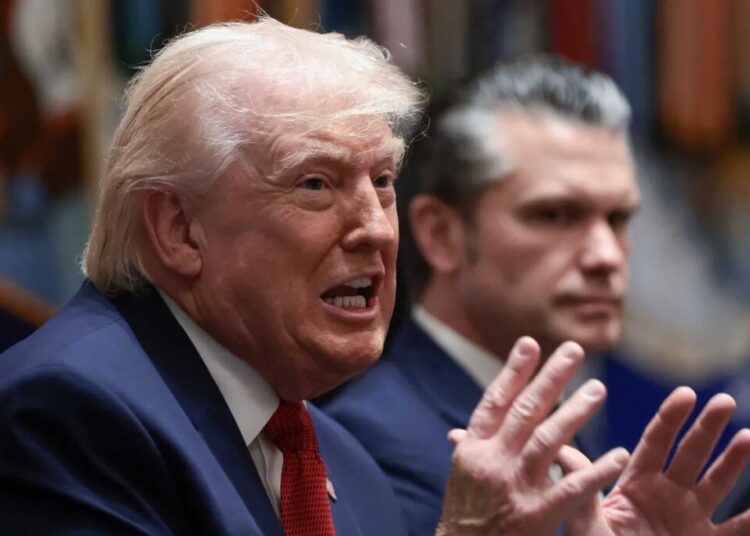
President Trump on Monday defended his decision to request that FIFA review a ban issued to a star player on the U.S. men’s soccer team, saying he was motivated to make the extraordinary intervention because he felt that a “suspect” referee made a bad call.
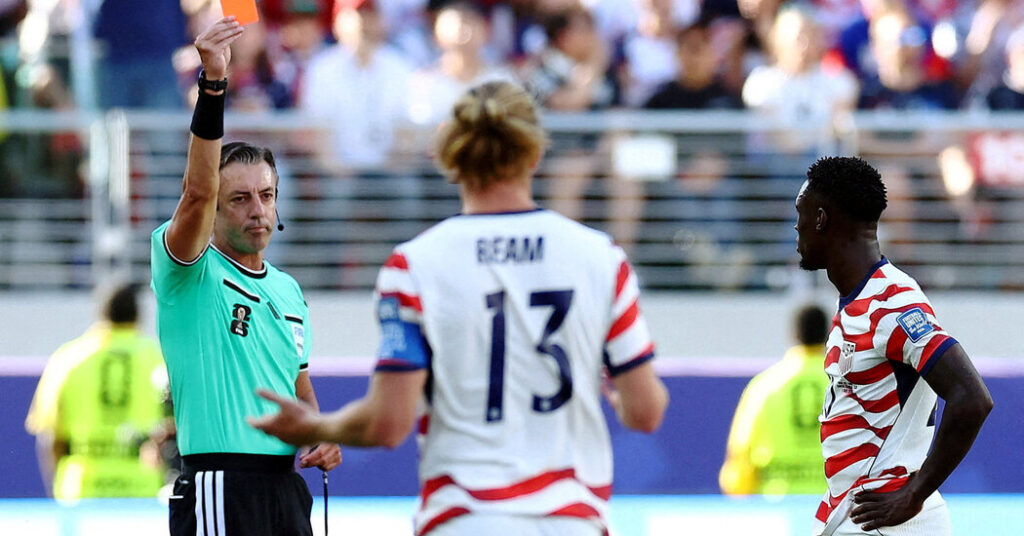
Mr. Trump called Gianni Infantino, the president of FIFA, in the hours after the United States men’s soccer team played Wednesday and asked him to review the suspension of the team’s top goal scorer in the World Cup, Folarin Balogun, after he was given a red card. On Sunday, FIFA reversed the decision, a remarkable development that has roiled the soccer world and brought renewed scrutiny to the close relationship between Mr. Trump and Mr. Infantino.
“I didn’t tell him what to do; I can’t tell him what to do,” Mr. Trump said. “And I don’t believe he made the decision. I think it was a committee that made the decision. And they made the right decision because, No. 1, it wasn’t a foul and you want to see a game with your best players.”
The sudden reinstatement of Mr. Balogun for the U.S. team’s knockout game against Belgium on Monday night went against all known norms in modern World Cup history and what appear to be FIFA’s regulations on dealing with red card offenses, which have led to other players in the tournament receiving minimum automatic one-game suspensions.
The decision, the first time since 1962, when the rules were less clear, that FIFA has overturned an in-tournament World Cup game suspension, threatens to taint a surprising run by the U.S. team in a year when Americans have embraced their hosting of the tournament.
“I didn’t know what the hell a red card was,” Mr. Trump said. “When I found out, I said, ‘You got to be kidding.’”
“You know, it’s one thing to penalize somebody for the game, but how do you penalize them for a game that hasn’t been played yet?” he later added. “It’s very unfair. You can’t do that, so yes, I asked for a review by FIFA. I spoke to a man who’s highly respected, and by the way, whose level of respect has gone up tenfold.”
For Mr. Infantino, the decision could have a ruinous impact. Soccer officials and coaches from around the world have criticized the decision, and the FIFA president is already the subject of a complaint to the organization’s ethics body amid allegations he breached FIFA’s rules on political neutrality by awarding Mr. Trump a hastily created peace prize in December.
While Mr. Infantino has been the subject of ridicule and scorn over his yearslong efforts to court Mr. Trump, the fury at what could be the first of those efforts to directly affect matters on the field has been of a different scale.
Mr. Infantino confirmed after Mr. Trump’s remarks on Monday that the two spoke but insisted that the decision resulted from an independent process.
“During our conversation, I explained that there was an ongoing legal process involving FIFA’s independent judicial bodies and that the case would be decided in due course by the competent bodies,” he said in a statement. “That is how FIFA’s system works, and it is a principle that I will always uphold.”
The decision was made by FIFA’s disciplinary committee, a group that FIFA insists is independent. It is led by a little-known Emirati sports administrator named Mohammed Ali AlKamali. He did not respond to a request for comment.
Governments across Europe, along with the soccer’s European governing body and the European Commission, have expressed dismay. Belgium’s soccer federation said in a lengthy statement that FIFA had effectively ignored its request for an “explanation of the process that had been followed.”
Mr. Balogun was penalized after a video review of a collision between him and his Bosnian opponent. The video showed Mr. Balogun’s foot coming down on the defender’s ankle, causing it to twist. The referee, Raphael Claus, then ejected Mr. Balogun. Many fans criticized the decision, but such actions are common since video technology entered professional soccer about a decade ago.
The rules of soccer say that “a tackle or challenge that endangers the safety of an opponent or uses excessive force or brutality must be sanctioned as serious foul play.”
Mr. Trump said he watched the game and felt Mr. Balogun’s action “wasn’t even an infraction” before describing Mr. Claus, a Brazilian league referee officiating his second World Cup match, as “very suspect.”
“He made a call that nobody could believe,” Mr. Trump added, saying that it was simply a clash between two men running at full speed. Mr. Claus had been investigated and cleared in 2024 of match fixing after allegations made by the American owner of a soccer team in Brazil.
Mr. Trump said he decided to act when he learned of the implications of the red card, saying that “when they take your best player, or just about,” it is “very unfair.”
FIFA has given Belgium the right to appeal, but as with the original decision, there is little clarity into how the process would work. Belgium’s soccer federation suggested that the outcome had already been decided.
Mr. Balogun has been a critical part of the U.S. run to the round of 16, scoring three goals, as the team has turned around its poor form before the tournament to generate anticipation about just how far it could go.
Mr. Trump implied the U.S. match against Belgium on Monday night would be fairer after his intervention because both teams would have their full slate of players, and he invoked his false claims that he won the 2020 election.
“And we’re going to have a full team, and Belgium is going to have a full team,” he said. “And you know what? If they beat us, then they can be really proud. The other way, if they beat us, we’ll say it was — I’d say — it was rigged, just like the election was rigged in 2020.”
The post Trump Defends Asking FIFA to Review U.S. Soccer Star’s Ban appeared first on New York Times.