The buff George Washington statue in the National Museum of American History speaks for itself. Taking in the washboard abs and determined expression of the 1840 work by Horatio Greenough, a visitor would be hard-pressed to see anything but a Founding Father rendered as a Greek god. Yet in a searing 162-page report on the Smithsonian museum released on July 4, the Trump administration takes issue with the lack of patriotism in even this exhibit. The statue contains other symbols “of a heroic nation,” including a carving of Hercules, accompanying wall text says, noting that the scene “symbolizes the perceived courage of the American people.” To the White House, the text “refuses to affirm the exceptional courage of the American people” and captures the museum’s “thinly veiled anti-Americanism.”
Titled “Saving America’s Story,” the report is filled with similar accusations against one of the marquee museums in Washington, D.C., ramping up criticism after more than a year in which repeated threats and demands aimed at the Smithsonian Institution seemed to be going mostly nowhere. ln the report, the White House Domestic Policy Council, which is run by Vince Haley, casts the American History Museum’s leadership as irredeemable ideologues and claims that the museum “has failed to tell America’s story and adheres to a radical, activist ideology.”
Haley, in a statement emailed to me by the White House, said, “During this 250th anniversary year of our heroic founding, the least we owe our Founding Fathers is an honest and inspiring account of who they were, what they did, and what they built. It is our hope and expectation that the Smithsonian will eventually rise once again to that noble obligation—to tell America’s story for our children, the world, and future generations of Americans.” A Smithsonian spokesperson told me in an email, “For more than 180 years, the Smithsonian has served the American public with nonpartisan and independent scholarship, and we remain committed to doing so.”
With 31 pages of citations, the document represents the most extensive White House criticism of a Smithsonian museum yet, signaling that Donald Trump has not forgotten about the March 2025 executive order in which he directed his administration to scrub the museum complex of “improper ideology.” The new document reads like a precursor for the president to attempt to overhaul the institution. For example, it points to a 1997 memo by then–Deputy Assistant Attorney General Randolph D. Moss that argued that the Smithsonian is “so closely connected to the Government that the two cannot realistically be viewed as separate entities.” (A “trust instrumentality” of the United States, the Smithsonian is about 62 percent federally funded, and the White House has usually left it alone.) The Domestic Policy Council adds, “In light of its federal status and the fact that it receives over one billion dollars in federal funding from the American taxpayer every year, the President has a duty and obligation to seek reforms of the Smithsonian.”
The Smithsonian’s secretary, Lonnie Bunch, known for his careful public diplomacy, has for months held the line between the administration and the storied museum institution, even attending “the most stressful lunch I’ve ever had in my life” with the president, as my colleague Clint Smith recently reported. Bunch appears to be moving closer to leaving the institution, meaning that the sprawling complex could soon have a power vacuum at the top.
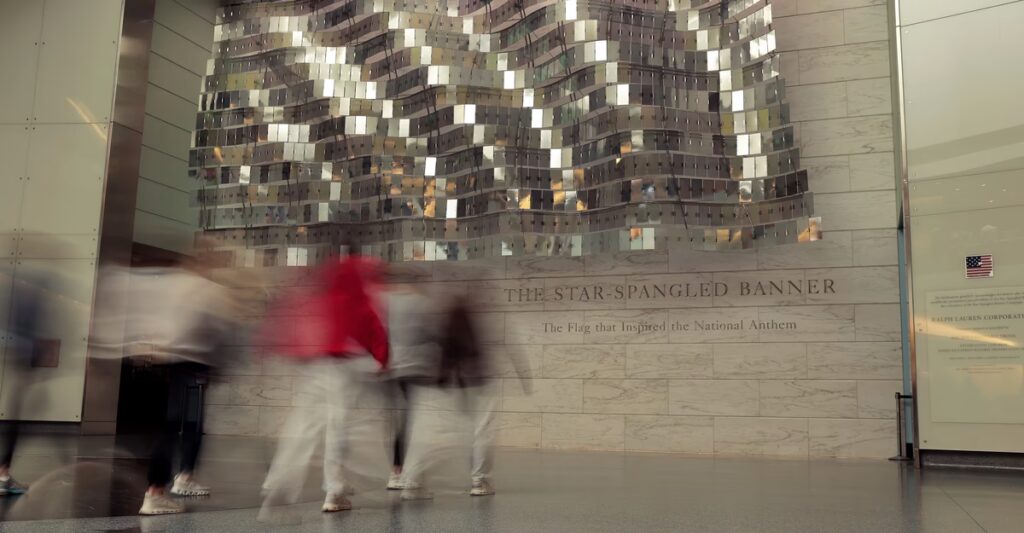
For years, the museum world has been able to proudly cite an aging statistic—that its institutions are among the most trusted in the country, second in trustworthiness only to friends and family. A certain fondness washes over people when they talk about the Smithsonian in particular, sparking awe-filled associations with larger-than-life rocket ships, towering dinosaur fossils, and everlasting American symbols such as the original Star-Spangled Banner.
The White House report seeks to undermine this credibility wholesale, pulling one of the nation’s most beloved institutions into the messy culture wars that have been reignited during the second Trump administration. Focusing on details such as how curators handle Christopher Columbus and undocumented immigrants, the document picks apart the American History Museum’s materials through the lens of right-wing talking points.
[Read: First the Kennedy Center, now the Smithsonian]
To anyone who has spent time at the institution—which, if anything, is known for its sober approach—language in the White House document alleging that wall texts contain “the wild-eyed language of an ideological manifesto” will feel dissonant. “My reaction was: Wow, I didn’t realize I worked for such a progressive, left-leaning institution,” one Smithsonian staffer joked to me after looking at the report. “I didn’t realize all my colleagues were Marxists.’”
There is a McCarthyite feel to the document, which, in addition to actually claiming that the museum follows “an intellectual framework rooted in Marxism,” repeatedly calls out, by name, Smithsonian staff members who created the content singled out by the White House. The report includes more than a dozen images of the museum’s director, Anthea Hartig, whom it casts repeatedly as the central villain in the museum’s move toward activism. The callouts echo Trump’s critiques of the former National Portrait Gallery director Kim Sajet, who resigned after the president tried to fire her last year.
The Smithsonian staff member, who requested anonymity because they were not authorized to speak on the record, said that the report has sparked fears for employees’ safety and concerns about doxxing.
Even for staff who are used to public scrutiny of their work, the White House report hits harder. “Our work is out there. It’s part of the deal, but having it included with such scathing critique in a White House report is a different matter,” the person said. Beyond that is a feeling that the institution’s output is being deliberately misconstrued, they said: “They’re trying to find, and sometimes really reaching for straws to find, anything that justifies what is already their opinion of the Smithsonian.”
[Lonnie G. Bunch III: How to define America in 30 objects]
The administration’s reading, for Smithsonian staff, is frustrating. The report, for one thing, relies on several museum exhibitions as examples of the activist tilt, but some are either no longer on view or were not at all influenced by the current director. “Girlhood (It’s Complicated),” a frequent subject of criticism for its discussion of transgender youth, closed more than three years ago. “Many Voices, One Nation” and “American Democracy,” which the document repeatedly points to as examples of the institution’s recent leftward slant under Hartig, both opened nearly a decade ago, more than a year before Hartig was appointed as director.
Many of the accusations—that the museum does not celebrate the country enough, that the Founding Fathers are not given significant space—ring as simply untrue for those who know the museum well. The “Price of Freedom: Americans at War” exhibit, for instance, chronicles how “Americans have fought to establish the nation’s independence, determine its borders, shape its values of freedom and opportunity, and define its role in world affairs.” Some especially patriotic and popular sections, such as the Gunboat Philadelphia and the first-lady dresses, are outright ignored.
At times, the report does touch on very real, very heated debates in the museum world. When the White House says that the American History Museum “has not created any exhibit dedicated to presenting a general narrative of American history,” the critique has some merit. In recent years, there has been a struggle over so-called metanarratives, or grand overarching stories, that museums tell. Many museums have been seeking to replace those sweepy stories, which can veer white and male-dominated, with a more multipronged approach that features smaller stories reflecting the many perspectives that compose the country’s history. Sometimes it can leave visitors used to smooth, direct storytelling confused.
This has been a conversation at the Smithsonian for decades, particularly at the American History Museum, which originated as a museum of technology and history that focused on “proudly displaying evidence of human progress,” David K. Allison and Hannah Peterson write in Exhibiting America, a history of the museum. In the 1990s, the institution coalesced around a different goal—exploring what it meant to be American—that would prove more challenging given the weighty issues at play (in addition to the idiosyncrasies of the collection).
Social-justice language has also been integrated into some museum spaces over the past decade or so, particularly during the height of the “Black Lives Matter” movement, which sparked the widespread embrace of guidelines such as the Museum as Site for Social Action tool kit. A 2017 resource for museum workers, the toolkit, which is cited in the White House report, looks at Western, colonial frameworks underlying museum practices and explores ways to make institutions more equitable and approachable. The Museum of American History, in a 2023 report on DEI initiatives, also referenced by the White House, said that it was holding regular discussion groups around the tool kit. There is a real conversation to be had about whether museums should strive to guide viewers toward civic action and the big questions of our times or simply tell them about the past. But these active, sensitive, and polarizing debates are also at risk of being used as a kind of Trojan horse to usher in different kinds of sweeping changes and rewritings.
As the White House accuses the American History Museum of bias, its own comes to the fore. For instance, the report complains that at one point this year, 75 percent of promotional materials outside the American History Museum featured “exhibits dedicated to peoples and cultural traditions foreign to the United States.” Those exhibits, a citation shows, are about Mexican Americans and Filipino Americans, suggesting that the White House does not believe that such groups are a part of American culture. The report argues that the museum “makes no meaningful effort to acknowledge the central and positive role Christianity played in the Founding and flourishing of America”—claims that some religious historians challenge, given many Founding Fathers’ ambivalent relationship with religion. In some places, the White House mirrors arguments used by right-wing education organizations, including PragerU, that it has worked with on history projects, such as an approach to past injustices that suggests that the U.S.’s role in slavery should be seen in context. The museum should stress that “the colonies inherited slavery from both global and European slaving practices,” the report argues. It uses similar logic to discuss the lack of women’s rights during America’s founding.
[Read: Here come Trump’s ‘Freedom Trucks’]
All told, the report employs a view on the past that posits that history ended at a certain time and that what’s happening today is none of museums’ business, bristling at any questions the museum puts forward that link its displays to current times. The story a museum tells “should be a basic consensus view that is not ideological or politicized, but presents the facts of history—what actually happened—as accurately as possible with minimal present-day bias,” the report reads. This, too, is an active debate; museums just a few years ago opened the doors to contemporaneous political moments with initiatives such as “rapid-response collecting.” The Smithsonian, in some places, has already started aligning with the White House, such as when the National Portrait Gallery earlier this year removed interpretative wall text describing portraits of recent U.S. presidents.
If “present-day bias” is a concern, it’s perhaps worth looking at how the White House has addressed the present moment in its own work. When creating a “Presidential Walk of Fame” along the White House exterior, the sitting president chose to depict his predecessor not with a portrait like the country’s other former leaders but with an autopen, accompanied by wall text calling him “the worst President in American History.” The White House press secretary described the texts as “eloquently written,” pointing out that “as a student of history, many were written directly by the President himself.”
The post Trump Comes for the American History Museum appeared first on The Atlantic.