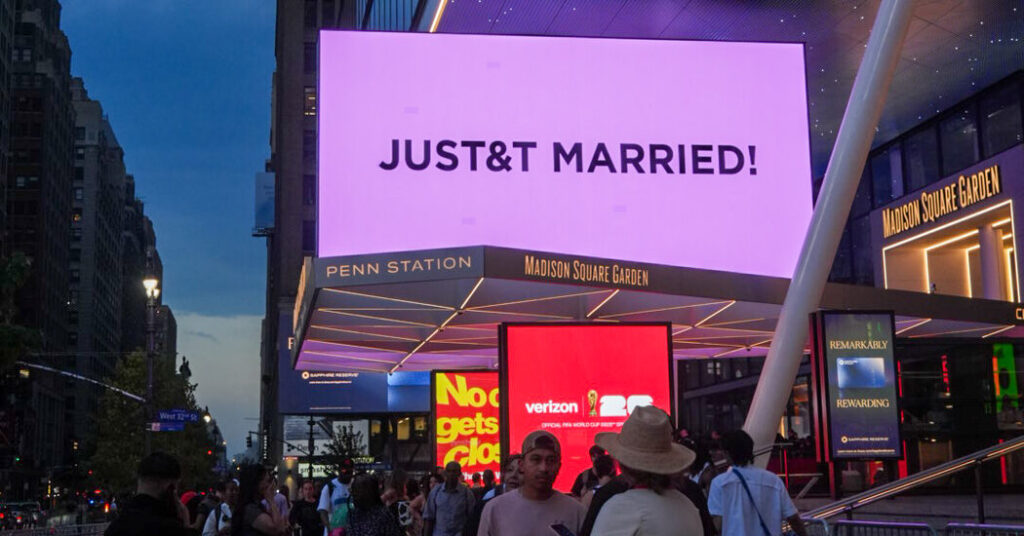
At 7:30 p.m. on Friday, July 3, the screens outside Madison Square Garden in Manhattan flashed purple with a simple message: “JUST&T MARRIED!” Was it an ad for a telecommunications company, or a nod to the celebrity newlyweds Taylor Swift and Travis Kelce? According to a release from Swift’s longtime publicist, Trina “Tree” Paine, it was the latter — though many on social media initially thought otherwise.
Around the same time, the Knot Worldwide, a technology and wedding-planning company, rolled out four digital billboard trucks near the arena displaying the messages “make your wedding the main event” and “cheers to the happy couple” alongside the company’s logo, turning one of the year’s biggest cultural moments into a well-timed marketing opportunity.
The Knot’s campaign was not a coincidence.
“Once we had confidence in N.Y.C. and M.S.G. as the likely venue, we mobilized quickly,” said Casey Moujaes, the company’s vice president of global vendor marketing, adding that the company had also secured a billboard near the arena for the week.
The frenzy surrounding Swift’s wedding did not surprise Ariane Lovell, a public relations executive and a founder of Trifecta Media Group.
“Taylor Swift, she’s not just a celebrity; she’s a cultural ecosystem,” said Lovell, who is based in Charleston, S.C. “I think when an event reaches that level of relevance, brands naturally see it as an opportunity to find a way in and participate.”
Other brands embraced the moment in both overt and subtle ways, using Swift’s wedding to market everything from multi-million-dollar venue spaces to beauty finds. The Barclays Center, for instance, posted a graphic on Instagram that read, “Ready to Tie the Knot?” alongside the caption: “Planning something special? Learn more about hosting your next private event with us.”
Sephora took a lighter approach, posing a question on Threads and Instagram that some fans may have been curious about: “But is she wearing a red lip to the wedding?”
In an era of A.I.-generated content, it’s unsurprising that the imagery surrounding the wedding would be repurposed for other forms of promotion. Shortly after the congratulatory message for Swift and Kelce appeared outside the arena, the White House social media account shared an altered version of the same billboard scene, replacing the original text with the message: “TRUMP IS YOUR PRESIDENT.”
On social media, retailers, local businesses and vendors large and small jokingly suggested that they had played a role in Swift and Kelce’s nuptials.
But Lovell cautioned brands against manufacturing connections to events that did not involve them.
“If your brand wasn’t part of the moment, don’t try to rewrite history with A.I.,” she said. “Consumers are increasingly savvy now. We can spot when a brand is manufacturing relevance instead of earning it.”
Marielle Conlon, 39, the founder of Ocean Road Antiques in Pennsylvania, found her own way to join the wedding excitement. On Friday, she posted an A.I.-generated reel showing her colorful, bamboo-lacquered furnishings being transported into Madison Square Garden by truck, as if she were one of the vendors working with Swift and Kelce’s production team.
“Because I, like other small businesses, don’t have a large advertising budget, I try to be creative with my marketing,” Conlon wrote in a text message. The tongue-in-cheek post, which garnered more than 10,000 views and 1,500 shares, sparked a mix of reactions: Some viewers believed it, and others appreciated the joke, though some questioned its authenticity.
“The goal wasn’t to deceive anyone,” Conlon said, adding that the post had been “poking fun at the internet’s obsession with celebrity weddings and the increasingly surreal nature of A.I.-generated content.”
Legal experts say that kind of obvious exaggeration is closer to a harmless marketing tactic than false advertising.
“If the image or statement merely conveys excitement or aspiration, it is more likely puffery, which is an exaggerated or boastful statement of opinion that no reasonable person would rely upon as a factual representation,” Andrew B. Jacobs, a partner and lawyer at Winston Taylor LLP, a global law firm based in New York City, wrote in a text message.
And despite the attention, Conlon said the reel’s virality hadn’t translated into sales.
“This wasn’t some wildly profitable marketing stunt,” she said.
The post Taylor Swift’s Wedding Became a Marketing Moment for Brands Big and Small appeared first on New York Times.