Greg Viviani has seen some elaborate beach setups in Orange County.
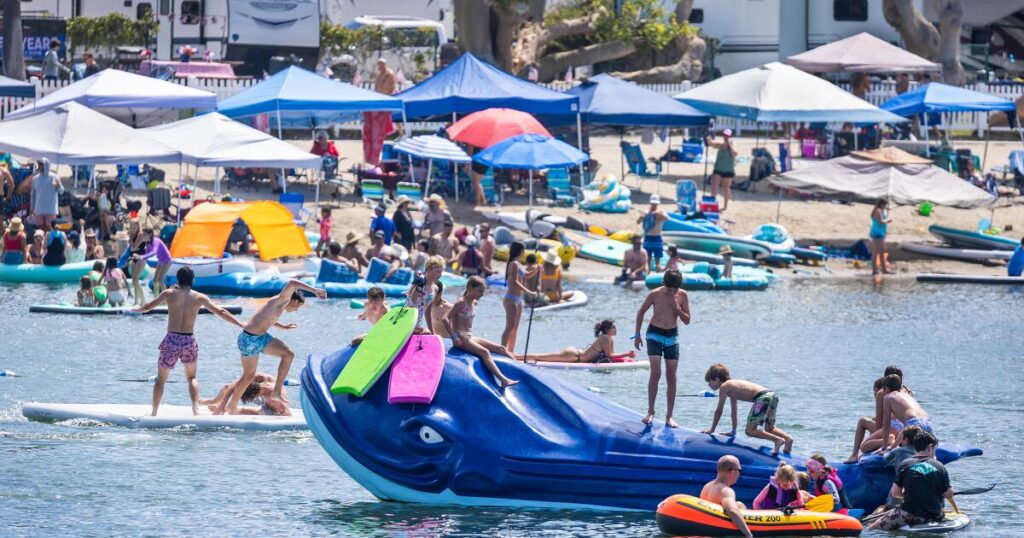
They range from lavish celebrations on the sand with tables and flatware to inventive ones, with groups bringing multiple canopies that shade tables, chairs and even couches from the scorching rays, the Laguna Beach resident said.
But the sun is poised to hit a bit different this summer on beaches in Southern California.
A growing number of beach towns are cracking down on some of the more elaborate shade coverings, citing safety issues.
Newport Beach now prohibits canopies larger than 6 feet by 6 feet and requires that the structures not be connected. Just down the coast in Laguna Beach, a city that already had rules governing the size of canopies, officials took it a step further in May and limited the use of such shade structures to certain sections of beach. Violators can be fined up to $500.
“Now it’s not people taking up all this space and acting like they have a freaking living room on the beach,” Viviani told The Times, adding that he’s already seen a reduction in trash along the sand in Laguna. “It makes the ambience better. The vibe is better and it’s safer.”
There was a time when a day at the beach involved a towel and some sunscreen. But heightened concerns about the health effects of sun exposure have brought an ever-growing number of tents, canopies and other products. At the same time, more people are going to the beach in larger groups and for special events, requiring more space and amenities. Some get to the beach bright and early in the morning to set up their compounds and stay until sunset.
There has long been a divide between locals and out-of-town visitors over the giant canopies. Locals say they block views, create safety issues and encourage illicit behavior such as alcohol consumption.
And it’s not just in Southern California.
Tents, cabanas and canopies have been banned along stretches of the Jersey Shore for the last two years. Last year, Ocean City, Md., passed a beach regulation prohibiting visitors from bringing tents and limiting the size of shade structures. And in Myrtle Beach, S.C., officials instituted an “umbrellas-only rule” from Memorial Day through Labor Day citing safety.
In Orange County, officials said it was limitations on visibility for lifeguards that prompted them to crack down on shade coverings ahead of the busy season when thousands of visitors hit the beach daily.
In a video posted on social media Tuesday, Newport Beach Lifeguard Captain Natalie May explained that shade structures like umbrellas and canopies can create visual barriers on busy beaches, preventing lifeguards from seeing activity on the shoreline and slowing down first responders.
“Lines of sight allow lifeguards to continuously monitor swimmers and quickly identify someone who may be in distress,” she said. “Smaller, separated shade coverings also help maintain open pathways for emergency responders, lifeguard vehicles and medical personnel who may need to reach an emergency quickly.”
Officials say large canopies create a similar visibility problem in Laguna Beach, where beaches are much more narrow and often hemmed in by coves.
In Laguna Beach, canopies — limited in size to 8 feet wide and 6 feet high — are only permitted in line with or behind lifeguard towers on Main Beach and the southernmost section of Aliso Beach.
Everywhere else is an umbrella-only zone.
Some beachgoers have lamented that Laguna Beach’s policy is too restrictive, and that long days spent on the sand require more shade than a small umbrella provides, particularly for families with small children.
One resident commented on the city’s social media post announcing the rules that Laguna has “turned into a giant HOA on steroids.”
During a hearing on the matter in Newport Beach, Adam Leverenz shared a photo with the council that he took of a recent teen birthday party with shade coverings at the beach that claimed would violate the city’s new rules.
“I see concerns on both sides, but the way this is written, it’s incredibly problematic,” he said. “Do you really want to keep some girls from having a party on the beach?”
Beach communities have long struggled with the balance between letting people enjoy the sand and preventing things from getting out of hand. The debate usually comes to a head in the summer, when high inland temperatures send bigger crowds to the beach, sometimes straining the mood of residents who live there. While some elaborate “living room” setups are evident, they are outliers, as many beachgoers simply use canopies to cover beach chairs, coolers and supplies.
Backers say the safety impact of rows of canopies is a real issue. Viviani said on a busy summer day at Aliso Beach, he watched as the fire department had to move canopies to make enough space to create a path to help a person with a broken leg.
“There was no room because there were so many people in so many canopies,” he said. “It was really shocking.”
Last year on July 4, beachgoers in Newport used zip ties to combine several 10 feet by 10 feet canopies to create “mega structures” that became not only an eyesore, but a safety issue, officials said.
“They’d put a bunch of these tents together and put a keg in the middle of it,” said Newport Beach Councilman Joe Stapleton. “It became a big party atmosphere for sure.”
Summertime problems in Newport often extend far beyond the reach of beach canopies.
The Balboa Peninsula, which Stapleton represents on the council, has historically been an infamous hot spot for public drinking, disruptive parties and brawls throughout the summer and especially during the Fourth of July. Officials have worked for more than a decade to try to combat those issues and promote the area as a more family-friendly locale.
The city launched its “Not in Newport” campaign across social media this summer to remind visitors that officials would have zero tolerance for public intoxication, illegal fireworks and other rowdy behavior. Fines for such infractions in West Newport Beach and the Peninsula — dubbed safety enhancement zones — will be tripled from July 3 through July 6.
“All the coastal cities are dealing with the same issues,” said Newport Beach Mayor Lauren Kleiman. “We just have massive crowds, particularly over these holiday weekends. Of course we welcome everyone to our cities and to our beaches, but it does start to become problematic for our public safety personnel.”
The post Some beachgoers are creating living rooms with a view on the sand. Cities are cracking down appeared first on Los Angeles Times.