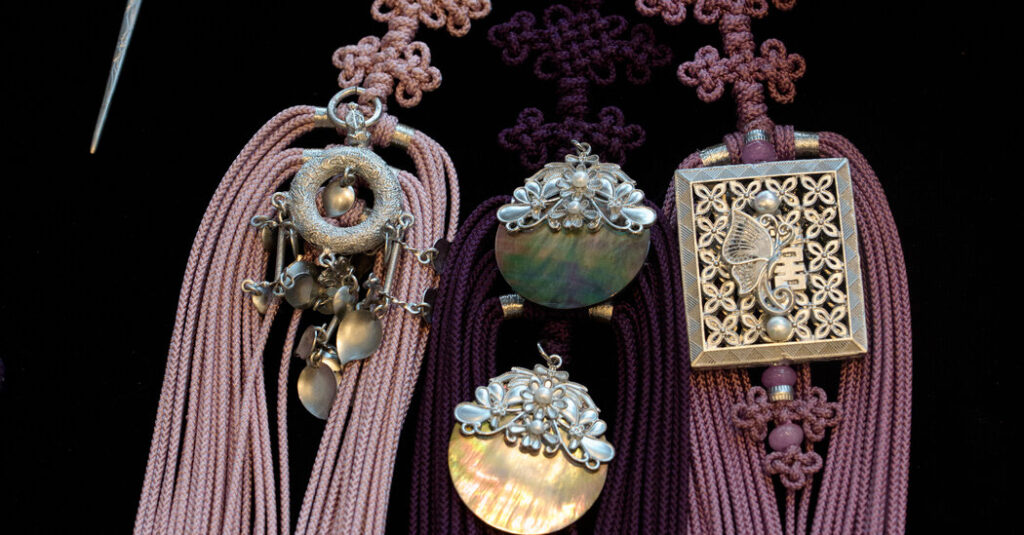
Like many things from South Korea these days, the norigae — a silk rope with a symbolic knotted pattern and small charms that ends with a tassel — is being embraced by a stylish international audience.
For more than 600 years, the ornament has hung from the waistbands and belts of the hanbok, the name for traditional Korean dress, signifying the wearer’s status and acting as an amulet.
But since they began swinging around the hips of K-pop performers in groups such as BTS and Blackpink, they now are seen dangling alongside plushies and Labubu dolls on handbags and backpacks around the world.
“I attached my norigae with my other keychains to decorate my bag,” Hasung Kim, a fashion production manager in Seoul, said. “The norigae is a beautiful accessory that blends well with modern fashion,” he added.
“Ever since ‘KPop Demon Hunters’ aired, we’ve seen double the number of people coming to the shop to make their own norigae,” said Ahn Seohun, one of the staff members at Leesle, a compact dress and jewelry shop in the Insadong neighborhood of Seoul. (She was referring to the animated film that Netflix has said is its most popular movie of all time.)
And in addition to the usual placement at the waist, “they are being attached to shoulders, to chains and worn as pendants, to hair clips, to cellphones and smaller ones as earrings,” Ms. Ahn said.
Leesle has a do-it-yourself program that offers customers a selection of norigae elements and provides help in using long-nose pliers to attach them to silklike cords.
Traditional Elements
A norigae traditionally has three elements, according to “Norigae: Splendor of the Korean Costume,” an academic publication on the subject by Lee Kyung Ja. At the top is the maedeup, traditionally a silk cord that has been knotted in a symbolic pattern — knots that resemble a butterfly, for example, stand for love. (Inexpensive modern norigaes may be made using synthetic silk cord.)
Attached to the maedeup is the paemul, the charm that is the physical centerpiece of a norigae. Traditionally these elements were carved from gold or silver or from gemstones such as jade, coral, amber or malachite, while the ones now available at Leesle or at souvenir shops usually are plastic. The charms all have symbolic shapes, such as cranes for eternal love or turtles for immortality.
Attached to the bottom of the paemul is the sul, or tassel, traditionally made with silk or, more recently, with inexpensive synthetic threads.
On one recent spring afternoon, Leesle had attracted several norigae makers. “We’re studying East Asian Studies at a university in Spain, in Malaga, and spending a semester in Seoul,” Nerea Lopez Roman said.
She was making a norigae as was her fellow student, Racquel Morales Marques, who said, “I plan to wear mine with a hanbok for graduation and hang it on my door.”
Eun Kyung Choi was creating her bespoke norigae for sentimental reasons: “I was adopted from Korea as an infant by a Grenoble family. I want to take my norigae back with me to France to have a piece of my heritage.”
Anna Nesterenko and Irina Kuznetsova planned, as they had in the past, to take their completed norigaes to their company headquarters outside Moscow, where they arrange tours to South Korea for Russian women interested in the culture.
“We travel around the country, shopping, trying different foods and going to where scenes from K-dramas were filmed,” Ms. Nesterenko said. In the past year, they said, they had shown 120 women the Seoul restaurant used in the “Itaewon Class” TV series, and had brought them to Leesle to make norigaes to take back to Russia.
Gifts for the Stars
Norigaes made by Choi Yoon Ha of Maison de Yoon were presented to Meryl Streep and Anne Hathaway in April at the Seoul premiere of “The Devil Wears Prada 2.”
Ms. Choi, who is self-taught and works alone, said she has a reputation for understanding the historical techniques and meanings of traditional Korean dress, which is the reason she has been asked to make such gifts.
Sitting at her workbench in her atelier in the Seongbuk-gu district of Seoul, she described what she created for the stars. “Anne Hathaway’s norigae,” she said, “is based on the nakjibal, or octopus leg norigae, derived from the multiple leg-like cords. It’s an unusual design without a tassel.
“The color is a deep gray, close to black, drawn from the film’s key palette of black, white, red — chosen to give the piece a younger, more contemporary edge,” she added. (At sale, it would be approximately 500,000 won, or $330.)
“Meryl Streep’s norigae,” she said, “features two round talgisul, or strawberry, tassel forms. In Korean tradition, the pairing of two tassels symbolizes inyeon, a meaningful bond or destined connection.” (About 650,000 won.)
Norigaes and other traditional accessories, including daenggis, which are used to tie back hair, were displayed on the walls surrounding Ms. Choi’s work table.
Streamlined Designs
As with most jewelry, inexpensive mass-produced norigaes are sold in souvenir shops and markets, while jewelers and artisans offer versions that are made in precious materials and sold in specialty shops and galleries.
For example, Oh Se Young and Um Do Yeon of Studio Ohuuu create traditional Korean jewelry based on myths and symbolism, but streamline their designs for modern customers. “We seek to reinterpret, not reproduce,” Ms. Um said.
For their norigaes, that means “we are eliminating the knots,” said Ms. Oh, “to give it a more modern look” and to adapt them to be worn more easily as earrings or pendants.
But the symbolic meanings of the norigae remains in its creation. The middle section, the paemul, is represented with a pearl or a chunk of some gem or mineral such as onyx, “to prevent bad luck,” Ms. Oh said.
And, Ms. Um said, “the movement of the swinging tassel is like water, which stands for prosperity.”
Ms. Oh said the norigae perfectly represents the Korean concept of stacking: the stacking of time, minute upon minute, year on year. She took a book off the shelf in their tiny jewel-box studio in Jongno, known as the largest jewelry district in the world, and opened the pages to show examples — a pile of stones; rice-cake layers in a pastry.
The two jewelers are in the process of changing the studio’s name. In the past it has been Ohuuu, which has stood for the brightest time of the day and their attempt to shine light on Korean traditions.
Now it will be known as By Mulde, which means “to permeate,” Ms. Oh explained.
“To spread out,” Ms. Um added.
To bring Korean jewelry, reinterpreted like the norigae, to the rest of the world.
The post The Modern Allure of a Traditional Korean Ornament appeared first on New York Times.