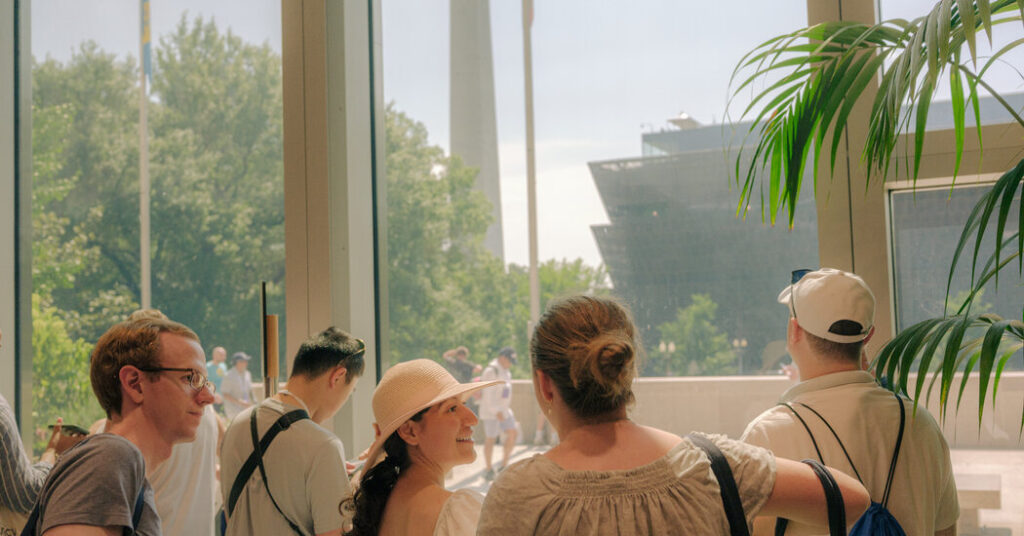
The crowds that snaked around the National Mall in Washington on Saturday, America’s 250th birthday, were dressed for a party. They wore red dresses, blue shorts and white tank tops with bald eagles on them. Some wore glittery hats emblazoned with “U.S.A.,” and most were slathered in sunscreen as they sweltered in the 101-degree heat and humidity.
The many Smithsonian museums that line the Mall were some of the only spaces that afforded respite from the scorching temperatures. And when severe weather threatened later in the day, they turned into shelters from lightning.
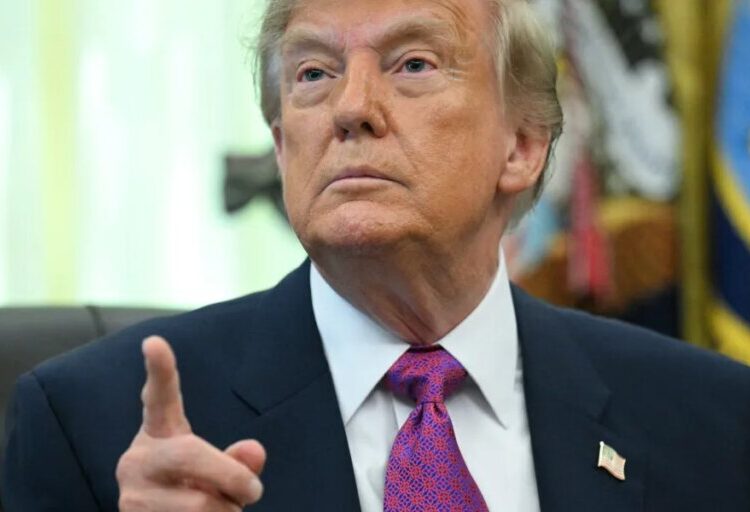
For nearly a year, the Smithsonian’s museums have come under attack from President Trump, who has argued that they are focusing too heavily on “how horrible our Country is” and not enough on its “brightness,” as he has put it on social media. The White House has ordered eight Smithsonian museums to turn over thousands of pages of documents, wall text and exhibition information for comprehensive review, aiming to assess the institution’s “tone, historical framing and alignment with American ideals.”
Those efforts were on the mind of some visitors at the National Museum of African American History and Culture on Saturday, including Zakiah Williams, a 29-year-old hotel receptionist from Jacksonville, Fla.
“It’s a step in the wrong direction, because these institutions exist for a reason,” Williams said, as she fanned herself just in front of the museum’s main entrance. Removing information designed to educate people about the rich history of America, she added, “is doing us as citizens a great disservice.”
Last year, when the Trump administration published a list of Smithsonian exhibits, programming and artwork that it saw as inaccurate, divisive or otherwise objectionable, it highlighted a series at the National Museum of African American History and Culture designed to educate visitors about whiteness and white culture in the United States. The administration argued that the series portrayed the “nuclear family,” “work ethic” and “intellect” as white qualities rooted in racism, and it objected to content from the “hardcore woke activist” Ibram X. Kendi, a prominent historian and the author of “How to Be an Antiracist.”
Many historians balked at the administration’s efforts, arguing that they were an attempt to dictate a distorted, sanitized version of history. The administration said its goals were to “ensure alignment with the president’s directive to celebrate American exceptionalism, remove divisive or partisan narratives and restore confidence in our shared cultural institutions.”
On Saturday, while taking in an exhibit on slavery, segregation and other topics related to the Black experience at the National Museum of African American History and Culture, Nicole Harris said that all history needs to be embraced.
Harris, an operations manager for a technology company near Tampa, Fla., was visiting the museum for the second time that week, though it was her first time with her 12-year-old son, David.
“I don’t think any history should be excluded or sugarcoated,” she said. “Nobody should feel bad. It’s our history, and so it’s a fact. Being intentional about hiding it or removing it seems wrong to me.”
Others, like Karen Kolojejchick-Kotch, a 66-year-old retiree from Woodland, Calif., who was on a five-day visit to Washington, kept her commentary about the president and his administration’s actions brief. “He doesn’t carry my sentiments,” she said.
Asked how the Trump administration’s scrutiny of the Smithsonian museums reflected the state of America on its 250th birthday, Kolojejchick-Kotch paused for a moment to reflect.
“It means we have to fight harder for the things that we want, and we, the people, want in this country,” she said.
In January, the Smithsonian complied with some of the administration’s demands, submitting materials in an effort to be “transparent and open,” and saying that it would continue to turn over documents on a rolling basis. The institution, which includes 21 museums, libraries, research centers and the National Zoo, is particularly vulnerable to the administration’s pressure because it receives 62 percent of its more than $1 billion annual budget from congressional appropriation, federal grants and government contracts.
Last year, the secretary of the Smithsonian Institution, Lonnie G. Bunch III, emailed staff members to say he wanted the institution “to look at the unvarnished self” by examining its exhibitions, programs and presentations. Without providing specific examples, he added: “While the vast majority of our content is rooted in meticulous research and thoughtful analysis of history and facts, we recognize that, on occasion, some of our work has not aligned with our institutional values of scholarship, even-handedness and nonpartisanship.”
In its list of Smithsonian content that it found objectionable, the Trump administration included a onetime exhibit at the National Museum of the American Latino that depicted migrants watching Fourth of July fireworks through an opening in the wall along the U.S.-Mexico border. The museum is on the first floor of the National Museum of American History.
At the American History Museum on this year’s Independence Day, visitors gathered around a large papier-mâché sculpture by Kat Rodriguez that depicts the Statue of Liberty holding a tomato in her right hand and a basket of tomatoes in her left. The work, which the Trump administration also objected to, symbolizes “the vital contribution of the often invisible farmworker in the U.S.,” as the Smithsonian describes it.
Arlinda Williams and her 12-year-old daughter, who live in Somerset, N.J., immediately picked up on the theme.
“We need more of it,” said Williams, who works in human resources.
She went on: “Our young people that are Black, or even immigrants that come from other countries, need to be able to see themselves. They need to be able to express themselves in art forms and see those pieces displayed.”
Nearby, Tracy Maruska, a 57-year-old retiree from Phoenix, paused to consider the meaning of “American.”
“Everybody that lives here,” she said, “should be able to be American.”
The post On America’s 250th, Smithsonian Museums Offer Respite and Reflection appeared first on New York Times.