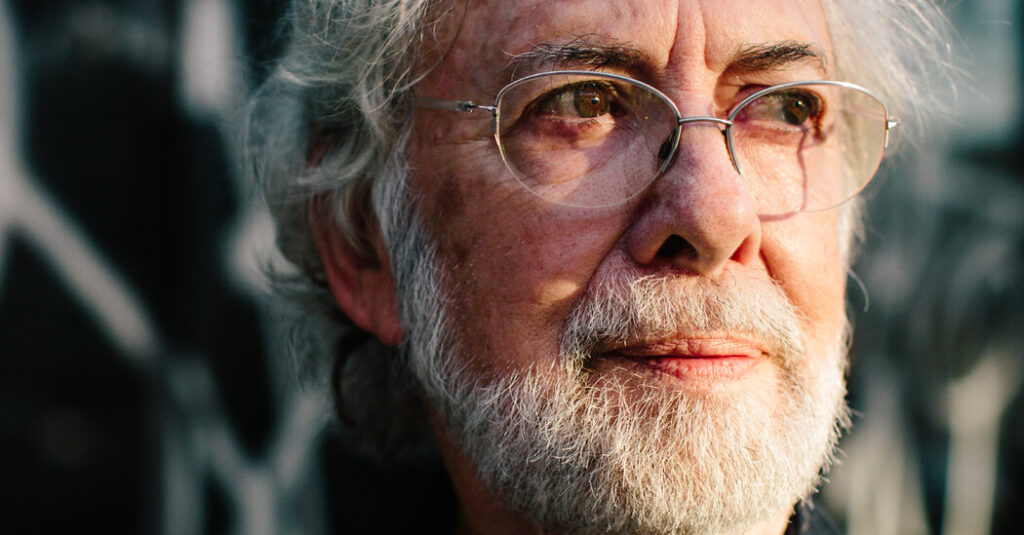
Mike Wallace, a self-proclaimed radical historian whose magisterial, unvarnished biography of New York, “Gotham,” written with Edwin G. Burrows, won the Pulitzer Prize and inspired two more door-stopper volumes about the city, died on Sunday in Mexico City. He was 83.
His death, in a hospital, was confirmed in a statement by his wife, Carmen Boullosa, a poet and playwright. She said he had been suffering from Lewy body dementia.
In the early 1960s, the Brooklyn-born Mr. Wallace was dutifully fulfilling his mother’s dream for him as a pre-med student at Columbia. But after nearly failing organic chemistry, he became radicalized in the years leading up to the 1968 student takeover of campus buildings to protest the Vietnam War. (He would be among the hundreds of students arrested during those demonstrations.)
Mr. Wallace turned his studies to history, and came to define “radical” as bottom-up social history that recognizes the profound influence of capitalism and of economic and social class distinctions and conflicts. He argued that in most conventional accounts “the dominant classes in the United States — wittingly or unwittingly — appropriated the past,” and he incorporated the voices of women, Black people, the working class and others who had often been excluded.
What became a half-century scholarly undertaking began in 1976, when Mr. Wallace and Mr. Burrows were awarded a $7,000 grant to write an expansive book that would encompass the global transition from feudalism to capitalism. Eventually, they decided that telling the story through the prism of New York over 500 years was formidable enough.
In “Gotham: A History of New York City to 1898,” published to coincide with the centennial of Greater New York, Mr. Wallace made a case that the consolidation of what became the five boroughs was a natural sequel by local government to what corporations had in the late 19th century recently accomplished to stifle competition through trusts and monopolies.
“For all the big bankers and corporate executives’ putative love of free markets,” he told The New York Times in 2017, “real capitalists of that era thought competition is lunatic. They have to cut wages, which leads to unionism, which has to be repressed, which leads to socialism.”
In describing the book, the Pulitzer committee said, “The authors weave together diverse histories — of sex and sewer systems, finance and architecture, immigration and politics, poetry and crime — into a single narrative tapestry that reads like a fast-paced novel.”
The book’s heroes, the committee added, were the hundreds of individuals, famous and unknown, whose “fusions and collisions generated tremendous kinetic energy, cultural inventiveness and a vision of unity-in-diversity that would become a distinctive contribution to world civilization.”
Mr. Wallace, now the sole author, wove similar themes into “Greater Gotham: A History of New York City From 1898 to 1919” (2017), in which he traced the city’s displacement of Europe as a world financial capital as the United States emerged from World War I as a creditor nation, and “Gotham at War: A History of New York City From 1933 to 1945” (2025), as the city claimed the mantle of world capital when it won its underdog campaign to become the United Nations headquarters.
Collectively, the three volumes numbered some 3,500 pages. But reviewers wrote that Mr. Wallace’s verve and wit, and his unsparing profiles of the characters who built the city, made for light reading.
He wrote, for example, that in 1908, before automobiles proliferated, more than 120,000 horses deposited 60,000 gallons of urine and 2.5 million pounds of manure in the streets every day; that reformers’ efforts to curb Sunday drinking, by limiting it to hotels with 10 or more bedrooms, unintentionally benefited the sex trade by inspiring saloonkeepers to partition their barrooms into brothels; and that when the New York labor leader Bayard Rustin was imprisoned as a war resister, the convicted murderer Louis “Lepke” Buchalter nearly died laughing over the anomaly that people could be jailed for not killing.
Michael L. Wallach was born on July 22, 1942, in Brooklyn. His father, Aaron, was the son of Russian immigrants. His mother, Margaret Lederer, a dressmaker, was born in Hungary.
In 1943, the family moved to San Francisco, where his father ran a record store. In 1949 (after the family apparently changed its surname sometime in the 1940s), they returned to New York, where he was raised in Fresh Meadows, Queens, and in Valley Stream and Great Neck on Long Island, where his father became a real estate broker.
“Politically I had come out of the heart of Reader’s Digest land,” he recalled.
After graduating from Great Neck North High School, he earned three degrees in history from Columbia: a bachelor’s in 1964, a master’s in 1966, and a doctorate in 1973. While he was researching his dissertation on the birth of the two-party system, he and his adviser, Richard Hofstadter, published “American Violence: A Documentary History” (1970).
Thanks to a recommendation from Professor Hofstadter, he was recruited by Leon Botstein, then the 23-year-old president of Franconia College in New Hampshire (and more recently the president of Bard College until he stepped down this year), to join Franconia’s one-man history department.
A year later, Mr. Wallace was denounced by The Wall Street Journal for an article he had published in The American Scholar. Mr. Wallace assumed the editorial had doomed his future employment prospects in academia.
He was commiserating with John M. Cammett, a scholar of Italian communism at the John Jay College of Criminal Justice, part of the City University of New York. Mr. Wallace later recalled: “Cammett says, ‘You’ve been attacked by The Wall Street Journal! You want a job?!’ John took this as a great job credential.”
At John Jay, where most of the students at the time worked in law enforcement, Mr. Wallace said: “My first class had lots of students who had been on the other side of the police barricades from me, up at Columbia in 1968. I also taught Western Civilization, which I reformulated as a course on the history of imperialism.”
Promoting public history in all its incarnations, he directed the Radical History Forum for about 10 years in the 1970s and ’80s; helped save the New-York Historical Society (now the New York Historical) from financial collapse in the 1990s; advised Ric Burns on his PBS series “New York: A Documentary Film”; and in 2000 founded the Gotham Center for New York City History at the City University Graduate Center.
He anthologized some of his pieces in “Mickey Mouse History and Other Essays on American Memory” (1996) and after the Sept. 11 attacks wrote the prescriptive “A New Deal for New York” (2002).
His marriages to Nancy Greenough, Elizabeth Fee and Hope Cooke ended in divorce.
In 2005, he married Ms. Boullosa. They lived in Brooklyn and Mexico City and together wrote “A Narco History: How the United States and Mexico Jointly Created the ‘Mexican Drug War’” (2015). Information about his other survivors was not immediately available.
Mr. Wallace said that historiography — the study of history — is, like history itself, a constant struggle, in part because most people are focused less on what came before than on what’s next.
“It’s an American characteristic, to some degree,” he told Columbia College Today in 2020, echoing George Orwell. “The past is the dustbin of history. It might be a source of amusing movies or interesting museum exhibits. But the action is in the future. Followed closely by the present.”
The post Mike Wallace, Who Wrote a Radical History of New York, Dies at 83 appeared first on New York Times.