“We were both young when I first saw you” goes the first line of one of Taylor Swift’s most enduring matrimonial tales, a bit of pop-musical Shakespearean fan fiction she wrote when she was 17 and had the audacity to call, simply, “Love Story.”
That 2008 hit is hardly an outlier. Swift’s songbook is littered not only with wedding imagery but also with recurring fantasies of star-crossed couples who met when they were wide-eyed kids. Take “It’s Nice to Have a Friend,” a lilting ditty from her 2019 album “Lover” that follows a pair of schoolmates from awkward walks home and afternoons playing video games before time-jumping to an altar scene: “Church bells ring, carry me home / Rice on the ground looks like snow.” The penultimate track of her 2006 self-titled debut, a rose-colored country rocker called “Mary’s Song (Oh My My My),” was inspired by her family’s next-door neighbors, an older couple who had grown up together and gradually fallen in love. “Take me back to the time when we walked down the aisle,” a sighing 16-year-old Swift sings in the imagined voice of a much older wife. “Our whole town came and our mamas cried.”
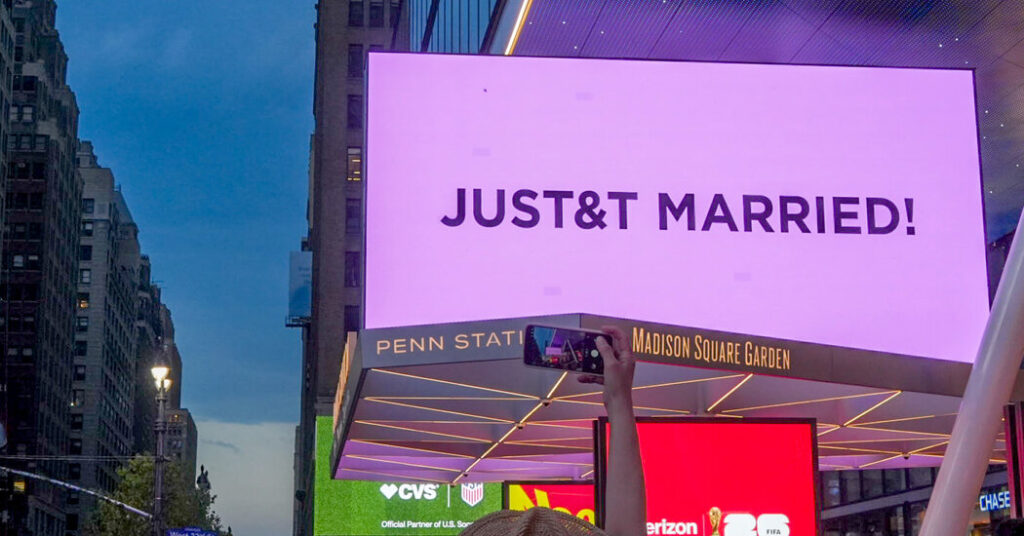
As we all heard this weekend, these quaint scenes of church bells, thrown rice and small-town social gatherings did not exactly align with Swift’s own singular and long-awaited journey to the altar. For starters, swap out the chapel for a maximum-security arena, the townsfolk for a somewhat absurdist litany of A-list celebrities (Hugh Grant? Brad Pitt? Mike Vrabel?) and the implied priest for Adam Sandler. Now you’re closer to the mark.
And unlike the fantasy she has imagined in song, Swift wasn’t a kid when she met the man she would marry. She was 33, still young by most metrics but also a grown woman with several dozen lifetimes’ worth of accomplishments under her belt, plenty of hard-won wisdom and self-knowledge gleaned from past relationships, and a net worth somewhere north of $1 billion and rising. It was still a fairy tale, perhaps, but a distinctly modern variety in which the princess doesn’t need saving by the prince so much as an assurance that he can handle, and maybe even be attracted to, her adult self-confidence and professional success.
Across the two decades that Swift has been releasing music, writing vivid depictions of romance and generally growing up in public, her ideas about marriage have slowly evolved, sharpening from soft-focus fables into something more realistic and personalized to her (very) specific needs. As the many fans who pore over Swift’s lyrics like scripture will tell you, the best way to chart that shift is to listen to her songs.
Fractured Fairy Tales
Despite her reputation as a wild-eyed dreamer, even in her early years Swift could temper her more starry-eyed depictions of marriage with skepticism. “Back then I swore I was going to marry him someday / But I realized some bigger dreams of mine,” she sings on “Fifteen,” from her 2008 album “Fearless” — looking back on her younger days from the wise, old age of 18. She wrote perhaps her most satirical take on holy matrimony for the playful title track of her third album, “Speak Now,” from 2010, which finds Swift scheming from the sidelines as the object of her affection prepares to marry a bridezilla, “wearing a gown shaped like a pastry” with a “snotty little family dressed all in pastel.” And so the girl who sang “It’s a love story, baby, just say yes” employs some light satire to skewer a sanctimonious ceremony and, in the song’s chorus, even slyly inverts that “Love Story” lyric: “Don’t say yes, run away now.”
The increasingly pop-oriented albums Swift released in her 20s — “Red,” “1989” and “Reputation” — more or less stopped mentioning marriage. Those albums were made as she honed her ability to document relationships that didn’t necessarily have staying power, but also as she learned how to better skewer her own hopeless romantic impulses. As she put it on the self-aware smash “Blank Space,” “So it’s gonna be forever / Or it’s gonna go down in flames,” knowing that the ashes would at least provide fodder for her songwriting.
Swift started singing about marriage in earnest again on her 2019 album “Lover,” released three years into her long and relatively private relationship with the British actor Joe Alwyn. The entire bridge of the title track is a recitation of playfully bespoke vows: “Ladies and gentlemen, will you please stand? / With every guitar-string scar on my hand / I take this magnetic force of a man to be my … lover.” A few tracks later, on the energetic pop rocker “Paper Rings,” Swift professes with palpable giddiness, “I like shiny things, but I’d marry you with paper rings.”
A New Romanticism
After pivoting to more character-driven fictions on her pair of 2020 albums, “Folklore” and “Evermore,” Swift began picking apart ideas about marriage with a newfound gusto on “Midnights,” her moody, malcontented synth-pop album from 2022. “He wanted a bride / I was making my own name,” she sings on “Midnight Rain,” auditing the failings of a relationship with a man looking for a wife who would be content to put her career on pause. On “Lavender Haze,” she rails against societal expectations of women and “the 1950s [expletive] they want from me.” As she puts it to her comparatively chill lover, “All they keep asking me is if I’m gonna be your bride / The only kind of girl they see is a one-night or a wife.”
Of course, it’s certainly possible (perhaps even recommended) to be critical of one’s aspirations, so what some of Swift’s detractors missed is that the critique of “Midnights” did not necessarily mean she no longer dreamed of marriage. That much became clear on her next album, “The Tortured Poets Department,” a lengthy purging of all the feelings surrounding her 2023 breakup with Alwyn and an intense rebound fling with the 1975 frontman Matty Healy. (The subject of her songs was often seemingly inspired by an amalgamation of the two.) On the title track, an otherwise flighty lover suggestively slips off the ring on her middle finger and puts it “on the one people put wedding rings on,” a romantic gesture that makes her swoon, “That’s the closest I’ve come to my heart exploding.” That image curdles into a false promise on the devastating piano ballad “loml,” which accuses an ex of stringing her along by “talking rings and talking cradles.” That Swift ends up rhyming “getting married” with “cemetery” suggests how that ended up. Even a song as arch as the flushed, cheeky pastoral “But Daddy I Love Him” has matrimony on the mind, as Swift has some pointed words for those who tsk-tsk her taste in men: “No, you can’t come to the wedding.”
Last year’s blockbuster “The Life of a Showgirl” was the first album Swift wrote entirely after she had started dating the N.F.L. star Travis Kelce, and it was released two months after they had announced their engagement. Skeptics were quick to accuse Swift of backsliding into some sort of pre-feminist fantasy, because she’d returned to singing about love, marriage and children (“have a couple kids, got the whole block lookin’ like you,” she sings on the airy reverie “Wi$h Li$t”), and some even used the reductive buzzword of the moment to dub “Showgirl” her “tradwife” album. But tradition has not exactly laid out a blueprint for a wife like Taylor Swift — a 36-year-old billionaire confessional singer-songwriter whose commercial peak is extending well into her late 30s and whose net worth (if you’re into that sort of thing) is estimated to be about 20 times her husband’s. Betty Draper she is not.
A Millennial Mirrorball
Swift’s engagement and marriage have been the subject of outsize fascination in part because she has chronicled her love life in her songs so vividly and for so long. But it is also because she has done so during a time of rapidly changing matrimonial mores, when more and more people are delaying marriage, forgoing it entirely or deciding for themselves which aspects of it to honor and which to discard. (The little we know about Swift’s wedding ceremony suggests that combined convention and idiosyncrasy, such as the decision to forgo a bridal party and call her brother, Austin, “the man of honor.”)
Indeed, across the two decades of Swift’s career the institution of marriage has undergone huge cultural, and legal, transformations. Consider that the first album she released into a moment when all 50 states constitutionally recognized same-sex marriage was her sixth, “Reputation.” The median age at which a woman gets married for the first time has risen about five years since Swift was born, and even about three years since she wrote “Love Story.” The sociologist Andrew Cherlin has popularized the idea that many modern marriages are not foundational transformations that herald the beginning of adulthood but “capstones,” occurring when both parties are a bit older and more financially independent. Despite its extravagant locale and ridiculous, megawatt guest list, Swift and Kelce’s marriage seems to fit this model.
“When I said I don’t believe in marriage / That was a lie,” Swift sang on the unapologetically earnest “Showgirl” piano ballad “Eldest Daughter.” You could read that as an overwriting of the more confrontational ideas she expressed on “Midnights,” I suppose. But you could also hear the song as the culmination of Swift’s two-decade self-interrogation and eventual acceptance of her own desires, a trial-and-error process in a time of rapidly changing mores that led her toward clarity about what her most personalized version of happiness looks like. That’s a love story, too.
The post Taylor Swift’s Shifting Thoughts on Marriage, Through Her Own Lyrics appeared first on New York Times.