All I needed was a call sign.
I was at a NASA airfield in eastern Virginia, watching mechanics prepare a squadron of eight fighter jets for the mission I would join that morning.
It had been a strange 24 hours. The previous day I had reported to a hotel where a flight surgeon and her assistant ran an EKG test on me before announcing, “Now we will measure your bones.” After thoroughly discussing my medical history and confirming the integrity of my eardrums, I was cleared to fly.
Now the adrenaline was pumping. I had donned an army green flight suit and heavy boots, tried on my flight helmet and more or less learned how to use my ejector seat. Soon I would be airborne.
I felt sublime — and ridiculous.
As a middle-aged suburban dad, my idea of adventure lately has amounted to, say, showing up at a restaurant without a reservation. Now I was imagining myself in “Top Gun,” as Maverick’s rakish new wingman. Maybe they could call me Deadline.
There was just one problem: A clear zippered pouch had been attached to the right leg of my flight suit. Inside was the tubular airsickness bag that I, like most civilian passengers, was expected to need at some point. It’s hard to feel like Tom Cruise when you’ve got a barf bag stuck to your leg.
Before long, I would be glad to have it.
But this wasn’t about me. I report on diplomacy, and this fighter jet ride — by invitation of the French air force — offered a window into a story about America’s independence that the French want to make sure we don’t forget.
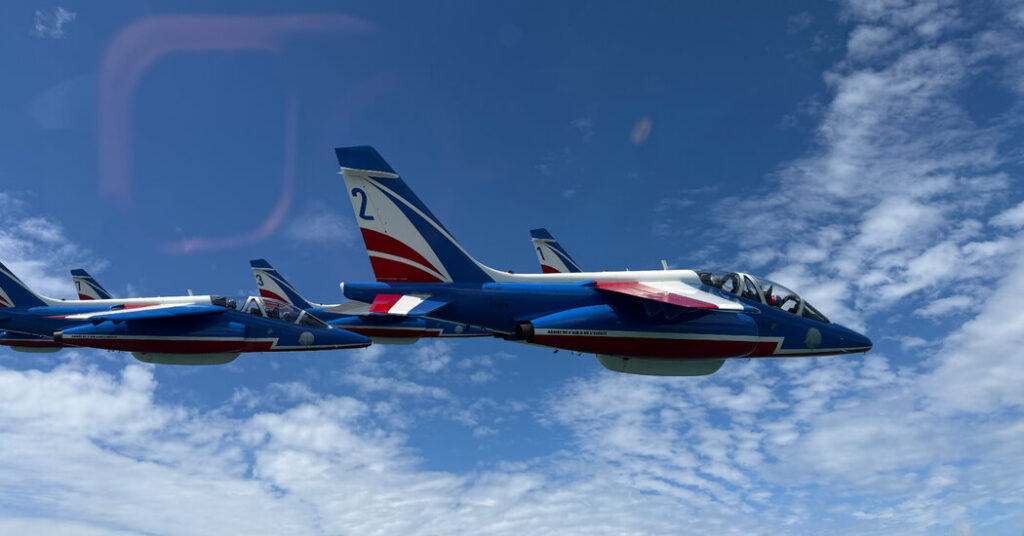
The fighter jets belonged to the Patrouille de France — “patrouille” translates to “patrol” — the acrobatics team of the French air force. Think the Blue Angels, with a certain je ne sais quoi.
Eighty five Patrouille personnel are here for the United States’ celebrations of the semiquincentennial, or 250th, anniversary of its independence. They are performing flyovers and joining air shows along the East Coast through July 4, when they will plan to punctuate their visit by flying over New York City and the (French-made) Statue of Liberty, etching the sky with smoke trails in red, white and blue.
This is friendship, yes. But it is also diplomacy.
Like so many European countries, France is doing its best to maintain decent relations with President Trump. It hasn’t been easy. Mr. Trump fumes that France and its neighbors haven’t done enough to help him fight Iran, and says he might not defend them in a future crisis. More recently, he has threatened to slap 100 percent tariffs on French wines and Champagne. Mon Dieu.
But France’s president, Emmanuel Macron, has shown a knack for handling Mr. Trump. In 2017 he dazzled the visiting American president with a Parisian military parade. Lately, Mr. Macron has celebrated America’s 250th birthday festivities by emphasizing France’s claim to be the savior of the American Revolution.
When the French leader hosted Mr. Trump at a Group of 7 summit in mid-June, for instance, he portrayed an opulent dinner at the Palace of Versailles as part of the 250th anniversary festivities. He recounted for Mr. Trump the way Benjamin Franklin had visited Versailles in 1778 seeking French support for the colonial rebellion against Britain.
Eager to undermine King George III, his British rival, King Louis XVI of France sent the Americans vast amounts of money and gunpowder, as well as troops and warships.
The support was crucial. Without the French, writes the historian Tom Shachtman, author of “How the French Saved America,” the Revolution might not have been won at all. Yet Americans, he adds, “are too beholden to our own myths to accept and appreciate how much we owe to outside assistance.”
Even Mr. Trump has said as much. “France helped us secure our independence,” he noted during his 2017 visit to Paris. “A lot of people forget.”
Enter the Patrouille.
Shortly before 10:30 a.m. a canopy closed over my head, and I was confined to a space about half the size of a typical airplane bathroom. Arrayed before me was a mostly incomprehensible instrument panel, though I knew enough to understand that I did not want the warning light labeled SAUTEZ — that would be French for “JUMP” — to start flashing. That said, in our brief chat before takeoff, my extremely courteous pilot seemed more concerned with the possibility that I might eject myself by accident.
The eight planes — twin-engine Alpha Jets, mainly used for training but sometimes modified into attack planes — roared into the sky one by one.
We took off and gently banked toward our first destination: Yorktown, Va., site of a major British defeat in 1781 that effectively ended the Revolutionary War.
The day after my flight, Brig. Gen. Pierre Gaudillière, a French air force general who oversees the Patrouille, reminded me of the vital role France’s military played in the battle. French ships blockaded the port town, and 10,000 French troops helped George Washington’s men force a crushing British surrender.
Yorktown “epitomizes the French contribution — decisive contribution — to your independence,” said General Gaudillière. It is a story thrillingly featured in the musical “Hamilton,” whose lyrics about the French Marquis de Lafayette’s revolutionary role General Gaudillière can recite from memory. (“Je m’appelle Lafayette! The Lancelot of the revolutionary set!”)
Some French find it annoying that, despite it all, Britain remains America’s favored ally in what is known as the “special relationship.” One French academic has even complained that Winston Churchill cooked up the idea out of national self-interest and that his successors have used it “to maximize their influence in Washington, and compensate for their relative decline.”
About all that, General Gaudillière had just one thing to say: “France has never been to war with the United States.”
(America even fought a second war with Britain, in 1812. That’s when British troops burned down the White House. The French never did that, either.)
The general also brushed off concerns about strains on the alliance under Mr. Trump. “This mission is beyond such considerations,” he said, “because it takes its roots in a very, very strong bond in history,”
The Alpha Jets zoomed low across the Chesapeake Bay in a V formation. As we approached Yorktown, the formation tightened. I could see the wingtip of the next closest jet about 10 feet away from ours, close enough to make out the markings on the pilots’ helmets.
“Smoke on!” my pilot said through the crackling radio. The planes deployed their red, white and blue smoke — which, in a happy historical echo, represents both the American and French flags.
Over my headset, my pilot asked me how I was doing. “Great!” I said. The ride was smooth, the views glorious, the formation thrillingly martial. I had not even reached for my bag.
That was good, he explained, because soon we would be doing formation “breaks,” which generate G-forces — a measurement of acceleration calculated as multiples of normal gravity — of 4 to 5. That’s enough to knock an untrained person out after a few seconds.
I did not pass out, but neither did I still feel great. By the time we made a pass over Colonial Williamsburg and headed for our touchdown at a Navy air base near Washington, I was clutching my sick bag.
Fortunately, I never quite needed it. I was in rough shape after landing, to be sure: drenched in sweat, weak-kneed and generally feeling like warm spoiled mayonnaise.
But I recovered quickly. Maybe that’s an omen for French-American relations.
The post What a French Fighter Jet Ride Taught Me About the Fourth of July appeared first on New York Times.