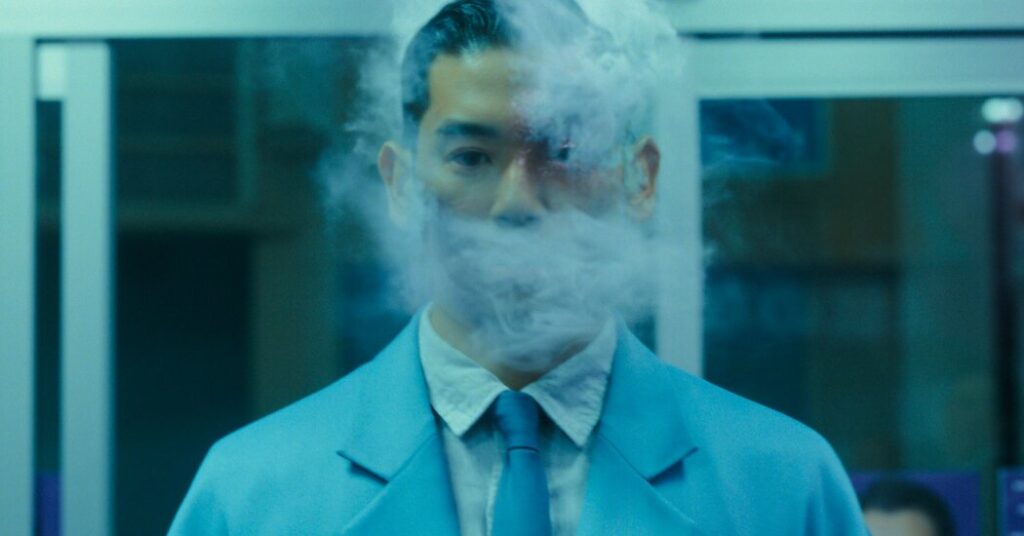
Six years after he unleashed “Godzilla,” the Japanese director Ishiro Honda let loose a smaller but no less frightening monster on the hapless residents of Tokyo. Mizuno, the villain of Honda’s 1960 film “The Human Vapor,” could turn himself into a cloud of white gas, capable of wafting into bank vaults and suffocating anyone in his path. In human form, he strode into a room full of cops and reporters and coolly identified himself as the bank robber, knowing he could escape through any handy air vent.
“The Human Vapor” is a highly diverting artifact, imbued with Honda’s crisp style and anticipating several strains of incipient swinging-’60s cinema: The smiling, coldblooded Mizuno would make an excellent Bond villain, and his obsession with an ethereal, classically trained dancer would be a typical plot point in chic Euro horror. (“The Human Vapor” is available at the streaming site FlixFling, apparently without subtitles; it can also be found on video sharing sites.)
Seven decades later, Honda’s sci-fi heist picture — a holiday from his giant-monster kaiju films — has been remade as a Netflix series, “Human Vapor,” and its lineage is likely to draw attention from genre aficionados. The South Korean filmmaker Yeon Sang-ho, director of the popular zombie films “Train to Busan” and “Peninsula,” had a soft spot for the original, and he worked with Honda’s studio, Toho, to develop the series with a Japanese cast, crew and setting.
Some of the changes Yeon and his collaborators have made — beyond dropping “The” from the English title — are the usual ones for a streaming series adaptation. “Human Vapor” has a lot more plot — the yakuza are now involved, along with a brother-and-sister team who host an online video horror series — and the back stories of the main characters are more thoroughly explored and interlaced. Other changes have to do with evolving standards of taste, such as the gas man’s new ability to make his victims explode from the inside.
And then some changes feel more specific to our moment. “The Human Vapor” reflected the anxieties of its era, but it was primarily an entertainment, a sci-fi-inflected caper wrapped around a tragic romance. “Human Vapor,” in keeping with our own anxieties, turns its title character into a semi-sentient golem, an avatar of revenge in a story that has been expanded — or reduced — into an anti-authoritarian, anticapitalist ecological parable. It’s still reasonably entertaining, but its guarded, morose atmosphere can wear you down across eight episodes.
Two central characters from the movie, the police detective Okamoto (Shun Oguri) and the reporter Kono (Yu Aoi), return in more melancholy, beaten-down forms, both pursuing the bad guy but often working at cross purposes. The vapor (a debut performance by the model Uta Uchida, billed as UTA) is now more of a righteous terrorist than a criminal, annihilating a talk-show guest and dispatching a former yakuza in a chain of killings whose motivation traces back to a bogus charity for the indigent.
With the occasional exception, like Hirokazu Kore-eda’s “Asura,” live-action Japanese TV drama is not a format with a distinguished history; it seems likely that a preponderance of the country’s storytelling talent is drawn into the anime industry. By that standard, “Human Vapor,” which is solidly acted and professionally assembled — and mostly avoids childlike sentimentality — is a step up.
This is to the credit of Netflix, which also presented “Asura” and Kore-eda’s mini-series “The Makanai: Cooking for the Maiko House.” At the same time, there is a blandness in the execution of “Human Vapor,” in the slight monotony of its action scenes and violence, that is also a Netflix hallmark. Knowing exactly what a studio like Toho expected in 1960 may have provided more creative freedom than guessing what a monolithic streamer will like in 2026.
The post ‘Human Vapor’ Review: Netflix Remakes a Japanese Sci-Fi Curio appeared first on New York Times.