This is an edited transcript of “The Ezra Klein Show.” You can listen to the episode wherever you get your podcasts.
So it’s the 250th birthday of America, and Donald Trump is president.
The celebration you’re getting from the Trump administration is very specific.
Archival clip of Pete Hegseth: Get ready, America. Because we’re putting our love of country on full display.
A celebration of American glory, American greatness. To describe it as “uncritical” would be underselling it.
There has been a severing of American history into two visions: one that can only see glory and one that can only see suffering and sin.
But one of my beliefs about politics is that until we can reintegrate that history, until we have leaders again able to tell a more holistic story of the country — one that is able to hold its triumphs and its tragedies together — it’s going to be very hard to move forward.
I’m in Montgomery, Ala. I think of Montgomery in some ways as the birthplace of American democracy. Not where it was conceived — that’s the founding — but where the actual thing promised at the founding really began to be born.
Archival clip from the Prayer Pilgrimage for Freedom: The people of Montgomery walked to maintain their human dignity and their rights.
This is where the Montgomery bus boycott began.
Archival clip from the Prayer Pilgrimage for Freedom: Let us all walk together for freedom, for liberty and equality.
It led to the civil rights movement —
Archival clip of Martin Luther King Jr.: I have a dream that one day this nation will rise up and live out the true meaning of its creed
which led to the triumphs and the laws that, for the first time, made America some version of the democracy and the country that it initially promised to be.
Archival clip of King: We hold these truths to be self-evident, that all men are created equal.
There’s a series of remarkable museums and sites here — including the Legacy Museum, the Freedom Monument Sculpture Park — that have been created by the Equal Justice Initiative as ways of apprehending that history, holding horror and beauty, tragedy and triumph, inhumanity and humanity together.
I think of wisdom as the ability to hold the totality of life. The wiser you are, the more of life you can hold. And I think this holds quite a bit in it.
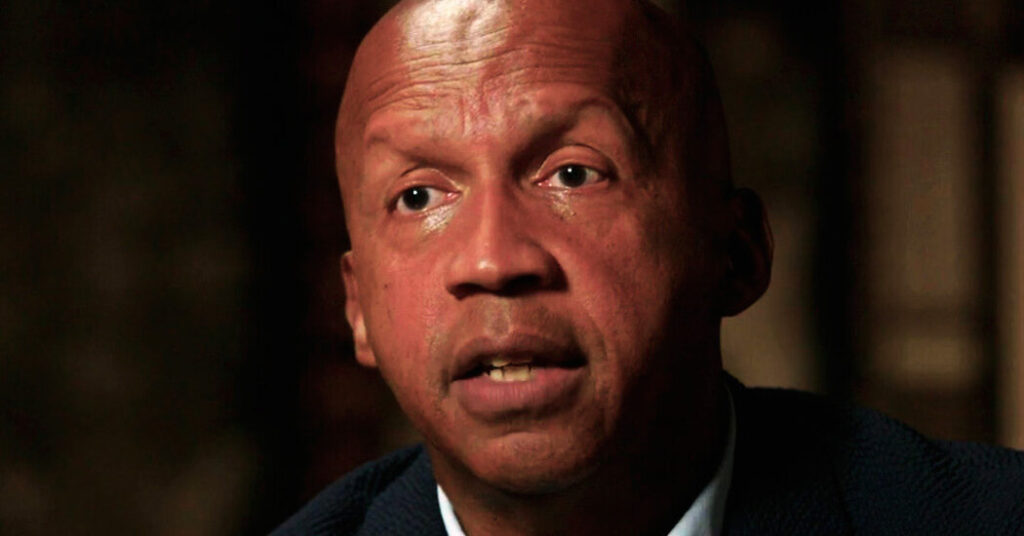
Bryan Stevenson is the founder of the Equal Justice Initiative. He has done amazing work over the years defending people on death row.
He is also the author of the book “Just Mercy,” which was turned into a movie, where he was played by Michael B. Jordan. How many of us can say that?
But over time, Stevenson began to expand that work into questions of remembrance, of our history and how we think about it, and whose humanity we are able to see inside of it.
Talking to Stevenson, I was interested in the question: How do you create a history of this country that loves it in its totality? How do you work with America’s past and its present in a way that doesn’t trap you in pain, but also doesn’t force you to inhabit only an imagined glory? How do you have a story that pushes a country forward, that enhances rather than reduces the bonds of brotherhood and solidarity between people within it?
Ezra Klein: Bryan Stevenson, welcome to the show.
Bryan Stevenson: Thank you.
We’re speaking not long before the 250th anniversary of America. What’s your relationship to that day?
I think anniversaries are always a time for reflection, to think about who we are and where we’ve been. But for me, even more important, is: Where are we going?
I think about this moment in terms of: What will people be talking about on our 300th anniversary?
The cage match?
[Laughs.] I hope that we will be past spectacle violence as a way to commemorate our nation.
Violence is a part of every nation’s history, but it’s not the best part — it’s not the glorious part. It’s not the battles won, it’s the ideas that motivated people to stand up for things that they believe in that I think are most important.
So I see this as a moment for reflection, to acknowledge things that are extraordinary and wonderful — but also to acknowledge things that are difficult and painful that continue to harm and haunt us.
We’re sitting here in a museum — in a place built to commemorate, to take seriously, to stare unflinchingly, at some of the most brutal, violent, horrible moments in American history. And not just the moments but the people who this violence was inflicted upon.
We’re going to talk about different pieces of the museum that moved me and what they mean. But for you, spending so much time in those eras, thinking so much about how to represent them, thinking so much about how to make people feel something they may not want to feel — what has that done to your relationship with America itself or the idea of America, the story of America?
I moved to Montgomery in the 1980s. We had 59 markers and monuments to the Confederacy. The three largest high schools here were Robert E. Lee, Jefferson Davis and Sidney Lanier.
People had to walk around in a space that shouted the history of the Confederacy and would not even whisper the history of slavery. You could not find the words “slave,” “slavery” or “enslavement” anywhere in the city landscape. And I think that does something unhealthy for everybody.
So I just saw it as a way of creating a space for us to understand our history more honestly, more completely. I think it is a narrative journey that you have to undertake, and there will be pain along the way. But it’s a very familiar way of helping the world reckon with human rights violations.
I mean, we have nearly 200 Jewish and Holocaust museums across the world. We have over 40 in the United States. I think we need all of them.
And when you go to the Holocaust museum, at least when I do, I get to the end of it, and I am motivated to say: “Never again.” I’m not Jewish, not connected to that history, but I am motivated by the suffering and the brutality that I have learned about to say: “Never again.”
For me, this country has never created a relationship to our history of racial violence, of enslavement, of lynching, of abuse of other people who are disfavored. We’ve never created a relationship to that history that has motivated us to say: “Never again.”
And because we’ve never made that commitment of “Never again,” we keep being romanced by new manifestations that pull us into the very patterns and behaviors that allow that kind of violence to be replicated.
There’s also conflict in bringing up this history. Donald Trump is president, and there has been an ongoing fury from him and from his White House, going back to his first term, about their sense that people like you — who are trying to create a relationship to our racial history, trying to create a reckoning with it — are trying to take the story of America and poison it.
Archival clip of Donald Trump: By viewing every issue through the lens of race, they want to impose a new segregation, and we must not allow that to happen.
Critical race theory, the 1619 Project and the crusade against American history is toxic propaganda — ideological poison that, if not removed, will dissolve the civic bonds that tie us together — will destroy our country.
In answer to the New York Times 1619 Project, they created the 1776 Commission. One of the sources of their political strength and also the engine of their political argument is that there is an organized faction trying to corrupt the story of America, trying to force us into a space of endless repentance to acidify the bonds of solidarity between us.
We are a nation. Nations need stories everybody believes in. One thing they offer the country is the ability to be proud of America.
What do you think of that?
Well, I think there are so many areas of our lives, particularly in this country, that are inspiring and energizing and create joy and create meaning and purpose. There are lots of opportunities to feel proud and excited about what we have done.
We cheer for our Olympic teams, we cheer for achievement, we cheer for success. The technology that has changed the world is something that we all embrace and celebrate — communication. But that doesn’t mean that’s the only thing you should think about, the only thing you should talk about.
I think public health, human health, is a really great way to think about this. It’s like saying we don’t want physicians to tell people that they have high blood pressure or diabetes because that’s depressing, that’s demoralizing. That it’s going to make people feel bad when they walk out.
We could ban physicians from ever giving that diagnosis, but the people who have high blood pressure, the people who have diabetes, are going to get sick. They’re not going to be healthy, and eventually, it will kill them in ways that they don’t have to die.
If you talk to military leaders in military colleges and all of these academies, what they study are the mistakes we have made during our past. It’s the misjudgments during war. It’s the miscalculations that created outcomes that we didn’t want. That’s what you study so that you don’t replicate those mistakes in the future.
You do the same thing in science. You do the same thing in business. That’s how we have succeeded. That’s how we have achieved in this country.
I don’t share the view that we are doomed. I don’t share the view that we are corrupted without any opportunity for repair.
I genuinely believe that there is something that feels more like freedom, more like equality, more like liberty and more like justice waiting for us in the United States. I think it’s just waiting. But we will not get there if we don’t find the courage to unburden ourselves from the parts of our history that hold us back. I genuinely believe that, and I see lots of examples of it all the time.
We’re here in Alabama. In Alabama, college football is like religion. It really is. If you moved here, people would start asking you almost immediately: Auburn or Alabama?
There was this intensity around college football that I didn’t quite understand. At first, I thought: Oh, they don’t have a professional sports team — that’s what it is.
No, it’s more than that. There’s an identity that has evolved in this state that is connected to the success of these athletic programs, and the question becomes: Why?
And when you think about it, here in Alabama, it’s one of the things that we can be legitimately proud of. We have won national championships against everybody — the Californians, the New Yorkers, the Midwest. We beat them on these playing fields, and it generates pride.
I just want to step back a few decades and remind people that George Wallace said: Segregation forever.
He stood in front of the University of Alabama schoolhouse door and said: Black people will never walk through these gates.
Most of the people in the state supported him. But then courageous Black athletes and courageous white parents sent their kids to that school as integration took place.
Then we got excited about the possibility of winning, and our desire to win overcame our desire to be segregated, and we started winning. Now you see this pride, you see this joy, you see this triumph for this state. And on those game days, Black people, white people, poor people, rich people are all glued to the TV. They’re all at the stadium. They’re all celebrating.
It’s like what’s happening with the Knicks in New York City. That triumph is a state triumph. It’s an everybody triumph.
And the only thing I want to acknowledge is that you owe that to the civil rights movement. You owe that to the courageous people who said: No, we reject “Segregation forever.”
If we understand that, then we begin to imagine: Well, where else might we have achievement and progress and win things if we got past that bigotry, if we got past that fear?
I always feel that you can make a real argument that Montgomery is the birthplace of American democracy.
Not where it was conceived. There’s a conception of American democracy that happens, arguably, in 1776, or maybe before that, depending on how you want to think about it.
But America is not a democracy until at least after the Civil Rights Act and the Voting Rights Act, by any real measure that we would recognize today.
And what turns that begins here with the bus boycott. This place is not just a monument to segregation or Jim Crow. I really do think the civil rights movement to be the most beautiful moment and movement in American history — of course, braided in with some of the absolute ugliest and most horrifying moments in American history.
But somehow, taking that in its totality, not choosing one or the other, not seeing so much of the ugliness that the heroism disappears, that you cease to see that as America, too — or vice versa — that feels like a mature relationship to our history.
Wisdom is holding both things as part of the American synthesis.
Oh, absolutely. I even think it actually starts earlier than that. When I think about the legacy of slavery, one of the things that I’ve been focused on a lot since we started working on our Legacy Sites is how extraordinary it was that when those four million Black people were emancipated after the Civil War, they decided not to seek revenge and retribution against the people who enslaved them.
They knew who sold their children. They knew who abused them. They knew who raped them. They knew who did all of these horrific things, and they could have given in to the emotion, the desire to seek retribution and revenge against the enslavers, the people who did these torturous things.
But instead, when you look at what happens after the Civil War, you see this community of people choose America.
They say: You know what? We’re going to build schools. We’re going to build churches. We’re going to build families. We’re going to commit to this country like nobody has ever committed before.
Black men registered to vote. They ran for office. They tried to create harmony and peace with those who had enslaved and tortured them. It was a remarkable commitment to a healthier, better future.
It collapsed quickly, and that’s what gives rise to a century of segregation and Jim Crow laws. Black people were killed by the police on buses. It wasn’t just one day. It was a whole history of abuse.
Black people had to get on the front of the bus, pay their fare, get off the bus, go to the back door, and sometimes the bus would just drive away before a Black person could get on the bus. So many Black riders in Montgomery would be left humiliated on the street, and that was the reality.
But to understand what happened in 1955, I think we need to have some appreciation for what happened in 1865. Because when they made that first commitment to build America and were brutally and violently rejected, you could also understand why people might say: We’re never going to do that again.
But that’s exactly what happens in 1955, when people finally said: We’re going to challenge this — they were believing in an America that would respect them, that would respond to their challenge to stay off the buses — every Black person in this community, 50,000 people. It’s remarkable.
And they succeeded. And that success then gives birth to the civil rights movement and inspires people, Black and white, to commit to swim-ins where they might be poisoned or threatened with acid; to commit to read-ins where they might get beaten and pulled out of libraries; to commit to freedom rides where riders were bloodied — brutalized. And to commit to all of that activism and struggle that then yielded this incredible moment in 1965 where democracy in this country took shape in a way that had never existed before.
And I think you’re right. That decade, that’s why we have this language at Montgomery Square: “the decade that changed the world.”
One thing that the museums, the sculpture sites and the monuments you have put together here do really beautifully is what you did there, which is to show this as an integrated history.
There’s no one moment. There are no eras disconnected from each other. So it begins even before slavery in this country, begins at the beginning of the slave trade.
When you walk into the museum, you’re greeted with waves.
I spend a lot of time with data visualizations. I’m not usually very moved by them. But you have one that is visualizing the flow of slave ships, and where they went, which was not, initially, primarily to America.
The slave trade was much more global than that. But you begin to see, as you take us into the 1700s, the 1800s, it concentrates in America — toward cotton, toward the South, toward those riches.
That’s, I think, the first thing that began to really settle into my soul from being at the museum. It made me think about the people on the ships in two ways.
One is — and you have incredibly moving installations around this — the people ripped from their homes and their families — pregnant women, children. Two million die in the crossing, just a huge number of people. So many throw themselves overboard. It’s gutting. It’s a truly gutting thing to sit with.
I also spent time thinking about the enslavers. And one thing that was really present for me throughout the work you all have done here is the power of stories. And what stories it must have taken to not see the humanity of the people before you — not see that when they were weeping, those tears mattered. Not see that the families you were destroying and dissolving loved one another and mattered exactly as much as your own. Not see that they were humans and that you had become the monster. And to do all this with a Bible in your hand.
I’m curious, having sat in so much of this, how you understand what those stories were that led people to sacrifice their humanity and to betray the humanity of the people they were enslaving?
I think that’s such an important question. The trans-Atlantic trade and that water in the Atlantic Ocean, just as backdrop, that exhibit really came out of my first trip to Africa. I mention this because I think it’s true for all of us. We’re all learning, evolving.
I grew up on the ocean. The Atlantic Ocean was the beach. It was a place to go. And then I went to Africa for the first time. There was a misconnect — I was supposed to give a speech in Abuja, in Nigeria, and I got there too late. So they sent somebody to meet me at the airport in Lagos who was supposed to take care of me.
And this young lawyer met me at the airport, and he was very nice, and the first thing he said was: I’ve canceled your hotel room. You’re not going to stay in a hotel. You’re going to stay with me and my family. My son is excited to meet you.
He was committed to giving me an authentic experience. He said: I have to show you Lagos. It was, like, 11 o’clock at night, and he took me all around the city, and we literally went into neighborhoods, and he would start shouting: Hey, everybody, come out and meet this Black American lawyer.
People would come out, and these women were trying to sell me shea butter and all these products. And it was rich. I was tired, but it was rich.
He took me all around the city, and I finally said: Man, I have to get a little rest. Can we just go home? I have to get up early.
He said: OK, one more place.
And he took me to the beach.
I didn’t even think about the beach in Lagos. It was not pretty. It was dark. It was concrete slabs. There were soldiers with guns and fast food. Nothing beautiful about it. He said: Come on, come on.
We climbed over the concrete slabs down to the shore of the beach. It was dark. You could see the moon shining across the ocean. And this guy who had been so gregarious and so talkative all of a sudden got so quiet.
I was standing there, and I looked over at him, and he was crying. He had a tear running down his face. Then he looked at me, and he said: I brought you here because I wanted to tell you I’m sorry. This is where we lost you.
For the first time in my life, I realized I was standing on the other side of this ocean that separated me from everything that’s important about me. My identity, my culture, my history was all taken from me by the Atlantic Ocean.
If I take a DNA test, I show up in 24 different countries. It hit me hard. First time. And it changed my relationship to the Atlantic Ocean.
When I got back here, I realized that body of water needed to be understood more honestly. We’ve spent millions of dollars looking for trinkets from the Titanic in the Atlantic, and we haven’t spent hardly anything to reckon with the two million bodies that are buried in the bottom of that ocean.
So a story can help us understand things about who we are and our relationship to the things around us that are important.
I still love the beach. I still see it as a place of beauty. But I also see this need to help others understand the harm that was caused by moving millions of people off their land, their place, their space. It was really unprecedented in human history.
So the second part of your question gets to the how and why. And when I look at the history of enslavement and try to understand how did that come — because you’re right: People who enslaved other people thought of themselves as moral and decent and Christian. And you have to ask: How do you think of yourself as moral and decent and Christian when you’re pulling away a screaming woman from her children, knowing that mother will never see those children again because you’re treating her as property?
How do you do that?
And you beat her for crying.
And you beat her. And you abuse.
You have so many exhibits on this.
I think you have to understand that takes a false narrative. In order for those people to feel moral and decent and Christian, there had to be a false narrative legitimating, sustaining, animating what they were saying. So we created a false narrative in this country.
It actually began when Europeans arrived, and we had to deal with Indigenous peoples, which is part of the reason I think we need to talk more about that history. When we created our Constitution, when we declared independence and advanced these ideas of equality and freedom and justice, we denied native people protection.
We said: Oh no, those native people, they’re different. And we created this narrative of racial difference that we used to justify forcing people off their lands, the famine, the war, the disease.
That narrative of racial difference, the same narrative, is what was used to justify 246 years of slavery. The false narrative was that Black people are not as good as white people, that Black people are less human, less evolved, less capable.
And that’s why I believe the great evil of slavery wasn’t the bondage, the forced labor, the violence, all of those things. I think the true evil of American slavery was the narrative we created to justify enslavement.
When I give talks, I often argue that the North won the Civil War, but the South won the narrative war. Those ideas of racial difference and racial hierarchy, they continued.
And an important footnote on that: Even many of the abolitionists in the North, even many of the people who did not believe in slavery, also did not believe in racial equality, which is a reason Reconstruction collapsed. They retreated from that because they were being governed by this narrative of racial differences.
So then when Southern states started codifying racial segregation and creating Jim Crow, it didn’t seem as strange as you would imagine it should be to have laws barring Black people and white people from sitting in the same part of a bus or playing checkers together or living next to one another.
This absurd, crazy world where Black kids couldn’t play with white kids and Black people couldn’t say this to a white person — that is all rooted in this narrative.
We talk about mass incarceration in the same context. Because I think there’s a way in which we have tolerated throwing away hundreds of thousands of people because it’s politically expedient.
During the drug war in the 1970s — we had about 300,000 people in our jails and prisons until the 1970s, and by the end of the century, we had over two million. How did that happen? Well, we had people from both political parties saying that people who are drug addicted, people who are drug dependent, are criminals who should be punished for their addiction and dependency.
People are trying to kill the people I represent. It’s heartbreaking to me. I’m working on a case now involving a 10-year-old child, and there are people in this state who refuse to put this child in the juvenile system. They’re trying to keep him in the adult system. A 10-year-old boy. And because there’s no place for 10-year-old children in the adult system, what they do with a 10-year-old boy is put him in solitary confinement.
That is such a destructive, cruel, abusive thing to do. And if I could just get them close enough to this child, I don’t think anybody would say that’s what we should be doing. But they won’t get close.
But some of them are close to this child. There was a judge who sentenced that child, no?
Well, there was. But judges don’t have to get close to the people they sentence. I think one of the things, if I could radically change our criminal legal system, I would make judges go to jails and prisons and see what’s happening to people in jails and prisons.
I would actually make them spend time in low-income communities, the ZIP codes where you have the highest rates of arrest. I would want them to go and actually see the lives of children, see what’s happening to kids who are born into violent families, where people are always shouting, who are living near gunshots all the time — to see the environments so they could have an appreciation for who that person is.
But that’s the problem now: We have so many people with the power — police, prosecutors and judges — who are disconnected. If the only thing you see is people at their worst, then that can mislead you, as well. That’s what happens to a lot of law enforcement. You only see people on their worst day, and that makes you angry, and I get it.
But if you actually spent time with their mothers, their siblings, the people trying to help them, if you spent time in poor communities, and you actually saw the struggle people are engaged in to overcome, then I think you’d actually have a different mind-set.
But I think this child is a consequence of the way in which we’ve divided things. Almost all the kids under the age of 13 in this state who’ve been condemned in this way are kids of color, and the judges are almost all white.
I was in the lynching room at the Legacy Museum, and I found that — of everything I sat with here — to be the hardest space to sit in.
Yeah.
But two things really sat with me. One was you have put up all this coverage of lynchings — newspapers and announcements and invitations to come out to see the lynching — of kids, of 13-year-olds, of 15-year-olds. There’s one in which an infant is lynched. And that’s talked about just as a fact: This is what happened. This is what we did.
And then the other was this other dimension of the news reports that you put up — the thirst for violence. There were multiple instances where they couldn’t find the person, so they lynched the brother.
Yes. Yes.
And that was, again, reported on and advertised: He talked too much. Now he won’t talk anymore. That was the way another one was described.
This difference between being close to someone and being near them is maybe a different way of saying what I was saying. There was a judge at some point near that child. There was a prosecutor near that child, in a room with that child.
And in these communities, there is maybe not closeness in the way you’re describing it — an intimacy, a seeing of another person’s struggle, humanity, dignity, soul — but there’s nearness.
And in some ways, it seems like you can feel a pulsing fear behind the nearness, right? Particularly if there’s ever evidence of revolt, of violence, of people trying to fight back in a system that is destroying them. Then the system has to come down with extraordinary force on them or anybody near them.
Yeah.
Escape. The punishment for escape would be, in some ways, the most honorable and human response to what is being done.
The number of people who are brutalized, or at times lynched, but certainly brutalized during slavery, for just going at night to try to see their wife who has been moved or their mother.
There’s something about this nearness but not closeness.
I think that’s right. The people who were most at risk of lynching violence in the 20th century were Black veterans after World War I and Black veterans after World War II.
I didn’t know that.
Why? Because they had gone to Europe and fought. They’d been given a gun. They had done something that people applauded them for. France celebrated them, and now they’re back in Mississippi, now they’re back in Georgia, and for the local power structure, that was a threat.
So they would try to humiliate them: Boy, take that uniform off right now. And they would say: No. And their resistance was such a threat to this social order, this racial order, that they would be particularly at risk of victimization.
So I think you can look at that in terms of proximity, and I think that is a very real framework. But it’s also worth stepping out from that: How did that happen? Well, that’s where I think this narrative becomes so important.
And part of what I’m saying is, yes, it is not good for you to enslave another human being. I don’t want you to do that because I care about you. I think it will corrupt your heart, your soul. It will limit your capacity to love.
It is not healthy to say to people: You can’t love that person because of their color. It is not good for you to take your children to a lynching, which many families did, and let them watch a Black man being brutalized and mutilated. It’s not good for them. You’re going to create an unhealthy relationship to life.
And that’s why I do see this as an effort to liberate everybody, to uplift everybody, not just the people who have disproportionately borne the burden of this bigotry, but everybody.
There’s a picture right next to us of a bunch of white families staring at the feet of a lynched man, and some of the children are in ties. They dressed them up for the occasion.
I was thinking, as you said some of that, about the word “narrative.” I’m trying to open up what I felt about that.
“Narrative” somehow seems so thin for what it was. There’s a narrative in a book. There’s a narrative in a Pixar film.
This wasn’t just a story people were telling. It was a way that they were and were not able to register plain facts of the world in front of them. Which isn’t to say it’s not a narrative or not a story, but it made me think about what has to happen for a story to penetrate so deeply that it is more powerful than your immediate reality to you.
I always think of Descartes vivisecting animals, and as they scream — and animals do scream if you cut them open while they’re alive — saying: They’re not really feeling pain. Those are just mechanical sounds.
One of the parts of the museum that I really spent a lot of time in was the ads to sell slaves. The reason I found myself just reading more and more and more of them is that there are moments when you saw something, a dissonance breaking through.
We talk about narrative, but there’s also the power of self-interest and of interest. And as you read these — there’s a wall of them in the museum — the slaves, the people are described as “able to learn anything,” “completely trustworthy,” “of a great family.” They read almost like college endorsement letters. Because they’re trying to get the highest price for them.
So on the one hand, there’s this narrative, this story of brutishness, of subhumanity, of incapacity, and then it’s: Peter is a master bricklayer.
You see something happening: what is known but can’t be admitted.
I think you’re absolutely right that the reality of being with another human being, seeing another person’s humanity, is always going to emerge in ways that are powerful.
I grew up in segregation. But for Brown v. Board of Education, I would have had a life where there was no engagement with people who were white. But because of that decision, lawyers came into our community, made them open up the public schools, and I began interacting with white kids, and they began interacting with me.
And by the end of high school, gosh, they elected me to be the president of the student body. Which would have been inconceivable — not because I was particularly special but just because we were able to get to a place of relationship.
I say that because when you think about the harm done by segregation, we never focus on what it did to our understanding of who we are. I think about the lives of most Americans in the 20th century. There were very few places where people had racially integrated lives.
And now what’s happened is we’re seeing that replicated again. Our public schools in Montgomery are racially segregated. The public schools are 76 percent Black. White parents didn’t want their kids going to school with Black kids after Brown, and so they left and started creating private schools and charter schools, and that separation has continued. That’s the tragedy of the narrative that keeps us apart.
When you really get to know a person — again, I see this in my legal work. A lot of what I’m trying to do in this space has been informed by that. I’ve had correctional officers come up to me with tears in their eyes when one of my clients is getting close to an execution date and say: Please, please save this man. He’s a good person. He doesn’t deserve this.
They wouldn’t be able to testify to that in court. If I asked them for an affidavit, they wouldn’t be able to do that because they would lose their job.
But it was a genuine understanding that this is a human being whose life has meaning and purpose and value. He’s not someone who’s beyond hope, beyond redemption. And it wasn’t even about innocence or guilt. It was about what they observed.
So I do think that dissonance, which you see in those ads, is a dissonance that was intentional, that was sustained obviously by the economic benefit of saying something positive about this person that you’re trying to sell. But you can see it throughout history.
And this brings us, in a way, to the 250th anniversary, to 1776. You can see it in the founding fathers. Many of them knew and left eloquent writings to the effect that slavery is a moral horror that God will judge this country for. Not only did they not abolish slavery upon the founding of the country, but they did not free their own slaves.
That’s where I think there’s something interesting in this question of how it almost takes us off the hook, then and now, to say that the problem was everyone believed a story that wasn’t true.
Because many people knew the story wasn’t true, or they believed multiple stories at one time. But it’s sometimes hard, costly, to act upon what you know is true.
You don’t have to take away from the brilliance of the founders or their morality in other dimensions or what they gifted unto the world to say that, actually, it’s a profound warning to read their writings on this and then recognize what they did not do.
Absolutely. And that’s why exploring what they did not do is as important as exploring what they did, understanding what they did. To not reckon with what they did not do, it’s not just dishonest, it’s misleading. It will allow you to believe that greatness can be achieved without completeness, without something that’s consistent.
I just think, again, it ends up being unhealthy. I think about incredibly talented people I know, and I could talk forever about how unique and skilled and talented they are as a musician, as an athlete. But I also know that they are suffering, that they are struggling, that they’re dealing with mental health challenges, emotional challenges, depression.
And if I don’t talk about that, if they don’t talk about that, their talents will not define them. They’ll be overwhelmed by these other things. So that’s why I feel like it’s unhealthy not to acknowledge the tensions, the contradictions, the failures of the founding fathers and the failures of our larger society.
Let me have you expand on that because I think that’s a very profound statement. I want to remember how you said it: that greatness is not possible without completeness.
I think many people have the fear that what you will have if you confront, if you admit, if you look straight at your failings, your country’s failings, is not completeness so much as a kind of overwhelm — that you will be overwhelmed by the darkness.
Tell me why you don’t believe that.
Well, I just think we have too many examples of that not happening to fear that it will happen to us.
A lot of what I’m doing here came out of going to South Africa and visiting the Apartheid Museum. To get into that museum, you get a ticket, and the ticket will arbitrarily assign you a label that says “white” or “colored,” and you have to go through the door that your ticket corresponds with.
So before you even go into that museum, you have to deal with the discomfort of participating with apartheid.
And I went with three or four Swedish lawyers. We were all at some human rights conference. And we all bought tickets. We all got tickets that said “white.” And when they realized that, and they saw the doors, they immediately stopped and said: Ooh, no.
And they went back to the Black woman working at the counter and said: Yeah, we don’t want the white ticket. We want the other ticket.
And she wouldn’t sell it to them. But that sense of discomfort before you even go in ——
What did it feel like for you?
Well, I walked right through the white door. It didn’t bother me, because I understood what they were trying to do.
They were trying to get you to imagine, to appreciate, to engage with, the arbitrariness of that regime. But there were rooms in that museum where there were nooses hanging from the wall, and I was like: Oh, my God.
And when I left, I thought: We don’t have any museums like this in America.
Then I went to Berlin, and in Berlin, I was blown away. You can’t go 200 meters in Berlin without seeing the Stolpersteine and the markers and the monuments dedicated to the victims of the Holocaust. The Holocaust memorial sits in the center of Berlin. There are like a dozen museums dealing with the horrors of the Holocaust just in Berlin.
There were no Adolf Hitler statues. There were no monuments to the perpetrators of the Holocaust. In Germany, you’re required to understand the Holocaust before you graduate from high school. You can’t graduate without a detailed understanding of that history.
And they don’t have people saying: Oh, we can’t teach our kids about the Holocaust. That might make them feel uncomfortable or ashamed.
It’s the opposite.
Well, now they do have some people saying that. And I think this is important because I remember our earlier conversations, and you were telling me about Berlin, and in the decade or so that has passed since then, we’ve seen the rise of the AfD.
And at the nuclear core of the AfD, they have an argument about immigration and many other things, but much of their appeal is about restoring German pride and allowing Germans to be proud of who they are again.
There is no vaccine against bigotry and politics of fear and anger. Nothing will insulate us from tensions, and you see that in Germany, you see that in Europe. But when you think about Germany, the villain of the 20th century, and where it stands today in the 21st century, in less than 80 years, that nation has transformed itself.
It wasn’t immediate. If you talked about the Holocaust, you’d get booed. You’d get shouted at.
But what has happened there in the last 80 years, I think, is quite remarkable, and we need to understand that before we say: Oh, we can’t talk about that in the United States because we’ll get defined by that. We’ll be overwhelmed by that.
The principal difference, of course, is that in South Africa, there was a change in power. A Black majority took over, and they were insisting on reckoning with the history of apartheid.
The Nazis lost the war. Had the Nazis won the war, we wouldn’t see the Germany that we see.
And in the United States, there hasn’t been a shift in power. The people who benefited from enslavement didn’t have to forfeit all that they benefited from. The people who actually fought against the United States were quickly restored to power and didn’t have to give up anything as a result of that.
The people who lynched others were never held accountable, even in the 1960s. The moment we’re in now is, I think, a consequence because we never required accountability. We didn’t even require people who disenfranchised Black people for a century to say: I’m sorry. I’m wrong. We shouldn’t have done that.
Almost all of them voted against the Voting Rights Act in 1965, all of these Southern Congress members, and they just began scheming for ways to maintain political disenfranchisement.
It’s the absence of reckoning that allows the problems that contribute to these issues to continue.
It’s interesting to me how much the memorials in other places informed what you have done here.
Being here, I thought a lot about Holocaust museums, concentration camps — that exists very much in my family’s history.
And I had a similar feeling here that I have there, that confronting the Holocaust doesn’t make me afraid of Germans. It makes me afraid of human beings.
Confronting that photo of people in their Sunday best looking at a man hanging from a tree doesn’t make me afraid of Americans or whatever county that might have happened in, the people of that county.
It makes me afraid of human beings — that what we are capable of is very easy for us to deny. And it’s also a mistake, I think, to assume that it’s only what they are capable of.
Absolutely. I’m glad to hear you say that because that’s the goal.
People will say: Well, my people never enslaved anybody. As if somehow that exonerates them from living in a community where the hotels and the railroads and the business and the insurance — all of that was trafficking in the commerce of slavery. You didn’t have to enslave someone to benefit from slavery.
So that’s not the right framework. If you’re looking for a personal exoneration in that way, that’s not going to get us where we need to go.
We are succeeding if we can get people to think past the particulars of the moment, the particulars of the era, which is what a lot of people do when they tell you: Don’t talk about that. That’s in the past. It doesn’t matter anymore.
They’re trying to reduce it to a particular phenomenon: Stop. Why are you talking about slavery? That happened a long time ago.
I think if you truly appreciate the harms of slavery, if you truly appreciate the harms of lynching, if you truly get to the horrors and the harms of segregation, then you’ll begin to never want to tolerate abuse of power. You’ll never want to exploit people who have less privilege. You’ll begin to talk against hatred.
Part of why I value making this a human story and recognizing the humanity of every person is because it stops mattering where you are in the story. You just know that it is wrong.
There’s not much in the museum about the abolitionists or about the Civil War. There’s a lot about enslavement. Frederick Douglass is not absent, but he’s not highly present — to say nothing of Lincoln or anything in that vast movement that ended this horror, and particularly the parts of it that did so when it seems so remote.
Now we see it on the other side of the story, but when I read the biographies of Douglass or others, there’s just such a long period when that work seemed so unlikely.
Well, if you ask most people in this country: What do you know about slavery? They’ll say: Well, we know there was a Civil War.
Can you identify anybody? Frederick Douglass. Maybe Harriet Tubman.
And it doesn’t help them understand anything about slavery. To know that someone escaped and then did these remarkable things, that’s an achievement narrative.
But I think it’s misleading to reduce slavery to the story of abolitionists or to reduce slavery to the success of Frederick Douglass. Because what that does is it actually allows you to avoid the pain and the harm and imagine that it created this opportunity for this great man to emerge.
What you need to know about slavery is how cruel it was, how horrific it was, how painful it was, the ways in which it distorted.
Most people haven’t thought about what it was like to be an enslaved mother and to give birth to a child, maybe even as a product of rape, and have to decide: Do I love this child or not? Half the people I know are being sold away from their children, or their children are being sold away from them. If I love this child, my heart is going to be broken, so maybe I shouldn’t love this child so much because it’s just too fragile. It’s too likely that they’ll be pulled away from me.
And when you learn that most of these mothers chose to love despite the threat that they would be sold, despite the fact that this was a product of sexual violence and rape, you begin to see something different about that enslaved woman. You begin to understand something different about these people. And if you don’t understand that, then you’re going to misunderstand the nature of slavery.
My great-grandfather was enslaved in Caroline County, Va. And even though he was enslaved, and enslaved people could lose their life for trying to read or write because it was against the law, my great-grandfather learned to read and write as a teenager.
He risked his life to learn to read and write as a teenager because he had a hope of freedom. This was the 1850s. He didn’t know a civil war was coming, but he had a hope of freedom, and he learned to read and write.
My grandmother told me that after Emancipation — something I never talked about before — my great-grandfather would read the newspaper to formerly enslaved people, whom he would invite to their house once a week so they would know what was going on.
He would stand on the porch and read the newspaper from front to back. People who didn’t know how to read or write would hear him read. And my grandmother said she loved the fact that her dad knew how to read.
She said: When my dad started reading, I would push my siblings aside, and I would get near him, and I would just wrap my arms around his leg.
I said: Mama, why’d you do that?
She said: Well, I would wrap my arms around his leg because I wanted to learn to read, too, and I thought you learned to read by touching somebody while they read.
He taught my grandmother to read and write, and she would insist that we would read. I would sometimes go to visit her. She’d make these desserts that smelled so good. She’d say: Come on, Bryan, get this pie. And I’d go running, and she’d be in front of the kitchen with a stack of books. She’d make you read for the dessert.
But what I realized is that there was power in the hopes of those who had come before me. I felt lifted up by generations of people who had struggled.
That’s what we’re trying to do with this history. We want to be very direct about the harms and the horrors of slavery. But we also want people to understand the resilience, the power, the strength, the courage, the character of people to love in the midst of agony.
It then gives you something to celebrate in a new way, when you get to the National Monument to Freedom, and we decided to take the names of the four million who were emancipated, who for the first time in American history could have a surname. That happened in 1870. It was the first time enslaved people in this country got to have a surname.
But to now have those 122,000 names on a monument that’s 43 feet tall and 150 feet wide, and to see the descendants of enslaved people in this country finally have a place to go where they can connect to their enslaved ancestors with pride for their capacity to survive, their capacity to love, their capacity to endure, I just think is really important.
We’re trying to help people understand there’s power in knowing who we are and what we’ve done. There’s power in appreciating our capacity to overcome not just slavery and lynching and segregation but anything that diminishes us, that pushes us away from these broad and beautiful ideas.
I really am energized by it.
There’s nothing that undid me across the museum the way the narratives of slaves’ commitments to their families did.
Over and over and over again, I would see the pictures or read the stories or read their words and think about my 7-year-old.
There’s one in which a young kid, and the father who’s being taken from him, talks about his running and trying to hit the chains around him, as if to break them. Or the men and women parted from one another.
And people’s names were changed, to go back to what you were saying about the names.
When the people you love are taken from you, you will very likely never see them again. So not only do I take nothing away from that heroism, I actually found it to be the most affecting. The commitment to the fundamental nature of being a human being, which is loving and caring for yours.
And there’s nothing I found to be more indicative of the way people turn themselves into monsters in the system than to force people to advertise themselves on a slave block and then whip them for crying upon separation from those they love. I find it unimaginable.
So when I ask about the abolitionists, I don’t ask to reduce the story of slavery to a narrative about them. But the reason I do ask about them, and the reason I want to do it from a different angle, is that you’ve been talking here about what it means to inhabit these moments and ask: How could that be me?
What it means to inhabit this moment and ask not just how could you identify with the man who was lynched, but what does it mean to identify with the people watching the man be lynched?
But there’s also something, if you’re thinking about how these stories lead you toward justice: What does it mean to commit yourself to that when it’s not easy, when it’s not a majoritarian position, when you don’t see the Civil War coming?
And yes, like the story of Frederick Douglass or Garrison or all these different people, it can be reduced down to cliché. But it’s also not just cliché. The abolitionist movement, all these movements, they are their own incredible, unlikely acts.
So I understand why you didn’t focus on them in the museum, but how do you take it yourself?
I think it is an intentional choice. We’ve tended to make the abolitionists the heroes of the antislavery movement, that they were the leaders who won the struggle for Emancipation.
I just think that’s not complete. I even think it borders on dishonesty.
The 10 million people who were enslaved over 246 years and found a way to hold on to their humanity and their dignity, there’s nothing more that contributes to abolition than to stay human when you’re being treated as an enslaved person. To hold on to your dignity when you’re being denied your dignity, to hold on to your humanity when your humanity is being crushed.
I think they are the heroes of that story. They are the champions. And you could be in Boston writing nice and polite things that others can read, but that’s not the hard thing about enduring enslavement. It’s not the hard thing. It’s not going to be the thing that gets us where we’re trying to go.
So I don’t have any problems with all of those who did all that they did, but I think we are not acknowledging the power, the strength, the courage it took to endure. Those husbands and wives and children and siblings who spent their last nickels and dimes to find their loved ones after Emancipation — you have to understand that heart if you really want to understand how slavery ended.
And similarly, in the civil rights context, I love Dr. King. I love Mrs. Parks, whom I had the privilege of getting to know. I love the names that are known by other people.
But it’s the cooks and the maids and the laborers who had to walk three miles every day to get to work because they didn’t have a car, then walk three miles back to get home. It’s Georgia Gilmore, who was making food for other people because she knew that some people would never have time to eat.
It’s these ordinary people doing extraordinary things. It’s the 50,000 Black people in this city, most of whose names will never be known.
Again, nothing but admiration for Frederick Douglass, but we actually use the words of William Wells Brown at Freedom Monument Sculpture Park, who was also, like Douglass, someone who escaped slavery.
But what he writes about is the pain of enslavement. He wants people to understand what it was like to hear his mother being whipped when he had been pulled into the house to work inside the house, but his mother was still out in the field. He wants people to read about his heartbreak when he tried to escape and was caught.
Those are the stories I think that are important to understanding this legacy.
His story was very, very powerful to read. It creates a narrative as you move through the park. He tells a story of escaping with his mother at one point, and they’re traveling, and they feel near to freedom.
It’s a particularly difficult pillar to read because you can begin to feel that they’re going to be caught, and they are. But the part that has stuck with me is that they’re caught by, functionally, bounty hunters, and he’s bound, and they’re being taken back, but the hunters stop somewhere to spend the night.
And the people who hunted them, who captured this man and his mother and are going to bring them back to terrible punishment — maybe death, definitely bondage — take out a Bible and read from it to everybody that night.
And he talks in that recounting of it: How is it that this person imagines himself to be a Christian?
Christianity is so present in the museum. It is so present on all sides of the conflict — of the civil rights movement but also of the people fighting the civil rights movement. The K.K.K. is a Christian organization. It’s so present in slavery.
Even just from the perspective of story, how do you understand how the same book, the same words, can take such different forms?
Christianity, when you have a lot of power, when you have a lot of status, can be corruptive. The Gospels speak to this. They basically say wealth and power and privilege are something that will make you a bad Christian. It will keep you away from the kingdom of God.
And unfortunately, in a nation as wealthy and powerful and privileged as our nation, there’s just not as much emphasis on that.
And so I want everybody to come to our spaces, but I want particularly Christians to come. And I just want them to ask themselves: Were those Christians who tried to justify and defend slavery on the right side not just of history but on the right side of theology, of Christianity, of faith?
Similarly, when Christians were saying: No — Black people over here. White people over here — the biggest proponent of segregation, the loudest opponent of the Montgomery bus boycott, was the pastor of the Baptist church here in Montgomery.
Were they good Christians? Were they good believers? Or were they misled? Did something get between them and true Christianity? And if you ask that question and you have to say yes, it just prompts these new questions for you, for how you function, how you believe.
If we believe we are called to do justice and love mercy and walk humbly, do you think those things should be easy? Or do you think those things are going to be hard?
I can tell you, they’re going to be hard. So you have to prepare yourself to do something hard. The good news is that we have been empowered to do the hard thing because of our faith.
I mean, I’ve always believed I had to believe things I haven’t seen. Nobody in my family had gone to college before. I had to believe that, even though I hadn’t seen it. I’d never met a lawyer. I had to believe I could be something I’d never seen.
We came to Alabama in the 1980s to represent people on death row. Everybody said: You can’t help anybody on death row in Alabama. You’ll never win a case. We had to believe we could make a difference — even though we hadn’t seen it.
Even today, I have to believe that there is something better waiting for us in America. It’s not that hard to have hope, to believe that.
I walk these streets of Montgomery knowing that the generation that came before me would put on their Sunday best. They’d go places to push for the right to vote. They’d get battered and bloodied and beaten while they were praying on their knees, and then they would go back home, wipe the blood off, pick their Bibles back up and do it again.
I stand on the shoulders of people who did so much more with so much less. I just think that’s where Christianity has power. That’s where faith has power. It doesn’t just have to be Christianity. It’s the ability to believe things that we haven’t seen, to do things that haven’t been done before.
It is the engine that drives the power of faith, and that’s what Dr. King and the civil rights community got so right. They knew that they could empower people who had lived lives rooted in that view to now challenge segregation, to challenge this racial order.
This is my own view, but one thing I often think about is that great spiritual teachers and mystics are unruly, and they are disruptive. It’s true of Jesus. True of any prophet you might want to name.
That’s right.
Religions, over time, not every single one of them, not at all times, but they often come to prize order. And spirituality often wants to reorder the world, and religions often want to maintain it because they’re built around the world as it is.
One of the places you saw that — and you see it so often in the history of slavery, of civil rights — is in the recruiting bill from the White Citizens’ Council, which is a group in the South built to fight civil rights. It’s trying to convince other white citizens to give their four dollars, give their six dollars.
And what it promises them isn’t white supremacy. It’s racial harmony. It says: We are here to maintain racial harmony in Selma. That if you work with us, we’ll get you another decade of racial harmony in Selma — the way that the status quo, the order of oppression, can look like harmony to those it is not harming.
You read histories of the Civil Rights Act, and civil rights activists are always called agitators. They’re agitating things.
That’s right. I think you’re absolutely right. If you think religion creates stability, if you think religion creates calm, if you think it creates order, then that will be your narrative. That will be the message that you try to give to people, and that’s exactly what happened.
The White Citizens’ Council in Montgomery was very small until the Montgomery bus boycott, and then it grew dramatically. The mayor wasn’t a member, the police commissioner wasn’t a member — until the Montgomery bus boycott.
But every month of that boycott, thousands and thousands more people started joining the White Citizens’ Council, all because Black people were not riding the bus, and they saw that as destabilizing.
Dr. King was articulating these things that people hadn’t articulated before, and he was challenging them. And when you listen to these speeches he gave, he would say at the mass meetings that we have to help our white brothers and sisters.
He said segregation is evil.
Archival clip of King: While living with the conditions of slavery and then, later, segregation, many Negroes lost faith in themselves. Many came to feel that perhaps they were less than human. Many came to feel that they were inferior.
Archival clip of King: This, it seems to me, is the greatest tragedy of slavery, the greatest tragedy of segregation: not merely what it does to the individual physically but what it does to one psychologically. It scars the soul of the segregated as well as the segregator. It gives the segregator a false sense of superiority while leaving the segregated with a false sense of inferiority. And this is exactly what happened.
It was brilliant, but it was particularly enraging to the White Citizens’ Council because he was actually saying: Hey, white people, I’ve got something to help you, too.
That’s what made it so provocative. He was saying we need a new order. We need a new future.
Archival clip of King: With this faith, we will be able to transform this pending cosmic elegy into a creative psalm of peace and brotherhood. With this faith, we will be able to speed up the day when all of God’s children — Black men and white men, Jews and Gentiles, Protestants and Catholics, Hindus and Muslims, theists and atheists — will be able to join hands and sing, in the words of the old Negro spiritual: “Free at last! Free at last! Thank God Almighty, we are free at last!”
That’s why, both in Christianity and in a lot of religions, there’s a message to the wealthy and the powerful and the privileged. It says: Woe to you, wealthy. Woe to you, privileged people. You have to think differently than your wealth and your privilege will push you to think. You have to think differently than your status will push you to think.
That’s something that some people of faith are embracing and using in very powerful ways, and that’s something that others are not.
The civil rights movement, I feel it when I watch the videos here. I feel it when I read the histories of it. It is hard for me to believe it existed.
That’s true for, as you were saying a minute ago, the names we associate with it — the Martin Luther King Jrs., the Bayard Rustins — but it’s even more true for the people who showed up at marches who were never going to be written about and who did so knowing they might take a brick to the head.
There’s a picture in the museum where you see a white man swinging a baseball bat at the back of a Black woman.
Yes.
And people who came day after day, the people who decided to send their children into the teeth of Bull Connor, who chose to do that, and that was very, very controversial. Martin Luther King Jr. and others were heavily criticized for it — to say nothing of the bus boycott, which went on not for a week or a month but nearly a year.
Yeah. Over a year.
Over a year.
Three hundred and eighty-two days.
It’s almost a hard text because I think people look at it and the restraint and the love — I almost think it’s easier to imagine yourself suffering or inflicting suffering, like being a victim or being a perpetrator, than to choose to absorb suffering with that kind of grace and restraint.
I think the brilliance of that generation of leaders is that they knew that they didn’t have the economic power, the military power or the political power to force change, so they had to use the power they had.
There was a morality in standing up against violence with nonviolence, being well-dressed and disciplined in the face of all of this brutality. When people were cussing and swearing at you, you were smiling, sending your children into spaces where they would be fire-hosed or menaced by dogs or beaten and brutalized. It was a profound, unprecedented use of moral power, of using humanity to confront the inhumanity of those who abuse. It’s hard, incredibly difficult, but I think people had an appreciation that that’s what it was going to take.
When Dr. King gives the first speech at the first mass meeting, he’s being very ornate with his language. He’s got all of the flourishes, and he’s being very methodical, and he’s saying what happened to Rosa Parks. But at some point, after laying it all out, what he says is: But we’re tired now.
And that’s when everybody erupts. It was the exhaustion of constantly dealing with the status quo, the humiliation, the degradation, the constant threats and menacing. People said: We want our freedom, and we want our freedom now.
Most of them were prepared to die for their freedom. And in a lot of ways, I appreciate that, and I recognize that. I do. Because I’m in my 60s. I’ve been representing people on death row and children in courts for 40 years. I’ve been fighting for a more just system. I want to end cruelty and abuse of people in prisons. I want all of those things.
I’m a product of Brown v. Board of Education at a time when I don’t think we could win Brown v. Board of Education. I think we’ve retreated so much.
And no matter what I do, no matter what I say, I will still go places in this country where I am presumed dangerous and guilty because of my color. I still have to navigate presumptions of incompetence because of my color.
I still bear the burden when I’m stopped by the police to make sure that nothing tragic and violent happens. So do my nephews and nieces and their children. And it’s continuing, and it’s continuing.
When you have to constantly navigate a presumption of dangerousness and guilt because of your color, when you have to constantly confront presumptions of incompetence, when you have to constantly bear the burden of other people’s ignorance, it’s exhausting.
And when you get to a certain point, you say: I want freedom, and I want freedom now. To get to that something better, we’re going to have to do some things differently.
I’m saying things I just never imagined I would say, but I’m saying them. I’ve decided recently that I am prepared to represent the 10 million Black people who were enslaved for 246 years in this country.
When people try to deny their suffering and try to deny their humiliation and distort their stories and minimize their pain and agony, I want to be their advocate. I want to stand up for them and say: No, you need to understand this. You need to hear this.
I want to represent the millions of Black people who were forced to leave the American South because of terror violence. Six million Black people fled the American South, and they left lands that they owned.
They gave up opportunities to create wealth for their children and grandchildren because of terror violence and our country’s unwillingness to enforce the rule of law. I want to represent them as they now continue to struggle with the economic consequences of that hardship.
I want to represent the people who had to deal with the humiliation and degradation of Jim Crow and segregation. Those signs that said “white” and “colored.” They weren’t directions. They were assaults. They created real injuries.
That’s why I’m committed to creating this era of truth and justice, truth and repair, truth and reconciliation, truth and restoration, and it needs to happen now.
We have to create a new era, and I say “era” very intentionally. It can’t be like five years ago. It can’t be a march for a few weeks. It’s going to take decades, and we’re going to have to build, and we’re going to have to imagine things, and we’re going to have to be structured and systematic and all of those things.
We need to create something better, and that’s why, when I think about the 250th, I want to think about the 300th.
You mentioned the difference between a moment and an era. You described a moment as what happened five years ago. So what do you take as having happened five years ago?
I mean, there was this moment, there were marches in the streets and Black Lives Matter and a sense that something really different — it was very popularly called a reckoning.
When Biden and then Kamala Harris ran for re-election, “We are not going back” was one of the big slogans. They said, “We are not going back.” And then we went back a little.
Now Donald Trump is president for the 250th — and president, in part, on a very explicit promise to represent a very different vision of American history.
When you look back on what happened five years ago, what do you learn? What needs to be done differently?
In many ways, it was too easy. It was too popular. Everybody just got to walk and claim something and didn’t have to give anything, didn’t have to do anything really hard.
Some people got mad when I said: It’s not that hard to march under these conditions. The police weren’t really brutalizing you like they did on the Edmund Pettus Bridge.
I think the same thing was true for corporations, who started saying: Yes, diversity, equity, inclusion — Black Lives Matter. They didn’t say it in 2015, but they were willing to say it in 2020, 2021, and we made it too easy.
I kept arguing: Don’t say we’re going to commit to diversity, equity and inclusion without first admitting to all of the harms that you created when you denied promotions to women and people of color for the last 30 years.
Do a report that documents the discrimination and the bigotry and the ways you held women and people of color back in your company — women and people of color who were more skilled, more competent than their white peers but who were denied the promotions because you didn’t trust women and people of color to be in leadership.
Admit to that. Document that. Name names and then say: But today we’re going to commit to a new era where we’re going to embrace diversity. We’re not going to allow gender and race to keep the most qualified person from playing the leadership role. We’re going to have equity. We’re going to be inclusive.
Two things would have happened. That company would know that when somebody says you shouldn’t do D.E.I., they would know how to respond to that. They would say: No, we’re doing this because this is what we used to do, and we’re not going to do that anymore. That was wrong, and this is not. And people who were looking at it wouldn’t think that Black people and women are just getting benefits that they don’t deserve.
But that was hard for corporations, and most of them wouldn’t do it. They didn’t do it. So then when somebody comes along and says: No, we’re going to wipe that out — they say: OK.
So that’s what I mean by an era. We’ve got to admit to the hard things. This legacy of slavery is something we have to acknowledge if we’re going to actually get to something better.
The lynching violence and the terror violence, we have to acknowledge if we’re going to create a world where mobs don’t form and engage in violent protests when our political candidate doesn’t win.
Fred Gray, the amazing lawyer — he’s still alive — who represented Dr. King and was the architect of Browder v. Gayle and did so much. I joke with him sometimes when we get together. I say: Mr. Gray, we need to go back to 1965. And he’ll say: What are we going to do when we get back to 1965?
I said: I think we misjudged what was needed. I wish we could get back to 1965, and what I want to say in 1965 to Alabama, Mississippi, Georgia and Louisiana, is: It is not enough for you who voted against the Voting Rights Act for you to just exist. All of you states that disenfranchised Black people for 100 years, you are now required to automatically register every Black person when they become 18 years of age.
It would not have been radical. It would have been a way of giving the violators of that right an opportunity to reckon with it, and the people who had been harmed by that an opportunity to benefit.
I don’t think it would’ve been wrong in 1965 to say: You all made polling places dangerous and treacherous for Black people for 100 years, so it’s not right for them to have to come to the dangerous place. You should go into the Black community and get their votes.
But let me ask you not just about what you would like to have happen, but how the power or the narrative to make that happen happens. There is a tremendous amount in that sort of five-year period we’re talking about that I think was right.
What we saw was that it was not able to build or sustain power. In fact, it created more backlash than it was able to create staying power in many ways.
So you talk about what happened on the Edmund Pettus Bridge, and that is people putting themselves on the line to create images meant to create power, and it works to some amount.
Then at a certain point — and you know this history much better than me — there’s white backlash to that and: Wait, we passed these bills. How are there still urban riots? When is it going to be enough?
When you talk about moving to this new era, and you talk about the power of these narratives, what lessons are there about building the power?
Because the corporations you’re talking about, they don’t want to go back and do a large analysis of who they did not promote and in what ways and open themselves to legal risk and all the rest of it.
We talked about the appeal of the harmony of the present. The harmony of the present is very seductive.
Right. But it’s the same thing you were saying about Christianity and faith wanting stability. I actually think those companies that are willing to do that become stronger companies, become healthier companies. Those are companies that are going to thrive and create an environment for employment that’s going to be so much more effective than those that continue to hide and deny their harms.
I think the problem with five years ago is it wasn’t rooted. We didn’t require people to know the history of police violence against Black people. We didn’t require them to understand the nature of this struggle over 400 years. We just allowed people to walk with a sign, and that was it. So I think it has to be rooted.
When I talk about an era of truth and justice, truth and repair, truth and reconciliation, truth and restoration, I think those things are sequential. I don’t think you can skip the truth-telling part and get to the beautiful R words. I think we make a mistake when we do that.
And just, again, coming from a faith tradition, in my church, you can’t come to my church and say: Oh, I want salvation and redemption and heaven and all that good stuff, but I’m not going to admit to anything. I’m not going to confess to ever doing anything wrong.
The clergy in my community will say: Oh, no, it doesn’t work like that. You have to first confess. You have to repent. But you shouldn’t fear it.
They will lovingly tell you: Do not fear confession and repentance. And they’ll explain to you that confession and repentance, acknowledgment, is what opens up your heart to grace and mercy.
That’s how redemption happens. That’s how repair happens. In a love relationship, we learn that we have to sometimes be willing to say: “I’m sorry.”
Show me two people who’ve been in love for 50 years, and I’ll show you two people who have learned how to apologize to one another when they offend, when they make a mistake.
We understand that in our personal lives, but I think the same is true in our collective life, our communal life, our national life.
But there was an effort to make people repent. There was an effort to make people reckon in a way that there hasn’t been, certainly, in other times in my lifetime.
The place I’m pushing here isn’t about whether or not I think it would be good if people did so but: What did you learn from the way the backlash overtook the project? Again, Donald Trump is going to be president for the 250th.
I was thinking before we sat down today about the way he frames what it means to believe in America versus the way Barack Obama framed what it means to believe in America.
Trump’s framing is very much to believe that America is great, that the story of being a patriot is loving your country very much as it is.
Obama’s story was very much that the people who have made America great, the people who’ve been part of the process of change, are the true patriots.
Archival clip of Barack Obama: It was a creed written into the founding documents that declare the destiny of a nation. Yes, we can: It was whispered by slaves and abolitionists as they blazed a trail toward freedom through the darkest of nights. Yes, we can: It was sung by immigrants as they struck out from distant shores and pioneers who pushed westward against an unforgiving wilderness. Yes, we can: It was the call of workers who organized, women who reached for the ballot, a president who chose the moon is our new frontier and a king who took us to the mountaintop and pointed the way to the promised land. Yes, we can: to justice and equality.
I do think there are real ways in which the left lost patriotism to the right. It felt like it was just an endless confrontation with sins without maybe the space for grace that you’re talking about.
Yes.
So to keep that from happening again, what do you believe should be done differently?
Well, first of all, I think we’ve gone through a moment where our platforms have been dominated by people who represent perspectives that don’t necessarily represent the perspectives of the majority of the population. But they create the debate, they create the discussion.
And I think we’re getting better at evaluating that and understanding that. But I don’t think this is something that can be shaped by academic elites. I don’t think it should be shaped by even media elites. I don’t think it should be shaped by people who have, by one means or another, created platforms.
You have to be connected. Dr. King succeeded because he had the respect of every Black person in this community, and if he didn’t, it wouldn’t have worked. They were connected.
Before we had elected Black officials, you just had people doing extraordinary things in the community. They became the leaders because of what they did — not because they won an election.
Now I’m glad we have elected officials, and you identify an amazing set of them — President Obama, etc. But it takes more than that. It takes a connection.
So No. 1, we have to truly understand who we are in this struggle.
Second, I just think there is a lot of power in appreciating what people have already done to get us to where we are — that is, what has already been done, the nature of that progress, the nature of that struggle.
When people say to me: Oh, it’s just so much harder now — the truth is, we’ve never been better positioned to win a narrative war, to create an era of truth and justice.
There are more talented writers and journalists. There are more Black journalists, there’s a diversity in journalism that has never existed before. There’s a diversity of platforms. We have more scholars. We have more everything.
We’re better positioned than we’ve ever been. The question is: Do we have the will? Do we have an understanding of what we must do?
I just look at different movements. Thirty years ago, nobody would have predicted that there would be marriage equality. What got us to marriage equality was a narrative movement that caused people to retreat from this idea that only a man can love a woman, and we just started to see the limitations of that.
It’s not stable. We may see retreat, but that’s progress. That is real progress that has changed the lives of real people based on that movement.
I want to read you something that Donald Trump said when he announced the 1776 Commission — his response to the New York Times 1619 Project — and he said:
Our mission is to defend the legacy of America’s founding, the virtue of America’s heroes and the nobility of the American character. We must clear away the twisted web of lies in our schools and classrooms and teach our children the magnificent truth about our country. We want our sons and our daughters to know that they are the citizens of the most exceptional nation in the history of the world.
Something you just said to me a few times is that we — and I take the “we” here to mean those who believe in a more just, more free America, an America that is beyond where it is today — have never been better positioned to win what you call the narrative war.
Rather than have you answer that, what I’d like to hear you describe here, as we come to a close, is: What is that narrative? What is the thing at the center of the answer to that — if what Trump wants to tell everybody at the anniversary is that this country has always been great and the people who are trying to take its greatness from you are the enemy.
What is the story that you want to see the people seeking justice tell in return, the story that you think can build that power and change the country?
I don’t think greatness is defined by who has the most powerful military. I don’t think greatness is defined by who has the most money. I don’t think greatness is defined by who has done the most innovation with regard to technology. It’s not defined by who gets to the moon first or to Mars first.
Those are all notable and laudable achievements. But when I think about human history and when I think about the human struggle, I’m quite convinced that greatness is defined by our capacity to love one another, our capacity to care for people we don’t have to care for, our capacity to show mercy, our capacity to help those in need, our capacity to get beyond boundaries and borders that have either artificially or naturally limited us, our capacity to unlock opportunities for those who have been unfairly bound and burdened.
That’s greatness.
So when I look at our history, the things that make me proud are the things that people have done to overcome. I actually think there’s an American story that appreciates the underdog who does the great thing that no one thought they could do. The team that wins when nobody expected them to win, the person who dazzles when no one thought they had that ability, the person who shocks you because they have a voice you didn’t expect them to have, the person who surprises you because they can do things in an entertainment or an athletic space you didn’t expect them to do.
That’s what creates wonder. That’s what makes you appreciate the glory of being a human, the beauty of being a human. And nothing, I think, reflects greatness more than our desire to see that everywhere and that opportunity given to everyone.
I just think the model of greatness that’s about power and strength and the ability to threaten and intimidate is a false narrative.
The nations that have been claimed to be the greatest nations because they had the most military power have all fallen. It’s not a stable or sustainable space to occupy. Those who diminish and deny and marginalize human relations, care, love, mercy, justice — those societies fall.
I’d still like to believe that America’s best days are in front of us. When I roll my eyes when people say, “Make America great again,” it’s not because I minimize some of the things we’ve done in the past. I just have to believe there is something better waiting for us. And I believe that. I really do.
I think we are poised to do some things, but we’re also threatened to go back. And so we’re going to have to win this struggle.
But, for me, greatness is creating a world where there’s more love, where there’s more hope, where there’s more mercy, where there’s more opportunity, where there’s less sickness, where there’s less poverty, where there’s less despair, where there’s the kind of joy and beauty that I think we all crave.
Our government should facilitate an opportunity for more of that, more of that beauty, more of that joy, more of that love. Not block people from understanding things that get in the way of joy and beauty and love, like bigotry and violence and hatred and racial categorizations and hierarchy.
That’s the greatness that I’m looking for.
This is something that I thought walking through the sculptures: It had to have been a choice to represent things that are so hard to bear, so hard to look at, in the sum of their cruelty, in ways that are so beautiful.
It’s a very difficult place to move through. It sits heavy in you, and yet the artists and the space you chose and the garden you created — I mean, there’s one sculpture of a slave child who has hurt his hand picking cotton showing it to his mother.
And there’s cotton, real cotton balls. I think I’ll never forget how beautiful and sad that sculpture is. But that choice to represent so much hardship and beauty struck me as very moving.
Yeah. I guess that’s just what I’ve learned from my work. I’ve chosen to stand next to condemned people who are going to be executed, and you can ask yourself: Why would you get close to something like that?
What I’ve learned is that when you’re close to the disfavored, the marginalized, the condemned, you sometimes have the ability to harness the power of love and grace and create something beautiful in the midst of something really ugly.
Those are the things that people hold on to. What inspires me the most about representing the people I represent is to see their humanity, to see them say something, hear them say something or see them do something beautiful.
I just think if you understand that enslaved people had the capacity to show compassion and love to their children, you begin to understand slavery differently. You don’t go: Well, they benefited from slavery. You end up better off than you were because you understand that they’re not so different.
Yes, I think beauty is important. I’ve seen a lot of ugly — locking people up in cages and seeing some of the bigotry and the hostility that people have sometimes shown. I’ve gotten death threats. There’s a lot of ugly.
But, oh, the beauty. Oh, the glory. The remarkable things that I get to see among condemned people, people who are in jails and prisons.
We have an anti-hunger program now. We’re going into the Black Belt. Alabama has one of the highest rates of food insecurity in the country. We go into these communities, and we support families who are food insecure. We give them, basically, $415 a month for six months, so they have some space to do some other things.
Then we have a mobile grocery that goes into these really isolated areas and sells groceries at next to nothing. And people come out, and there is a love and an excitement and an appreciation. Everybody on my staff is fighting to be on the team that goes out because it’s just so energizing.
Every now and then, I’ll talk to somebody, an older person pulls me aside and says: Thank you for doing this.
And we allow people in the program to identify other people who should be in the program. I’ll say to some of the people in the program: You pick three people in your community who you think need this more than you. No relatives — but just pick three people. And they’ll take it so seriously. Then they’ll come back and say: Well, these are the three people.
And what this woman said to me is: Mr. Stevenson, just because you’re poor doesn’t mean that you don’t want to be generous. Just because you’re poor doesn’t mean you don’t want to help other people.
She’s more grateful that we have allowed her, in her words, to be a philanthropist than she is for the food. For me, there’s a beauty in that — not just the material exchange, but in understanding the heart of this human being who, despite poverty, wants to be generous.
Instead of just labeling and demonizing and marginalizing the poor, when we understand there’s a desire in that community to be generous, we think differently about what it would mean to fight poverty.
Yes, I think that beauty is really important. Without the beauty of overcoming segregation and Jim Crow, the beauty of overcoming the violence and menace of lynching and not hating everybody for that, the beauty of choosing America and citizenship and not retribution and revenge after Emancipation, it would be hard to believe in this country.
But when I experience that beauty, and I see that beauty, and I know that beauty doesn’t have a racial boundary, it doesn’t have an age boundary, it doesn’t have a gender boundary, it doesn’t have an identity boundary, it is a human experience that we can all embrace — then I’m motivated.
I’ll end, before I ask you about books, on something you just said: what it means to choose this country, what it means to believe in the country.
I know a lot of people who have come to feel very alienated from the country over the past 10 years — with Trump’s first term and his second term and what he represents and the way he acts and the things he says. It’s been hard for them to know so many of their countrymen chose him, then chose him again.
Yes.
They actually have done reckoning with parts of the country’s past they maybe did not know that much about, and that has been deeply overwhelming.
It’s a hard thing to hold. And the mixture of the two and then the 250th coming when it does, in the political moment it does, when I asked them: Do you love the country? Would you say you believe in America? They sort of paused and said: Well, it’s a hard moment.
So to you, what does it mean to love America, to believe in it, to choose it?
In some ways, for me, at least, “Do you love America?” is kind of the wrong question. It feels like it’s a question created as a litmus test.
It’s like asking, “Which child do you love the most?” We think that’s an inappropriate question because we have an obligation, we have a responsibility, to all of our children.
I am an American, and when I think about my foreparents as much as I have been recently: They have fought for me to be an American.
I think the emancipated, those four million Black people who were emancipated after the Civil War, are some of the greatest Americans I can identify. Because they committed when it wasn’t rational. They contributed when it wasn’t appreciated. They persevered when they were being threatened and menaced.
They continued to believe, despite unspeakable abuse and cruelty. I think they’re the greatest Americans.
I’m not trying to rank Americans, but if you ask me to name some great Americans, I’m going to name the four million people who were emancipated, who continued to fight, just like I would name the people in this community in 1955 who committed themselves to staying off the buses.
They were great Americans.
So I want to be a great American, too. I want to be a great American like my enslaved foreparents, like my grandparents who fled terror violence and fought for a better way, like my parents who dealt with the humiliation and degradation of segregation. It’s not the only kind of American, but I want to be a great American.
My heart is in creating a world where that becomes easier and easier for more and more people. Because if I think about America, if I try to reduce it to something: It’s a place for everybody who wants better, who believes in equality, who believes in justice, who believes in fairness, who believes in opportunity.
That’s the essence of it. To get there, we have to do some work.
It’s been going on for a long time. It will go on for a lot longer. But that’s what I want. I want to be a great American in that tradition.
That’s a beautiful recasting of that. Not: What does it mean to choose America? — but: What does it mean to choose to be a great American?
Yeah.
Always our final question: What are three books you would recommend to the audience?
Oh, yes. I think a great book I recently reread was “Their Eyes Were Watching God” by Zora Neale Hurston. I recently read, again, “Les Misérables” by Victor Hugo. Powerful. And I guess my third book would be, in this moment, Fyodor Dostoyevsky’s “The Brothers Karamazov,” which is one of my favorite books in the world.
Bryan Stevenson, thank you very much.
You’re very welcome.
You can listen to this conversation by following “The Ezra Klein Show” on the NYTimes app, Apple, Spotify, Amazon Music, YouTube, iHeartRadio or wherever you get your podcasts. View a list of book recommendations from our guests here.
This episode of “The Ezra Klein Show” was produced by Annie Galvin. Fact-checking by Kelsey Lannin. Audio by Jeff Geld and Johnny Simon Our executive producer is Claire Gordon. The show’s production team also includes Marie Cascione, Michelle Harris, Rollin Hu, Kristin Lin, Emma Kehlbeck, Jack McCordick, Marina King and Jan Kobal. Original music by Marion Lozano and Pat McCusker. Audience strategy by Shannon Busta. The director of New York Times Opinion Shows is Annie-Rose Strasser. Special Thanks to Sonia Kapadia, Tania Cordes, Danielle Carrasquero and the Equal Justice Initiative. Transcript editing by Sarah Murphy and Marlaine Glicksman.
The Times is committed to publishing a diversity of letters to the editor. We’d like to hear what you think about this or any of our articles. Here are some tips. And here’s our email: [email protected].
Follow the New York Times Opinion section on Facebook, Instagram, TikTok, Bluesky, WhatsApp and Threads.
The post The America That’s Still Possible appeared first on New York Times.