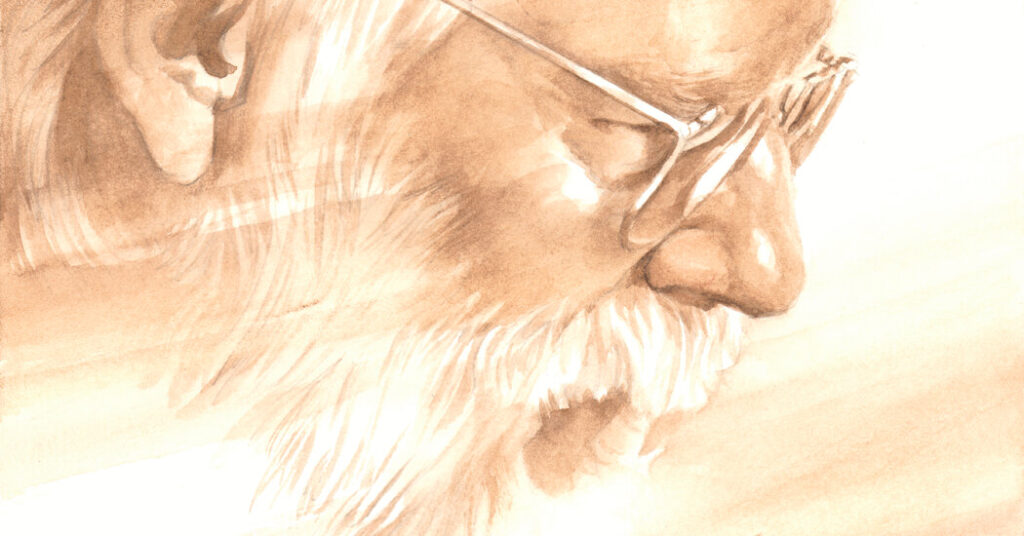
A half century ago, the artist John Byrne, alongside key collaborators Chris Claremont and Terry Austin, took Uncanny X-Men — a light-selling Marvel comic book title created by Stan Lee and Jack Kirby in the early 1960s — and turned it into a juggernaut.
The book, about a team of humans born with extraordinary powers, helped to light the fuse that led to the pop culture explosion that is Marvel today.
But in 1981, after controversially killing off Jean Grey (aka Phoenix), one of the original X-Men, Byrne struck out on his own, leaving his mark on scores of other titles, including the Fantastic Four, the Hulk, Captain America and Superman.
Now 76, Byrne has re-emerged with what he’s calling his swan song: “X-Men: Elsewhen,” an alternate reality hardcover which revisits the X-Men at the point where he left, without his former collaborators but with a big plot twist: Phoenix was not killed.
The first of three volumes, which Abrams ComicArts published last week, immediately sold out its initial run and put Byrne reluctantly back in the spotlight.
In a recent conversation, edited for length and clarity, he talked about revisiting familiar characters, good versus evil and how he’d like to be remembered.
You have a reputation for being an outspoken guy.
I shoot from the lip, yes.
What is it about the X-Men that has captured the imaginations of so many?
Roger Stern, who was a writer and editor at Marvel, used to say that the appeal of the X-Men was that they were very much like the fans themselves. They were outsiders who only hung out with their own kind. And so the fans saw themselves in the X-Men more than they did in, say, the Fantastic Four or the Justice League.
We’ve seen a pretty major cultural shift in terms of understanding and accepting people with differences. The X-Men were created in a more conservative time, when difference was still a bugaboo.
Stan said that the X-Men were his metaphor for racism, that Xavier [the leader] was Martin Luther King, and Magneto [his nemesis] was Malcolm X. And I go, no, actually, go look at the earliest issues. Xavier is F.D.R. and Magneto is Hitler. You know, he’s even using Nazi trappings. But people persuaded Stan that he was doing something else, and Stan said, “Sure, why not?”
For readers who may not be well-versed in the long history of the X-Men, can you briefly talk about the controversy around the Phoenix character?
There had never been a case where a superhero created by Stan and Jack had been turned into a villain. And we did that. We had her go out and blow up a whole planet and destroy an entire alien race. [Then editor in chief] Jim Shooter knew this was coming, but for some reason he said, “She must be punished” — that Phoenix had to be taken to a “prison asteroid,” and horribly tortured for all eternity. I said, “I’d rather kill her.” So that’s what we ended up doing.
But later, after you stopped working on X-Men books, Jean was brought back. So is anything ever really at stake in mainstream comics?
When Mark Gruenwald, my friend and editor, died unexpectedly, I mentioned it on my website and the first response was, “Oh, that’s terrible. I hope he recovers.” I thought: Oh my God, we’ve trained fans to expect that no death is actually permanent, even in the real world!
At any point did you consider reaching out to Chris Claremont and Terry Austin and getting the old band back together?
No. It was so much a personal project, just done strictly for my own amusement. And then I got frustrated by the fact that no one was seeing it. So I decided to put it on my website in daily installments. But I never thought it would turn into a real published book.
Which of the characters is the most fun to write?
Cyclops was always my favorite X-Man, from when I first started reading the book. Wolverine, of course. I often say Wolverine is my fault because [when I came on] Chris told me that he intended to write him out of the book. I was Canadian at that time and said, “No way are you getting rid of the only Canadian!”
When people talk about giants of the era you came up in, you and Frank Miller are often on similar footing. Thoughts about his treatment of Wolverine?
This will get me in trouble, but I didn’t care much for Frank’s Wolverine. In terms of creating a hugely popular character, he did the right thing. My gut reaction was: beautiful artwork, but I don’t know this guy.
There’s a page in Elsewhen where you depict Wolverine brutally attacking Magneto. The backgrounds are bright red, his eyes are bright red, he’s in a murderous rage. Is this a new kind of ferocity for this character?
Well, it was always what we had in mind. There’s a scene, that I would never, in a million years, do. It’s Wolverine sitting at the breakfast table and Kitty Pryde [the youngest of the X-Men] comes in and says, “Hey,” in just the wrong tone of voice. And he guts her without a second thought and then goes on eating his Cheerios. Because he is quite literally a homicidal maniac.
Artists often have to deal with their own perceived limitations throughout their career. Which ones consistently come up for you?
My approach has been: Get it right the next time. And in the case of this book, I don’t think there’s going to be a next time. I sort of just ran out of steam and stopped. For the third volume, I’m going to include a text page saying, “Here’s where these stories were going.”
You ran out of steam, but not out of ideas?
I didn’t run out of ideas, I just didn’t feel like doing it anymore.
And did that really feel like the end to you?
Pretty much.
It almost feels like we’re living in a comic book world today.
It feels like evil has won. I look at Washington and go, oh my God, this is the [guy] who I modeled my Lex Luthor in part on, back when he was just a big noise in business in New York.
What helps get you out of bed in the morning?
Less and less. I take joy from my friends, I take joy from my pets, I take joy from my house, which is basically a big museum of all my cool stuff.
It sounds like you lead a pretty solitary existence.
Not deliberately, but that is how it worked out. I have no siblings, my parents are dead … I’ve got maybe a dozen people who I consider my dearest friends and they matter to me and that’s my social circle.
What do you consider your legacy?
When I look at my work, all I can see is the influences. There’s Neal Adams, there’s Joe Kubert, there’s Bernie Wrightson, there’s Jack Kirby, there’s Gil Kane. When people tell me they’re huge John Byrne fans, I go, “What are they seeing?”
I would like to think that when people see my work, it’s believable. If it’s two guys sitting at a bar, or if it’s two planets crashing into each other, I like to think that people will believe what they’re looking at. Just verisimilitude. There’s the word.
The post An ‘X-Men’ Artist Returns to Rewrite the Story His Way appeared first on New York Times.