The history of contemporary dance at Lincoln Center is long but inconsistent, especially in contrast to the institution’s commitment to ballet. The new Lincoln Center Contemporary Dance Festival is a welcome corrective, a well-funded effort that seems to have legs.
The festival’s first three selections focused on lesser-known international artists, some making local debuts. These choices were, as my colleague Gia Kourlas put it, not “the same old, same old.” For the final two programs, though, the festival turned to the well-established, world-famous choreographers Rachid Ouramdane and Akram Khan. This was a return to the familiar, in both positive and negative senses.
Ouramdane’s offering, “Tordre,” was literally a repeat. It was performed in New York ten years ago. But while it might have been better to see a new piece by the French-Algerian choreographer, whose recent work seems to be hitting new heights, it was still good to see “Tordre” again.
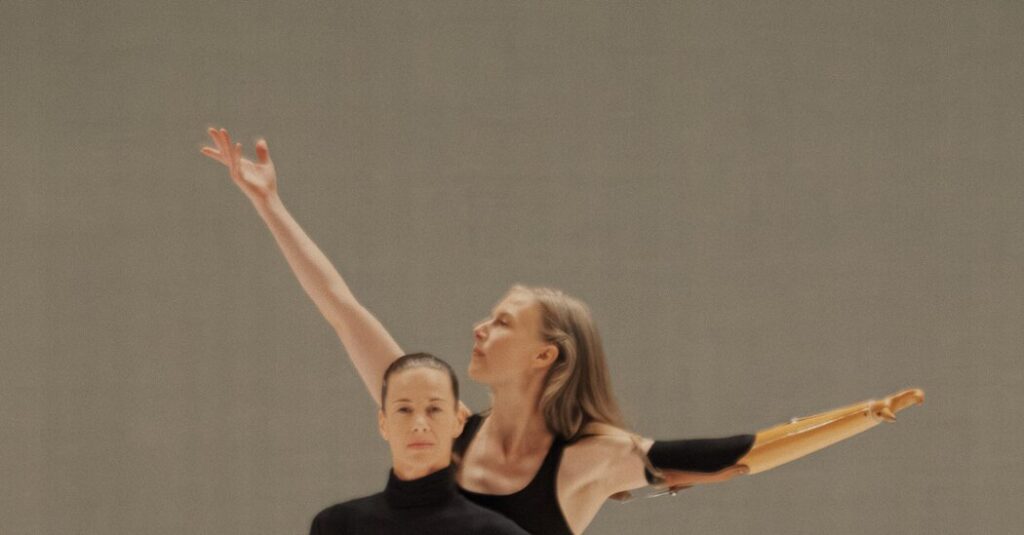
It’s a duet fashioned for two exceptional performers: Annie Hanauer and Lora Juodkaite. They enter with a fanfare, making the sweeping gestures of magicians’ assistants or game-show hostesses. Then the fanfare restarts — and restarts and restarts — with the two sampling from a catalog of those kinds of gestures.
This resetting repetition introduces a tongue in the duet’s cheek, but the work’s principal structure is a compare/contrast alternation of solos. Juodkaite goes first, slowly developing her version of the action labeled in the work’s title — “twist” in French. Then, to the same burbling bass music, Hanauer offers her take. It’s thrashier but also different because of how she initiates her turns: one arm curving around her body, followed by the other arm, which happens to be prosthetic.
“Torde” doesn’t really take off, though, until Juodkaite starts spinning. She holds her arms in a circle in front of her, as if clinging to something, and as she spins, she circles the stage. Unlike a dancer doing pirouettes, she doesn’t spot — or snap her head around to maintain the same focus. This increases our vicarious sense of centripetal force, especially when she accelerates to the wild speeds of a carnival ride.
Hanauer reappears and catches Juodkaite in a rescuing embrace. But Juodkaite just keeps on spinning, and Hanauer leaves her to it. Like a figure skater, Juodkaite cycles through shapes. Some, with one arm bent behind her head, suggest torture or decapitation — suggestions that Ouramdane underlined in the spinning in earlier works.
Here, though, the spinning is happy, self-soothing. Juodkaite tells us so herself as she whirls, in a sweet-voiced monologue about her childhood. The two women finish with a jazzy routine, set to “Don’t Rain on My Parade,” that could be from a Jacques Demy musical.
Before that, Hanauer does a music-tracking solo to a Nina Simone cover of “Feelings.” In the recording, Simone expresses some disbelief in the corny song’s lyrics, and I have my doubts about this solo and the work’s cute bookends. But with Khan’s “Thikra: Night of Remembering,” my reservations went a lot further. I didn’t believe it for a moment.
For more than 25 years, Khan — who is British-Bangladeshi and trained in the subcontinental tradition of kathak — has been known for crossing contemporary dance with Indian classical forms. At the start, this was thrilling, but as he became more successful, his productions seemed to suffer from a swelling that increased sentimentality and spectacle at the expense of substance. His most recent work to come to New York, “Gigenis,” was a return to classical discipline. But “Thikra,” which the choreographer has said will be his final one for his company, is the same old Khan.
It’s an ersatz ritual for a cast of women. The set, by the Saudi Arabian artist Manal AlDowayan (who also designed the Nabatean-inspired costumes and masks), presents a mound of boulders with steps to an altar and, below it, an entrance to a cave. The women are intensely interested in a rock with runes on its underside. The choreography, which incorporates bharatanatyam, is more focused on long, loose hair than Pina Bausch was. The women toss their hair and twirl it. They wipe the floor with it, strangle themselves with it, and use it to drag one another around.
This all makes a little more sense if you know that “Thikra” (“memory” in Arabic) was created for an arts festival in the Saudi Arabian oasis AlUla. But the program note about a Matriarch, a Vessel and a Shaman doesn’t help much with the work’s poor narrative clarity. The ingénue in white (the spirited Ching-Ying Chien), who has all the markers of a sacrificial victim, is actually the ancestor spirit.
As always with Khan, there are some striking sizzle-reel moments, here mostly involving hair. And there are standout performances, particularly Joy Alpuerto Ritter as a scuttling shaman with telekinetic powers. As a finish to the festival, though, “Thikra” reminded me too much of the shallow and showy international programming that often plagued the old Lincoln Center festival. Here’s hoping the next Contemporary Dance Festival will follow its promising start rather than its dispiriting end.
Lincoln Center Contemporary Dance Festival
Through Sunday at Alice Tully Hall; lincolncenter.org.
The post A Return to the Familiar at Lincoln Center’s New Dance Festival appeared first on New York Times.