An attempt to save NASA’s Neil Gehrels Swift Observatory telescope before it burns up in the atmosphere successfully launched to orbit on Friday.
NASA is in a race against time before the friction of air pulls Swift, a 1.6-ton spacecraft, down to its destruction within a few months.
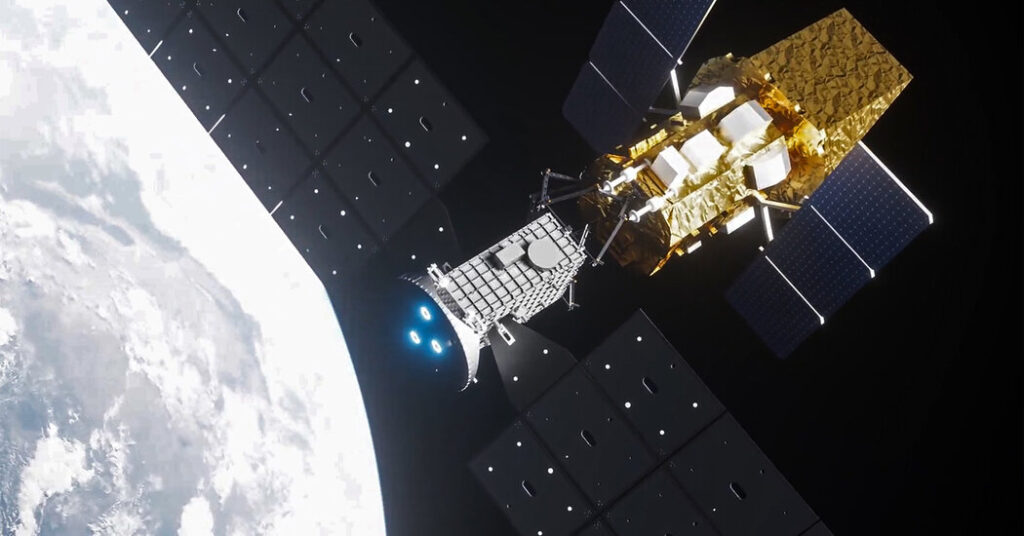
A refrigerator-size rescue spacecraft called Link will attempt to grab Swift and push it to a higher orbit where that it can continue its observations of gamma-ray bursts. These flashes of high-energy light are emitted by some of the most violent explosions in the universe, such as from the collisions of stars.
Link, built by Katalyst Space Technologies of Flagstaff, Ariz., finally headed to space after three unsuccessful launch attempts. Two were called off because of bad weather, and a third was stymied by a technical problem.
The spacecraft was housed in the nose cone of a winged rocket known as the Pegasus XL from Northrop Grumman.
A converted Lockheed L-1011 jetliner took off from Kwajalein Atoll, one of the Marshall Islands in the middle of the Pacific Ocean, with Pegasus mounted beneath its fuselage.
At an altitude of 40,000 feet, the rocket was dropped from the airplane at 4:36 a.m. Eastern time. (At Kwajalein, it was 8:36 p.m.) The engines of Pegasus then ignited and pushed Link upward.
The first steps will be for mission controllers at Katalyst to get in contact with Link and confirm that its solar panels have deployed.
They will then spend a week or two checking that Link’s systems are working properly. After that, the spacecraft will take about a month and a half to approach Swift and grab it.
The spacecraft will gradually propel Swift upward for two months before letting it go 100 miles higher. That will be enough of a boost for it to remain in orbit for another decade.
Swift, launched in 2004, has far outlived its original planned lifetime of just two years. Over time, the friction of wisps of air against the telescope, which does not have any thrusters, has slowly pulled its orbit downward. The pace of falling sped up at the end of 2024, when the peak of the sun’s 11-year sunspot cycle was stronger than predicted. When the sun is more active, it shoots out more intense solar flares that heat the Earth’s atmosphere and increase the drag on satellites like Swift.
NASA realized that Swift was probably going to burn up in Earth’s atmosphere this year unless the space telescope could be nudged back into a higher orbit. The space agency awarded Katalyst a $30 million contract to do just that.
NASA officials described the Swift rescue as a high-risk, high-reward undertaking worth trying because Swift was still in working condition, and a replacement, if one were to be built, would take years and cost far more.
The post A Rescue Mission to Save NASA’s Swift Telescope Launches to Orbit appeared first on New York Times.