A New York gallery has surrendered 20 valuable ancient artifacts linked to Douglas A.J. Latchford, an art dealer who was accused of trafficking in items looted from Cambodia, according to court documents filed last week.
The stone and bronze items, dating from the 2nd century B.C. to the 13th century A.D., include depictions of Khmer deities and mythical figures carved from sandstone and bronze ceremonial objects. They were acquired from Mr. Latchford by the gallery between 1995 and 2005, according to a forfeiture complaint filed in the Southern District of New York on June 25.
Investigators said the gallery had decided to relinquish them after being approached by the Department of Homeland Security with evidence that the objects had been illegally looted from Cambodia. Mr. Latchford, the filing said, had provided the gallery with false provenance documents.
Homeland Security Investigations took custody of the objects in 2022 and 2023, but the paperwork filed in court on June 25 completed the seizure before the return of the items to Cambodia. The court papers credited the gallery with voluntarily surrendering the artifacts it had purchased from the dealer after learning more about Mr. Latchford’s activities and the history of the items.
Mr. Latchford, long viewed as a scholar of Khmer sculpture who supplied many museums and collectors with ancient artifacts from Cambodia, was indicted by federal prosecutors in New York in 2019, a year before he died. He was accused, in court filings, of trafficking in looted Cambodian relics and of falsifying documents, and was said to have “built a career out of the smuggling and illicit sale of priceless Cambodian antiquities, often straight from archaeological sites.” The indictment was dismissed a year later after Mr. Latchford’s death at 88.
The gallery is not named in the court document. But the Cambodian government identified it as Antiquarium Fine Ancient Arts Gallery, a gallery on Madison Avenue in Manhattan. The gallery did not return requests for comment.
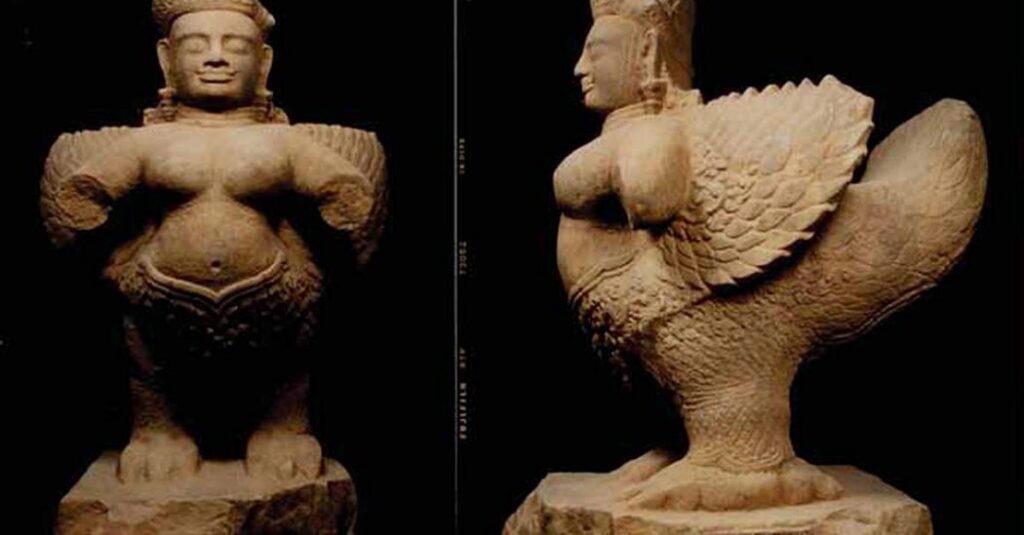
One of the statues is a 10th century depiction of a Kinnari, a mythological figure who has attributes of both a bird and a woman.
In the case of this artifact, Mr. Latchford sent the gallery a false invoice that identified the country of origin as Thailand. On U.S. Customs paperwork, it was described as a stone figure of a female bird. In fact, the court papers said, it is “a well-known artifact from the Prasat Krachap Temple in the ancient archaeological complex of Koh Ker in Cambodia.”
Bradley J. Gordon, the lawyer handling recoveries for the Cambodian government, said the piece was considered a “national treasure.” He said archaeologists had found the broken base of the sculpture still in place at the remote temple.
Mr. Gordon, who has worked with American law enforcement agencies to recover hundreds of looted Cambodian and Khmer artifacts over the past decade, said the trail of documents that led to the Manhattan gallery had begun in Mr. Latchford’s computer, which was seized by Cambodian investigators years ago.
Among the documents was an appraisal of items that Mr. Latchford had provided to the gallery. With evidence of that sort, Mr. Gordon said, Cambodian officials had approached federal prosecutors in Manhattan, seeking help in securing the return of artifacts thought to have been looted, he said, and were grateful for the officials’ diligence in pursuing the matter.
In a 2007 appraisal, Mr. Latchford had valued the Kinnari sculpture at more than $400,000.
The post New York Gallery Surrenders 20 Artifacts Thought Looted From Cambodia appeared first on New York Times.