One evening in May, Michael Scurr was in the National Archives in London studying 18th-century letters from a British naval captain when he found a piece of paper tucked in a sheaf of papers.
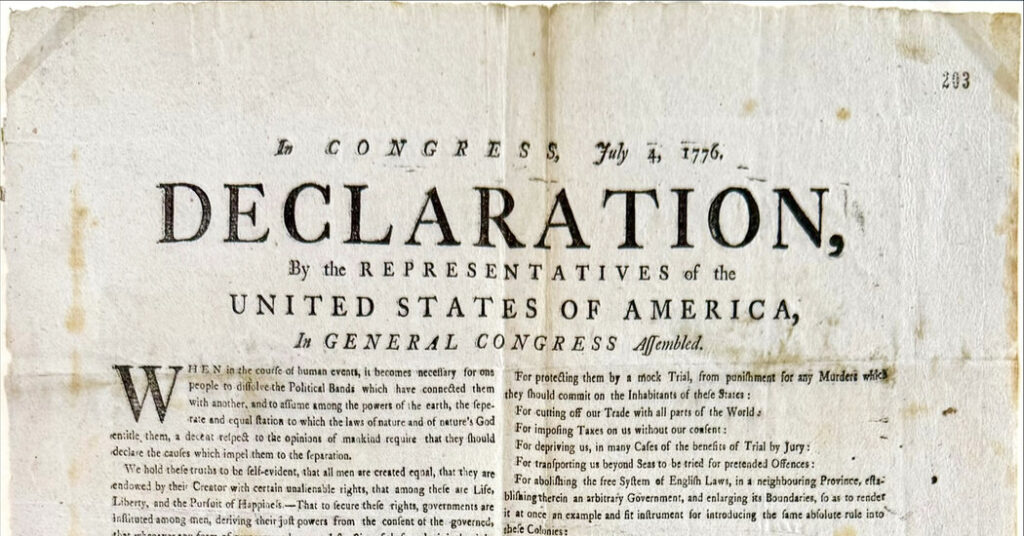
“I unfolded it and there it said: Declaration of Independence,” said Mr. Schurr, a retiree who volunteers to catalog records at the archives.
It turned out that Mr. Schurr had uncovered a previously unknown copy of the famed document, printed in mid-July 1776 in Exeter, N.H.
Only about 10 of the copies — known as the Exeter broadsides, for the large sheets on which they were printed — had been thought to have survived over the years. The first copies of the declaration were made by John Dunlap, a printer in Philadelphia, to alert the people of what were then the American colonies that their representatives had decided to sever the colonies from British rule. Other copies, such as those printed in Exeter, followed as word spread of the declaration.
But few of those copies have survived, including just 26 of the original 200 Dunlap broadsides. Even fewer of those from Exeter have been located; one copy sold at auction in January for over $5.6 million.
The newly found print, unveiled on Thursday by historians at the National Archives, just in time for the 250th anniversary of American independence, was in good condition, although staff members at the archives said they had repaired a tear. It will join other copies of the document that the British archives has in its collection. One of its copies, a Dunlap broadside, is currently on display as part of an exhibition tied to the anniversary of American independence.
Records from the ship and its captain paint a picture of how the document traveled across the Atlantic from New Hampshire to Britain, said Dr. Graham Moore, a historian and curator at the archives.
Its journey began in Portsmouth, N.H., in 1776 when a member of the crew of the Dalton, an American privateer ship tasked with capturing British vessels, picked up the print and brought it aboard.
The ship’s captain, according to historians at the archives, declared that the crew of 120 was a mix of English, Irish, Scottish, French and Danes, and subjects of the United States. Dr. Amanda Bevan, a researcher at the archives, said it was possible that the copy had been read aloud on the ship to offer motivation for the crew.
In December 1776, the Dalton was captured near Cape Finisterre in Spain by the H.M.S. Raisonnable, a British navy ship, making it the first American privateer ship to be seized in European waters. The Dalton crew were taken to Plymouth as prisoners, and items from the ship were confiscated by the British captain of the Raisonnable, Thomas Fitzherbert.
Instead of sending the copy to a wartime court overseeing seizures of enemy ships, as was protocol, Fitzherbert sent the declaration directly to the Admiralty, which oversaw Britain’s Royal Navy, describing it as “another document” enclosed with a letter.
Researchers said it was possible that Fitzherbert had recognized the significance of the document and considered it sensitive. In any case, the copy remained hidden from public knowledge. It made its way eventually to the National Archives, where it lay among thick volumes of 18th century letters, until Mr. Scurr unfolded it in May.
Even for those used to handling historic papers, discovering a copy of the declaration is a career highlight.
“It’s the most iconic document I’ve ever found, and it’s such a privilege to have found it,” said Bruno Pappalardo, who oversees a team of 20 volunteers at the archives. He said they had cataloged more than 110,000 letters of naval correspondence, including those from the French Revolution.
A former insurance broker who is now retired, Mr. Scurr said in an interview that he had come across several other interesting documents in his 11 years volunteering at the archives, including letters from a British captain describing their travels setting up colonies in Australia. “I studied history at school, and I think it’s important to learn from history — as well as about it,” he said.
But a copy of the Declaration of Independence was a high point, he said. “It was a thrilling find.”
Claire Moses contributed reporting from London.
The post Rare Copy of the Declaration of Independence Is Discovered in London appeared first on New York Times.