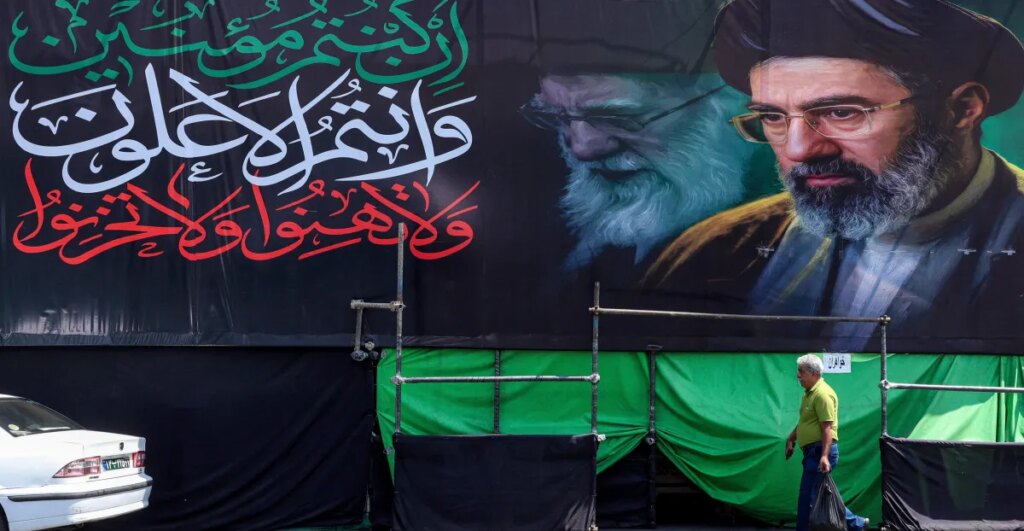
For 36 years, the question of who ultimately ruled Iran had one answer: Supreme Leader Ayatollah Ali Khamenei. While Iran has an elected president and legislature, that power is subordinate to the religious supreme leader, who has the last say over all foreign and domestic policies and is the commander in chief of Iran’s conventional military and the paramilitary Revolutionary Guard Corps. Whenever the US confronted Iran, American policymakers knew it was Khamenei who would make the final decision.
Key takeaways
- Three months after succeeding his father as supreme leader of Iran, Mojtaba Khamenei has still not been seen in public. All eyes will be on his upcoming funeral to see if he appears.
- With the supreme leader taking a less active role, other power players in the Iranian regime have become more independent and outspoken, jockeying for position in the new system.
- It’s still unclear exactly what the new system will look like. One possibility is a less overly religious but still authoritarian and nationalistic regime.
They’re no longer so sure, however. Joint US-Israeli airstrikes on the first day of the war four months ended Khamenei’s rule, and on July 4, the former supreme leader will be given a public funeral in Tehran. And while the Ayatollah’s second son Mojtaba Khamenei formally succeeded his father as supreme leader on March 4, he has not been seen in public since, reportedly still recovering from severe and disfiguring injuries to his legs and face suffered in the same airstrike that killed his father on February 28. No videos, audio recordings, or current photographs have been issued since then — only written statements read by the anchors on state television or posted on his Telegram channel. Iranian TV networks have even resorted to airing AI-generated videos of him giving speeches.
Just how disabled Mojtaba Khamenei remains is unknown. US officials believe that Khamenei is actually alive and participating in decision-making but if he does not make some sort of appearance for his father’s funeral, it’s going to start to raise questions: Can anyone truly fill the Ayatollah shoes? Could the troubled transition from father to son lead to an Iran that is simultaneously less overtly religious but more nationalistic and authoritarian than before? And most importantly: Who actually rules Iran today?
A system of rivals
The unique setup of the Iranian regime — civilian leaders, but a mullah who holds ultimate power — has been a complicating factor in previous rounds of diplomatic negotiations with the United States. Even when “moderates” who favored better relations with the West were in power, any decision had to be signed off by the supreme leader, whose real views were not always immediately apparent.
Nothing has changed in the transition from father to son about the formal powers Iran’s supreme leader holds. But while Khamenei has been taking some part in the current US-Iran ceasefire talks including authorizing negotiators to carry out direct talks with the Americans last month in a published statement and periodically weighing in on particular negotiating points, he does not yet appear to be taking as active a role as his father did in similar situations. “There is evidence that the power that the supreme leader exercises has diminished significantly,” said Hussein Banai, expert on Iranian politics and professor at Indiana University Bloomington, said.
Specifically, he noted that the supreme leader normally plays a “central headquarters” role, getting all of the regime’s factions on the same page voicing a unified message. Iran’s politics has never been wholly unified: There are multiple centers of power, including the religious establishment, the elected government, and the military, as well as competing factions within those centers. But when the supreme leader weighed in, everyone aligned their message with his.
Whatever Mojtaba Khamenei’s current condition, that seems to be conspicuously absent now. “The president says what he wants, the speaker says what he wants,” Banai said. “There isn’t any coordination.”
Combined with the sheer number of senior figures who were killed by airstrikes, there’s something of a power vacuum in Tehran right now.
“Everyone is fighting for their relevance in this next iteration of the Islamic Republic,” said Sanam Vakil, director of the Middle East program at Chatham House.
On the civilian side of the regime, there’s President Masoud Pezeshkian, a relative moderate who took power in 2024 after his predecessor was killed in a plane crash. While formally the second most powerful leader in Iran, Pezeshkian saw his power and influence curtailed during the war. As an advocate for diplomacy, his position could improve if the talks actually deliver economic relief for Iranians.
More prominent in public in recent weeks has been Mohammed Ghalibaf, the speaker of the Iranian parliament, who led the delegations conducting negotiationswith the United States and appears frequently in the media to explain the government’s positions. As a publicity-hungy conservative populist known as a perennial presidential candidate and implicated in some shady real estate deals, Ghalibaf may have found his calling as the Iranian government’s point of contact with the Trump administration. More than any other figure in the regime, he’s seen his public and international profile rise as a result of the war.
But the degree to which the civilians can actually speak for the Iranian regime as a whole in these talks is perhaps Iran’s single biggest question after Mojtaba Khamenei’s real status. On the military side, the most significant ascending figure may be Ahmad Vahidi, commander in chief of the revolutionary guard, who has frequently overruled the moderates seeking a quick deal to end the war. According to reporting by the Wall Street Journal, it was Vahidi who pushed for Iran to launch new missile strikes in June, despite concerns it would imperil the ongoing ceasefire negotiations with the US. Vahidi is under US sanctions for the regime’s crackdowns on protests and wanted by interpol for his alleged role in the 1994 bombing of a Jewish community center in Argentina. But he’s not always averse to cutting deals with Americans: He reportedly took part in the talks with the Reagan administration in the 1980s that became known in the US as Iran-Contra.
With various voices and factions jockeying for influence, the question is just who is actually in charge of the Iranian system. “The system is in control of the system,” Vakil said. “I know we all want to think that there’s one individual that has power or authority. There’s no one commander in chief. It is a system that is commanding collectively for the time being.” All this could add up to a far more unpredictable Iran going forward.
President Donald Trump has repeatedly claimed that Iran’s new leaders are “much more reasonable” than their predecessors and top US officials claim to be developing productive relationships with their Iranian counterparts. But the Iranian leadership has also repeatedly shown in recent weeks that it is willing to risk blowing up the talks by using force when it feels its red lines are being crossed, whether that’s Israel’s incursions into Lebanon or threats to Tehran’s control of the Strait of Hormuz.
What will the new Iranian regime look like?
At some point, the world will get more clarity on Mojtaba Khamenei’s real role, and a new system will click into place. When the power struggles shake out, that regime will probably be not any more democratic than Iran under the Ayatollah and certainly no more inclined to trust the United States. But it is possible that an Iran will emerge that is less ideological, religious, and revolutionary — and yet potentially more aggressive — than what we’ve seen since 1979.
In a recent article in Foreign Affairs, the Iranian-American scholars Narges Bajoghli and Vali Nasr argued that Iran’s more “technocratic” new leaders, many of whom came of age during the brutal Iran-Iraq war of the 1980s rather than the anti-Shah resistance of the 1970s, may be more willing to engage in direct talks with the US than the more ideological cohort led by Ali Khamenei, but may be even more to risk force.
Bigger changes could come on the domestic side. Iran’s famously strict religious laws were already loosening a bit before the war. Though wearing a hijab is still legally required for Iranian women, the law is less enforced and many more women have been going without the headscarf since “woman, life, freedom” protests in 2022. Some experts expect Iran’s government, particularly if the supreme leader is ultimately playing a muted role, to promote a more secular form of authoritarian nationalism. That may already be underway — the sight of partially or even unveiled women at pro-regime rallies was one of the more surprising developments of this war.
Vakil said that the government is likely to continue to point to religion as a justification for its policies, but in a moment of crisis and instability the regime will have to choose its battles, which may mean “tolerating women walking around wearing whatever they want.” What it will not mean, given the hardline positions men like Ghalibaf and Vahidi have taken during previous mass protests, is tolerating dissent or opposition to the political system itself. The hopes, expressed by US and Israeli leaders at the outset of this war, that it would spark a public uprising or fracturing of the regime, have obviously not come to pass.
The revolution is now nearly 50 years old, and change was coming to Iran eventually, whether the war happened or not. It was already clear in the last years of Ali Khamenei’s life that the system he led was under stress from economic stagnation, international isolation, and public discontent from a population, the majority of whom have no memory of the 1979 revolution. The transition to his successor was expected to be a test of whether the regime could reform itself to survive another generation. Thanks to US and Israeli airstrikes, that transition is happening on an accelerated timeline.
The regime has shown it can survive ‚ and arguably win — a war with much more powerful adversaries. But a population desperate for a return to normalcy may not get it for some time, given the uncertain state of the ceasefire. Domestic divisions and rivalries that were suppressed during wartime may reemerge now that the fighting has mostly stopped.
Right now, many Iranians are wondering whether Mojtaba Khamenei is actually in any shape to perform the role his father played for 36 years. But the bigger question may be whether, in Iran’s new political reality, that role will even exist much longer.
The post Who is actually ruling Iran right now? appeared first on Vox.