“Coriolanus” has never been one of Shakespeare’s more popular tragedies. And for understandable reasons, it’s never been a favorite of outdoor festivals either. The title character disdains the common folk, and the play’s complicated political discussion and harsh, jagged poetry aren’t what most picnicking playgoers are after.
It’s hard to love “Coriolanus,” but it’s equally hard not to be impressed by its ambition, originality and dramatic rigor. The Independent Shakespeare Co.’s Griffith Park Free Shakespeare Festival production isn’t going to win awards for subtlety, but the storytelling is crisp and vivid. And even those unfamiliar with the tale — the vast majority of attendees, in all likelihood — should find it engrossing.
Coriolanus is a military hero of the early Roman Republic. The city-state’s all-powerful defender, he is unmatched on the battlefield. But in peacetime, he’s a fish out of water. He lives by a warrior code that defines nobility by bravery and sacrifice in action. He’d rather silently wear his wounds earned in the line of duty than exploit them for political ends.
Up in arms about the way the government has been controlling the food supply, the common folk are eager to test their newfound democratic power. Tribunals have been appointed, and Coriolanus’ scornful elitism strikes them as too heavy a price for his military protection.
The Republic is thus at loggerheads with itself. And Coriolanus, raised to destroy Rome’s enemies by a mother who would rather her son be a dead hero than a bon vivant, is caught in the middle of the only war he has no interest in fighting and isn’t favored to win.
Indie Shakes managing director David Melville distills his production around scenes of intense conflict. The characters are all in a continual state of collision, their shifting conflicts inflamed by Coriolanus’ arrogantly uncompromising nature.
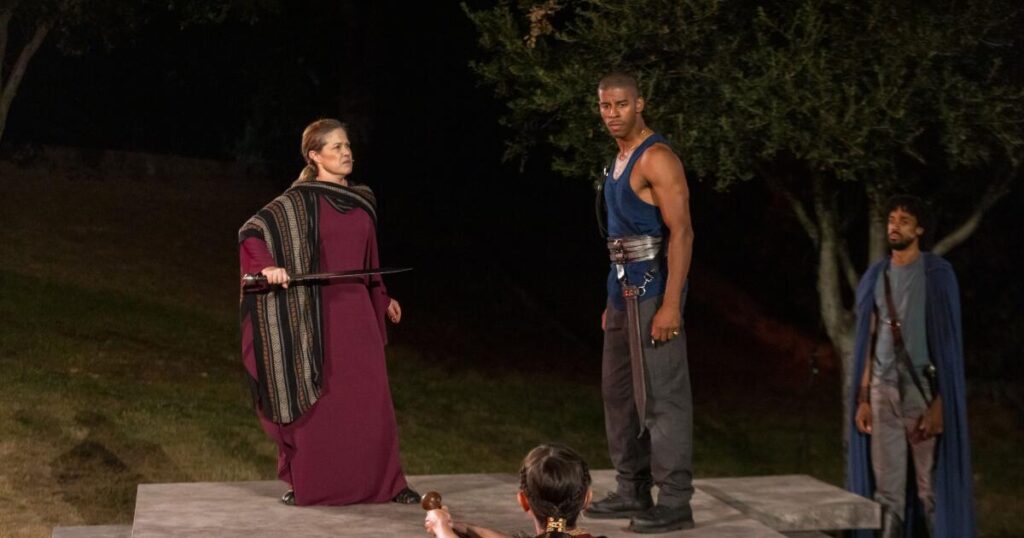
At the center of it all is Brent Charles’ sinewy Caius Martius Coriolanus, who runs through the play like a human scythe. Wearing a toga over an often bloodied tank top, Charles’ Coriolanus infuses the classical with a jolt of the modern, particularly in his confrontations with Patrick Batiste’s Tullus Aufidius, the Volscian general who is both Coriolanus’ most formidable enemy and mirror image. Together, amid recorded bursts of electric guitar, they kinetically update these rival combatants.
As Coriolanus’ iron-fisted mother, Volumnia, artistic director and Indie Shakes co-founder Melissa Chalsma doesn’t so much speak as roar. Her Volumnia bellows at her meek daughter-in-law, Virgilia (Justine Faith) as though reprimanding an incompetent private. Chalsma’s unstinting vociferousness, which sometimes seems over the top, leaves little doubt as to who shaped Coriolanus’ martial character.
As the tribunes, Bernardo De Paula’s Brutus and Daniel DeYoung’s Sicinius scheme and rabble-rouse with manipulative glee. The plebeians have plenty to be furious about, but their representatives, skilled at turning a crowd into a mob, seem hellbent on shoring up their own influence.
The audience at the reviewed performance kept wanting to applaud one side or another. But Shakespeare, who was as wary of rebellion as he was of tyranny, saw the flaws in every faction of society.
It becomes clear why Lorenzo González’s agreeable Menenius, the Roman senator who has been like a father to Coriolanus, hasn’t been able to mold his charge’s mind as effectively as Volumnia. Always seeking the safety of middle ground, he’s too willing to bend to necessity to satisfy Coriolanus’ narrow militaristic idealism.
The body politic wages war against itself in Shakespeare’s tragedy, and the all-out battle makes for a gripping spectacle in Griffith Park. Even a swooping hawk couldn’t resist perching on a tree overlooking the makeshift stage. This avian bystander may have recognized a fellow bird of prey in Coriolanus, whose role in the Roman ecosystem is necessary yet not fit for all purposes in a young democracy beset with growing pains.
The post ‘Coriolanus’ in Griffith Park: Indie Shakes conscripts Shakespeare’s haughty warrior appeared first on Los Angeles Times.